
Why Transfers Fail After 10 p.m
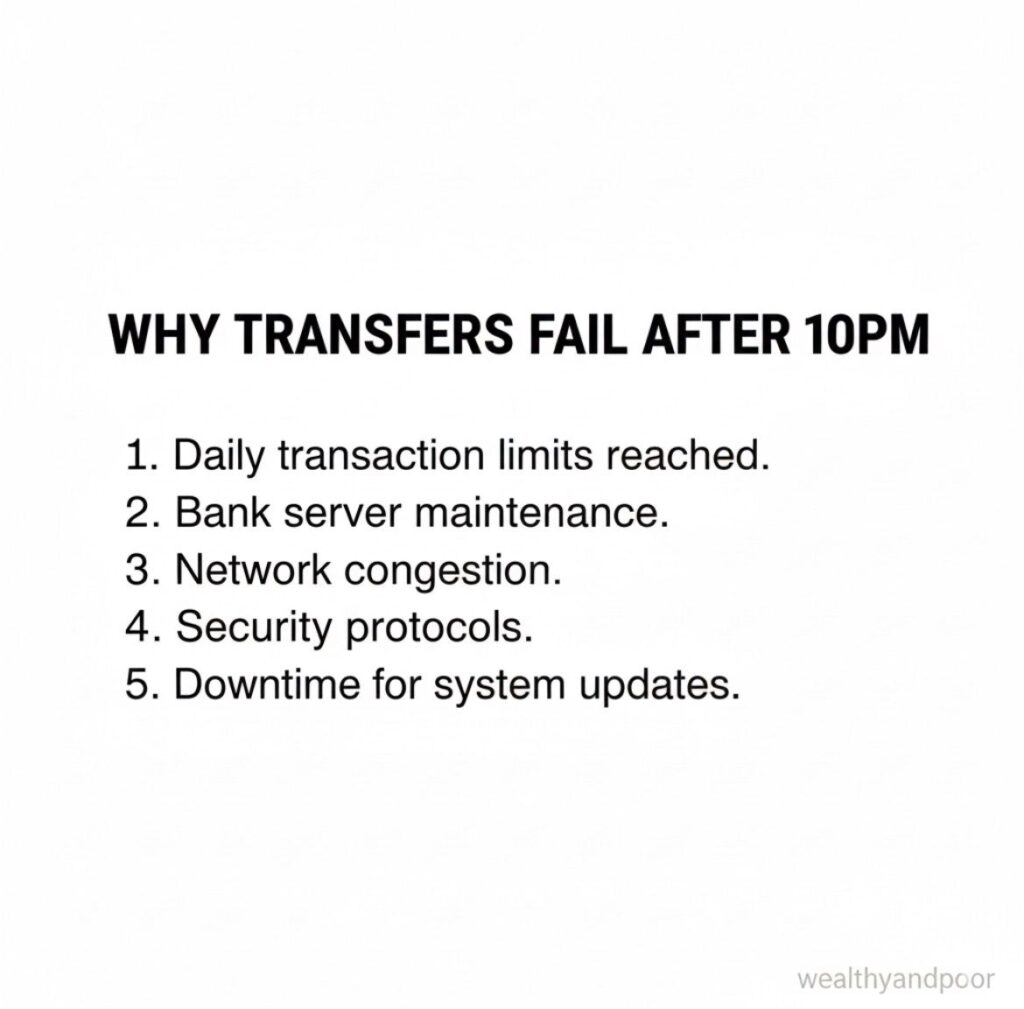

There are few phrases more frustrating for everyday Nigerians than “Transfer failed” especially when it happens late at night. You might be paying school fees, helping family members, or settling bills when that dreaded alert pops up, usually after 10 p.m., and you’re left wondering:
“Why now? What stopped it?”
To answer that, we have to look beyond your phone screen and into how the Nigerian banking system really works at night.
Banking Systems Still Work in Cycles:
Not Constantly
Even though mobile banking, USSD transfers, and bank apps seem to operate “24/7,” the core infrastructure that settles and finalizes transactions doesn’t run flat out every hour of the day. Many banks and central systems process and finalize transfers in settlement windows rather than continuously.
For example, the Nigeria Inter Bank Settlement System (NIBSS) the central platform that clears and settles interbank transfers uses a Deferred Net Settlement model, which pools transactions and reconciles them at designated cutoff times (commonly early in the morning like around 2:00 a.m. and 2:00 p.m.) rather than instantly at all hours.
This means a transaction you initiate at 10:05 p.m. has technically been recorded, but the final clearing, checking, reconciliation, and settlement processes might not yet happen until that next settlement window opens. If something goes slightly out of synch a slight delay, a network timeout, or a missing acknowledgement from a bank server the system will flag the transfer and mark it as failed or pending.
High System Load Late at Night
It’s Not Just You
Late evening and overnight hours especially between about 9:00 p.m. and 1:00 a.m. are peak times for people sending money. That’s when most people have free time after work, businesses settle accounts, traders make end of day payments, and many automated payment services try to push transactions before the next business day.
This huge volume of activity puts a strain on:
- Core banking systems
- Central switches like NIBSS
- Network communication layers between banks
When systems are congested, messages can get delayed or dropped entirely, causing transfers to time out or return an error. This is why you might see error alerts or delayed posting at night more often than during midday lull periods.
Daily Batch Processing and System Maintenance
Another reason night time transfers fail is that background processes and maintenance routines often run outside business hours to reduce disruption. Many Nigerian banks schedule system updates, server backups, and routine maintenance late at night typically after 10 p.m. or around midnight because that’s when the fewest customers are online.
During these maintenance windows:
Certain systems go into a maintenance or restricted mode
- Transaction routing pathways may be temporarily unavailable
- Some interbank messaging interfaces are taken offline or throttled
When that happens, transactions may be rejected or marked as failed even if your debit was successful. The system simply couldn’t complete the full cycle.
In many cases, this maintenance is planned but not always communicated to customers in real time. So you might experience it without prior notice.
Cut-Off Times and Settlement Boundaries
Most banks and clearing houses operate with something like a “business day” structure even if digital channels work 24/7. According to regulatory and settlement frameworks, the official daily cycle often runs from midnight to 11:59 p.m.
But internally, systems define cut-off points throughout that cycle when batched activities are reconciled. After certain cut-off times like late evening transfers may still be initiated and appear debited from your account in real time, yet the backend reconciliation that ensures the money actually moves between banks won’t happen until the next batch run or the next business day.
That’s why:
- Your bank app may show “Debit successful” late at night …
But the recipient doesn’t receive it until the settlement batch executes - Or the transfer gets flagged as failed first and then reversed later.
In one documented settlement structure, NIBSS groups transactions from the previous afternoon through to the early morning and settles them in an early morning window, meaning some late night transfers just miss the current cycle and have to wait.
Timeout Thresholds and Communication Limits
Every bank system sets an internal timeout threshold the maximum time it will wait for confirmation from another system before giving up and returning an error.
These timeouts are technical safety mechanisms to prevent hung processes and protect system stability.
After 10 p.m., when systems are rebooting parts of their infrastructure, network communication delays are more likely, and those timeouts trigger more frequently.
Basically, if one bank doesn’t respond within the allocated window while both are engaged in late night processing, the transaction gets marked failed.
Reduced Support at Night
Unlike systems that operate instantly, real world banking still depends on human oversight, especially for exceptions (like failed or disputed transactions). Most technical support teams in banks and clearing systems aren’t fully staffed overnight.
There are fewer engineers monitoring systems, fewer support agents available to correct issues, and fewer backend teams to intervene when something goes awry.That means:
- Errors that could be corrected in minutes during the day take hours at night
- Reversals aren’t always processed instantly
- Pending items accumulate until the next business day
From the user’s perspective, this feels like failure because the system doesn’t have an immediate human to push it over the finish line after automation hits a snag.
Putting It All Together: What Happens After 10 p.m.
When you initiate a transfer after 10 p.m. in Nigeria:
- Your bank records your debit and sends instructions across the payment network.
- The receiving bank or central switch may not be fully available for settlement processing.
- Batch cycles and system maintenance can intercept or delay reconciliation.
- Timeout thresholds may label the transaction, “failed,” even though the debit was logged.
- If the system repeatedly fails to complete the backend checks, the transfer gets reversed later often the next day or cycle.
So the transfer “fails” not because your money disappeared, but because the complex plumbing beneath digital banking couldn’t complete its job in real time at that hour.
Why This Isn’t a Sign of Permanent Loss
It’s important to reassure readers that:
- Failed late night transfers don’t usually mean lost money
Most such transactions are automatically reversed within hours or by the next business cycle
If a reversal doesn’t happen within 24-72 hours, contacting the bank with reference details usually resolves it
This lag happens because final settlement mechanisms are still tied to systems that operate in cycles, not continuous real time rails.
Conclusion
It’s Not Just Your Phone, It’s the Whole System
A transfer failing after 10 p.m. doesn’t usually mean your bank account fizzled or that the bank lost your money. It reflects the real architecture of Nigeria’s payment system: Finite settlement windows, Overnight maintenance,High late night usage,Timeout thresholds, Fewer support staff.
All of these factors converge around that typical late evening period, making failures more common then.
For everyday Nigerians, understanding this doesn’t just reduce frustration it helps you plan transfers more effectively, anticipate potential delays, and know when to follow up with your bank.












Comments