
POS Reversal Time by Bank (GTBank, UBA, Zenith Bank)

In Nigeria’s fast changing digital economy, POS transactions (Point-of-Sale payments) are part of daily life. From paying for groceries to withdrawing cash at a corner shop’s POS, millions of card-to-POS transactions occur every day.
But anyone who has tried one knows the anxiety that follows when the money leaves your account but the merchant doesn’t receive it or when your POS terminal shows “failed” and your balance still reflects a debit.
At the heart of all this is the POS reversal process the mechanism that refunds your money when a transaction doesn’t complete successfully.
But how long should a reversal take and does that timeline differ from bank to bank?
This article breaks it down in simple, relatable terms.
Why POS Reversals Happen at All
Before we talk timelines, it’s important to understand what a POS reversal really is.
When you make a card payment at a POS terminal, the bank attempts two things:
- Authorization Checks that you have enough funds and that the card is valid.
- Settlement Actually moves the money from your account to the merchant’s.
A reversal is triggered when the settlement fails after authorization typically because of:
- Network or terminal glitches
- Connectivity problems between the bank and POS acquirer
Settlement failures between banks and payment processors
In these cases, the bank debited you (money left your account), but the merchant never received the funds so the bank must credit your account back.
It isn’t just individual banks that decide how long a POS reversal should take, the Central Bank of Nigeria (CBN) sets clear standards for the industry.
The CBN’s Guidelines on the Operation of Electronic Payment Channels require that:
- Failed or disputed POS/Web transaction reversals should be completed within 48 hours (under the revised 2020 rules) a significant reduction from the earlier 5 day window.
- All banks must work together with payment switches and processors to make sure reversals happen swiftly.
This regulatory guidance exists to protect consumers ensuring you aren’t left out of pocket because of a technical glitch.
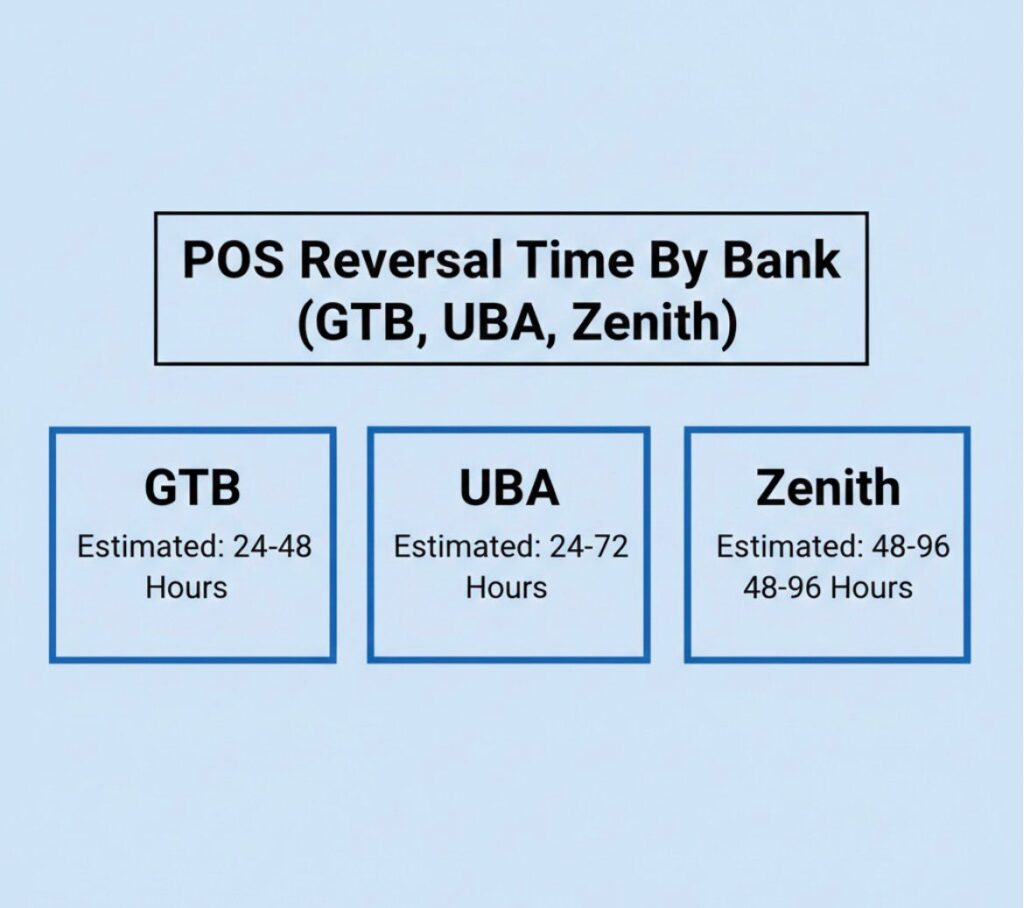
How Long Reversals Take in Practice GTBank, UBA, Zenith & General Reality
- GTBank (Guaranty Trust Bank)
On GTBank’s official support pages, you can find helpful timelines for dispense errors including POS reversals:
POS/Merchant website errors and failed POS transactions are generally resolved within 3 working days.
GTBank also notes that local ATM dispense errors are reversed within 24 hours showing that the bank prioritizes quick turnaround where it can.
That “3 working days” timeline means that while many POS reversals happen much sooner, the bank allows up to a few business days to investigate and resolve more complex or disputed errors.
This GTBank information matches the lived experience of many Nigerians who make card payments often seeing reversals within a day or two, but occasionally waiting the full period allowed for manual checks.
- UBA (United Bank for Africa): UBA’s public POS documentation specifically addresses reversal timelines for failed transactions:
Reversals are generally automated within 24 hours and if not, they are expected within 2 to 3 working days.
This aligns with both CBN guidelines and industry practice: most banks aim to finalize reversal within 72 hours, but automated systems often complete them much faster when the failure is straightforward.
In practice, many UBA customers report receiving refunds within 24-48 hours especially when the failed POS charge was clearly a network or terminal error.
- Zenith Bank:
Unlike GTBank or UBA, Zenith Bank doesn’t publish an official POS reversal timeline on its customer FAQ pages which is common in the industry. However, real customer reports and regulatory context paint a clear picture:
The CBN’s guidelines apply equally to all banks including Zenith meaning reversals should be concluded within the regulated 48-72 hours.
In reality, some customers have faced longer delays there are reports of reversal taking days, weeks, or even months in isolated cases when disputes are complex or documentation is needed to confirm the error.
These outlier scenarios while frustrating underscore why it’s critical to keep the transaction receipt and reference details: complicated disputes often happen when merchants claim they received the funds, prompting deeper investigation.
Why Reversals Sometimes Take Longer Than Expected
Even with regulations and bank policies aimed at fast turnaround, several factors can delay refunds:
- System & Settlement Delays
POS transactions go through multiple systems the POS terminal, payment processor, switch, and final settlement between banks. Delays at any point can slow reversal. - Network Issues & Peak Volume
High traffic periods (weekends, month-end, festive seasons) can overload systems, pushing reversals closer to the maximum 72 hour timeline. - Dispute Investigations
If a merchant insists they received the funds or if there’s inconsistency in settlement records, banks may initiate formal investigations extending the time needed to resolve the issue.
Manual Intervention Requirements
Some error cases aren’t automatically reversible they require bank teams to manually validate transaction logs, contact the acquiring bank, or reconcile the settlement batch.
This is why banks allow up to 3 working days to give room for these scenarios without breaching regulatory provisions.
Practical Tips for Customers Waiting on POS Reversals
Here’s how you can protect yourself and speed up the process:
- Always keep your POS slip or customer receipt
It contains transaction details that your bank will request if automatic reversal doesn’t happen. - Check your bank statement often
Sometimes notifications lag behind the reversal posting. - Wait the full 48-72 hours before escalating
In most cases, reversal happens within this window under CBN guidelines. - Contact your bank promptly if it takes longer
Use your online banking app, call center, or branch to lodge a complaint with your reference and receipt info.
Conclusion
While POS reversals can happen almost instantly in many cases, the widely accepted industry standard in Nigeria backed by Central Bank of Nigeria guidelines is that POS reversals should be concluded within 48 to 72 hours of a failed transaction.
GTBank typically resolves POS reversals within 3 working days, with many reversals happening sooner.
UBA automates reversals often within 24 hours, with a practical expectation of up to 2-3 working days.
Zenith Bank, while not publicly specifying a timeline, is subject to the same regulatory standards and anomalies in practice highlight the importance of documentation and follow-up.
Understanding these timelines and the reasons behind them prepares everyday consumers not just to wait, but to act smartly when a failed POS transaction occurs.












Comments