
Capital Spending on Education Drops 18% in One Yea
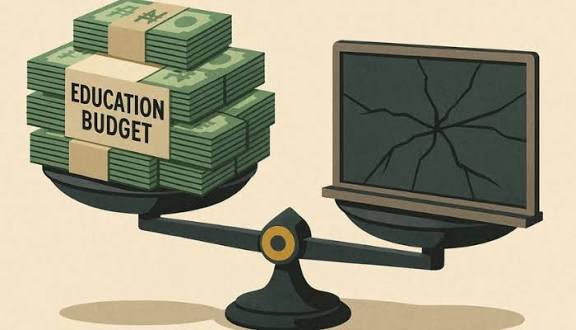

Nigeria’s education budget is under fresh scrutiny after the government’s latest figures show a significant shift in how funds are being deployed within the sector, even as the headline allocation edges higher. According to a report on Nigeria’s 2025 education spending, capital expenditure — crucial for building classrooms, laboratories and improving infrastructure — has slumped by about 18.1 per cent compared to the previous year, raising alarm among educators, analysts and development advocates
The striking statistic came as part of an analysis of budget data showing that while the overall education allocation increased from roughly N2.36 trillion in 2024 to N2.59 trillion in 2025 — a near-10 per cent uptick — this growth has been swallowed up by rising recurrent expenditure. Capital spending, which drives physical infrastructure and expansion of learning facilities, fell from N1.15 trillion to just under N939 billion year-on-year.
The consequences of this shift are already being felt in classrooms across the country. Teachers and school administrators report that many institutions, particularly federal unity schools, are struggling with a lack of essential resources. “Desks and chairs, library books, mathematics boards and laboratory equipment are in short supply,” one educator in Abi hia State told reporters, noting that some schools have resorted to hiring ad hoc teachers on meagre pay just to stay afloat.
Policy analysts are warning that the reduced investment in capital projects could have ripple effects far beyond physical buildings. Unlike recurrent expenditure — which covers salaries and operational costs — capital budgets fund the construction and rehabilitation of classrooms, ICT centres, workshops and research infrastructure. These are areas where Nigeria’s education sector has long lagged behind global peers, and experts fear the cut could widen existing gaps in learning quality.
Jessica Osuere, CEO of an educational services firm, described the trend as “alarming” because it threatens progress on tackling chronic issues such as overcrowded classrooms, inadequate laboratories and weak digital infrastructure. Without adequate capital funding, she argues, Nigeria risks entrenching inequality as private schools and urban institutions — with deeper pockets — widen the gap with under-resourced rural schools.
Human capital development advocates also highlight the broader economic implications. Investment in education is a key driver of productivity, innovation and competitiveness, yet Nigeria’s allocation to human capital encompassing both education and health — accounts for just 9.9 per cent of the total 2025 budget, a share many see as insufficient given the country’s demographic profile and development aspirations.
Nigeria’s education financing woes are not new. Previous reports have lamented the country’s failure to meet the UNESCO-recommended benchmark of at least 15 per cent of national budgets for education, a shortfall that has historically constrained sector performance and quality. Against this backdrop, stakeholders are urging policymakers to adopt more strategic funding approaches, including boosting infrastructure investment, incentivising private sector participation and ensuring that recurrent and capital spending are balanced to deliver meaningful improvements across the board..
As the country grapples with inflationary pressures and competing fiscal priorities, how the government navigates these budgetary trade-offs will be closely watched by educators, parents and economic planners alike. The challenge remains clear: without a deliberate ramp-up of capital investment in schools, colleges and universities, Nigeria risks undermining the very foundation of its future workforce and broader socio-economic development.











Comments