
How PAYE Tax is Calculated in Nigeria
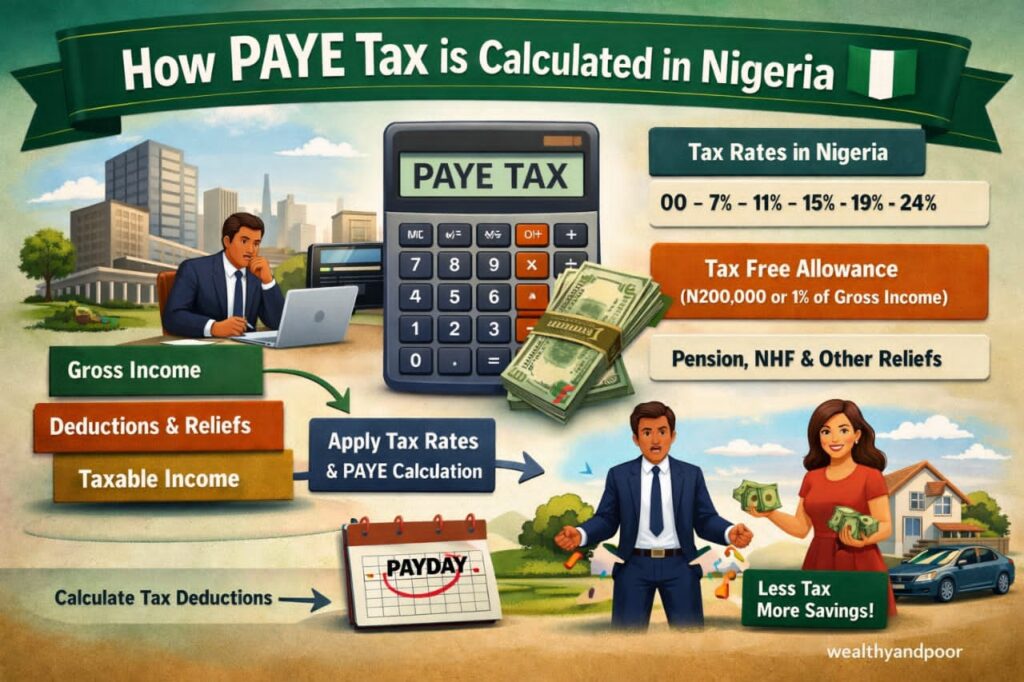

Pay As You Earn (PAYE) is the system used to deduct Personal Income Tax directly from an employee’s salary in Nigeria. Instead of paying tax in one lump sum at the end of the year, employees pay gradually through monthly deductions handled by their employer and remitted to the relevant State Internal Revenue Service under the supervision of the Federal Inland Revenue Service (FIRS).
Understanding how PAYE tax is calculated in Nigeria is important for every salary earner. It helps you know why your net salary differs from your gross salary and ensures your employer is deducting the correct amount.
What Is PAYE in Nigeria?
PAYE is a tax collection system under the Personal Income Tax Act (PITA). It applies to employees in both the public and private sectors. Employers are legally required to:
- Deduct tax from employees’ salaries every month
- Remit the deductions to the appropriate State Internal Revenue Service
- File annual tax returns on behalf of employees
PAYE applies to residents of a state, meaning you pay your tax to the state where you reside, not necessarily where you work.
Step-by-Step Process of Calculating PAYE in Nigeria
PAYE calculation follows a structured formula. It is not a random percentage. The process involves:
- Determining Gross Annual Income
- Deducting allowable reliefs and exemptions
- Applying Consolidated Relief Allowance (CRA)
- Applying graduated tax rates
- Dividing annual tax by 12 for monthly PAYE.
Step 1: Determine Gross Annual Income
Gross income includes
- Basic salary
- Housing allowance
- Transport allowance
- Utility allowance
- Meal allowance
- Leave allowance
- Bonuses and other taxable benefits
For example, if an employee earns:
- Basic Salary: ₦1,800,000 per year
- Housing: ₦600,000
- Transport: ₦300,000
- Other allowances: ₦300,000
- Total Gross Annual Income = ₦3,000,000
Step 2: Deduct Pension Contribution
Under the Pension Reform Act, employees contribute a minimum of 8% of their gross salary to pension (while employers contribute 10%).
If the gross annual income is ₦3,000,000:
8% pension contribution = ₦240,000
This amount is tax-deductible.
Step 3: Apply Consolidated Relief Allowance (CRA)
The Consolidated Relief Allowance is calculated as:
₦200,000 flat PLUS 20% of Gross Income
Using our example:
20% of ₦3,000,000 = ₦600,000
Add ₦200,000
CRA = ₦800,000
Step 4: Calculate Taxable Income
Taxable Income is calculated as:
Gross Income
– Pension Contribution
– Consolidated Relief Allowance
₦3,000,000– ₦240,000– ₦800,000= ₦1,960,000
This ₦1,960,000 is the amount that will now be taxed using Nigeria’s graduated tax rates
Step 5: Apply Nigeria’s Personal Income Tax Rates
Nigeria operates a progressive tax system. This means the more you earn, the higher the percentage applied to portions of your income.
Current annual tax bands are:
First ₦300,000 — 7%
Next ₦300,000 — 11%
Next ₦500,000 — 15%
Next ₦500,000 — 19%
Next ₦1,600,000 — 21%
Above ₦3,200,000 — 24%
Now let’s apply this to the taxable income of ₦1,960,000:
First ₦300,000 at 7% = ₦21,000
Next ₦300,000 at 11% = ₦33,000
Next ₦500,000 at 15% = ₦75,000
Next ₦500,000 at 19% = ₦95,000
Remaining ₦360,000 at 21% = ₦75,600
Total Annual Tax = ₦299,600
Step 6: Calculate Monthly PAYE
To determine monthly PAYE:
₦299,600 ÷ 12 = ₦24,967
So, approximately ₦24,967 will be deducted monthly as PAYE tax.
Other Tax-Exempt Deductions
Apart from pension, other allowable deductions may include:
- National Housing Fund (NHF) contribution
- National Health Insurance Scheme (NHIS)
- Life assurance premium
- Gratuities (under certain conditions)
These reduce taxable income and lower the PAYE burden
Why Understanding PAYE Matters
Many employees complain that “tax is too much” without understanding how it was calculated. When you understand:
- How CRA works
- How pension reduces tax
- How tax bands apply
You can verify your payslip and avoid under-deduction or over-deduction.
It also helps when negotiating salary offers, because you can estimate your take-home pay before accepting a job.
PAYE tax calculation in Nigeria follows a clear formula: determine gross income, subtract pension and relief allowances, then apply graduated tax rates. While the process may look complex at first, it becomes straightforward once broken into steps.
As a salary earner, knowing how PAYE works empowers you financially. It helps you plan better, detect payroll errors, and understand the difference between your gross salary and your net pay.
If you are unsure about your PAYE deductions, request a detailed breakdown from your employer or consult a tax professional to ensure compliance with Nigerian tax laws.












Comments