
How Self-Employed People Pay Tax in Nigeria
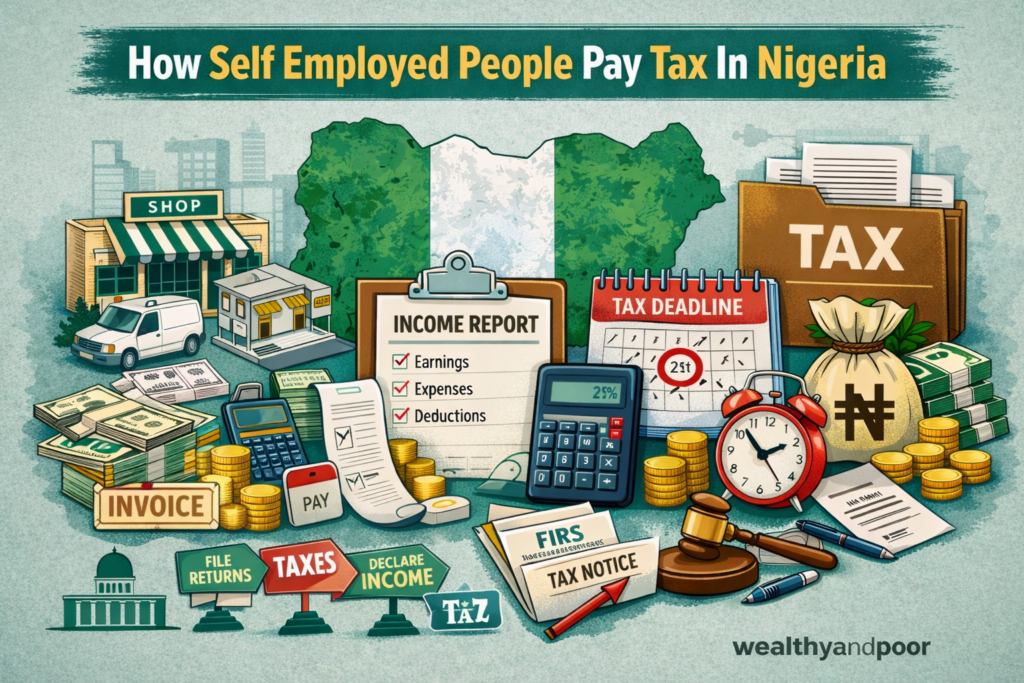

In recent years, Nigeria has intensified efforts to broaden its tax base and ensure that all individuals who earn income whether through formal employment, business, freelance work, or digital gigs meet their statutory tax obligations. For self-employed professionals and entrepreneurs, understanding how tax works is critical not just for compliance, but for long-term business planning and financial health.
This article explains step by step how self-employed individuals pay tax in Nigeria under the current regime, what taxes they are liable for, how to register,how to calculate Tax, how to assess and pay their tax, and what pitfalls to avoid.
Understanding the Nigerian Tax System
- Who Collects Taxes?
In Nigeria, personal income tax (PIT) is primarily collected by the State Internal Revenue Service (SIRS) where the taxpayer resides. Certain categories such as federal personnel and non-residents are taxed by the Federal Inland Revenue Service (FIRS), but for most self-employed residents, it’s the state tax authority that matters.
This means if you live in Lagos State, Lagos State Internal Revenue Service administers your PIT; if you live in Rivers State, then Rivers State IRS does, and so on.
What Is Personal Income Tax (PIT)?
Personal Income Tax is a tax on income arising from an individual’s trade, business, profession, vocation, or employment within Nigeria. It applies to all residents earning income above certain thresholds, including profits from business and self-employment.
LIRS – Lagos Internal Revenue Service
The legal foundation is contained in the Personal Income Tax Act (PITA), as amended.
Who Is Considered “Self-Employed”?
A self-employed person is someone who earns income through their own business, trade, profession, or vocational activities without being on a PAYE payroll of an employer. Common examples include:
- Freelancers (writers, designers, consultants)
- Small business owners and sole proprietors
- Traders and market stall owners
- Professionals (lawyers, accountants, architects) running their own practices
- Digital content creators, influencers, and remote workers earning directly from clients
These individuals are not on a regular salary with PAYE withheld by an employer, so their tax must be computed and paid differently.
Registration: Tax Identification Number (TIN)
Before you can pay tax in Nigeria, you must have a Tax Identification Number (TIN). This unique number is issued by the relevant tax authority (usually the SIRS of your state) and allows the tax agency to track your filings and payments.
To obtain a TIN, applicants generally need:
- National ID (e.g., Nigerian National ID or passport)
- Proof of address
- Biometric details (BVN where required)
- Any business or professional documentation
TIN registration is usually free, though some states may have minimal administrative charges for electronic filing.
How Self-Employed Persons Are Taxed: Direct Assessment
Self-employed people are taxed through a system known as Direct Assessment this is the process where the individual declares income and calculates tax themselves, rather than having an employer deduct tax monthly.
What You Must Do
- Prepare your income and expense records: Gather all records of earnings and allowable business expenses for the tax year.
- Use the tax form — often Form A or state equivalent: You complete an annual return that shows your total income and allowable deductions.
- Calculate your tax liability: Apply the appropriate tax rates and reliefs.
- Submit the return to the relevant SIRS: This is usually done online via e- tax portals in some states or physically at tax offices.
- Pay the tax due: Payment must be made before the filing deadline.
Personal Income Tax Rates and Thresholds
Under the current tax regime, there are graduated tax bands for personal incomes:
- Up to ₦800,000 — 0% (tax-free threshold)
- ₦800,001 – ₦3,000,000 — 15%
- ₦3,000,001 – ₦12,000,000 — 18%
- ₦12,000,001 – ₦25,000,000 — 21%
- ₦25,000,001 – ₦50,000,000 — 23%
- Above ₦50,000,000 — 25%
This means as your annual taxable income increases, the rate applied to the additional portion increases. Most self-employed taxpayers with modest incomes will fall in the 15–18% brackets.
Deductions and Reliefs for Self-Employed Taxpayers
Tax law allows certain deductions expenses that reduce your taxable income including:
- Retirement pension contributions
- Rent relief (capped and defined by the rules)
- Life insurance and deferred annuity premiums
- Approved business expenses such as office supplies and professional subscriptions
These deductions are important because they lower your chargeable income the amount on which tax is calculated.
Filing Deadlines and Payment Schedule
- For self-employed taxpayers:
Annual return filing is typically due by 31st March of the year following the income year — for example, income earned in 2025 must be filed by March 31, 2026.
Payment is due before or on the same date as the return unless the state allows installment arrangements.
Failure to file on time incurs penalties and interest charges sometimes as high as tens of thousands of naira based on tax due and delay period.
Withholding Taxes and Other Obligations
As a self-employed person, there may also be other tax considerations:
- If your clients deduct withholding tax at source on fees paid to you, this can often be used as a credit against your tax liability.
- Depending on your services and state rules, you might also be liable for business premises levies or development levies, although these are generally separate from PIT.
New Tax Law and Digital/Remote Income
Under Nigeria’s newly reformed tax regime effective from January 1, 2026 digital and remote work income earned by Nigerians is officially taxable wherever the individual resides and earns the income. This means that remote workers, influencers, and digital freelancers should declare that income if it’s received directly, even if the paying client is outside Nigeria.
This came as part of broader tax reforms aimed at modernizing the tax system and capturing income sources previously outside the tax net.
Common Mistakes That Cost Self-Employed Taxpayers
Many self-employed individuals fall into avoidable traps that lead to penalties:
- Not Registering for a TIN Early
Some believe tax applies only to formal employees this misconception can lead to years of unfiled returns and back penalties.
- Underestimating Income
Inaccurate income reporting such as failing to include side gigs, rental income, or digital earnings can trigger tax audits.
- Ignoring Record Keeping
Without proper receipts and records, allowable deductions can’t be validated, costing you higher tax.
Final Thoughts
Paying tax as a self employed person in Nigeria might seem complex, but with good record-keeping, timely registration, and an understanding of your obligations, it can be manageable and even beneficial especially when compliance opens doors to loans, contracts, and official business recognition.
Taxes aren’t just compliance; they are part of building a transparent, sustainable economy.









Comments