
How to Pay Tax as a Side Hustler in Nigeria
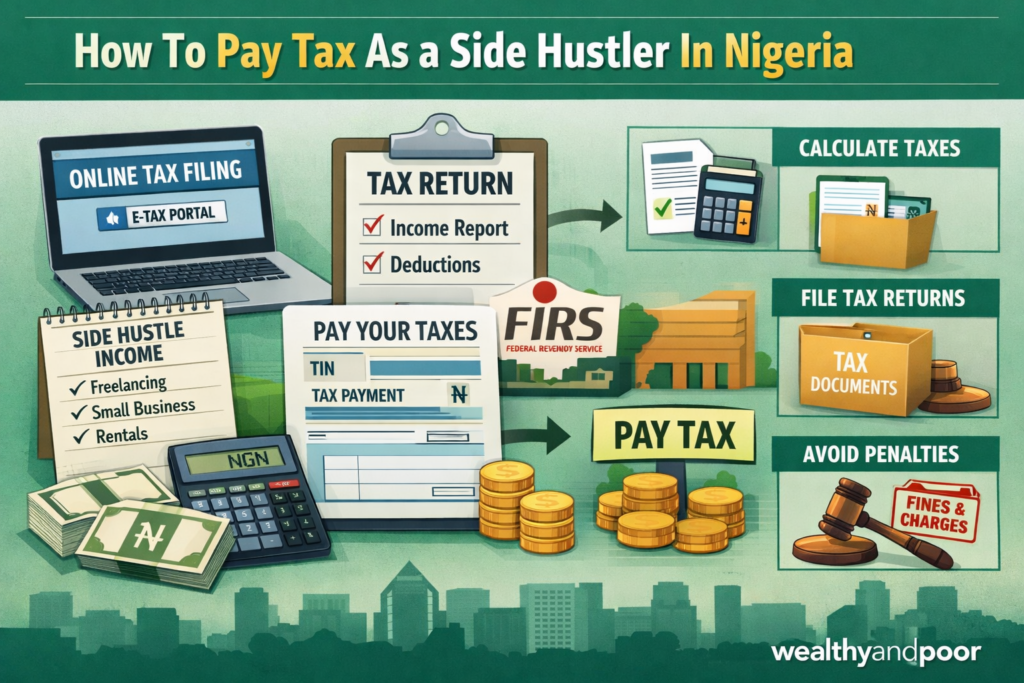

In Nigeria today, more people are earning money in informal ways from freelancing and creative gigs to online businesses and ride-hailing services. These activities, often called side hustles, are no longer “under the radar” when it comes to taxes. Under current Nigerian tax law (especially with reforms in 2025 and 2026), you are legally required to pay tax on income from your side hustle if you earn above certain thresholds.
This article explains exactly what tax you may need to pay, how to register with tax authorities, how to calculate and file your tax returns, and practical tips to stay compliant.
First Things First: What Is a Taxable Side Hustle?
In Nigeria, any income you earn whether from a full time job, freelancing, selling products, or digital services can be subject to tax. It doesn’t matter if it’s your main job or a secondary source of income. The law considers all income-generating activities as taxable, including:
- Freelancing (writing, design, development)
- Selling goods or services online
- Ride-hailing (Uber, Bolt)
- Consulting or coaching
- YouTube monetization, TikTok brand deals, etc.
A common misconception is that only big businesses pay taxes but under Nigeria’s tax reforms, informal earners and side hustlers must also declare and pay what they owe.
Step-by-Step: Registering Yourself for Tax
Before you can pay taxes, you must register with the tax authorities and obtain a Tax Identification Number (TIN). Without a TIN, you cannot file returns or make payments.
- Get Your Tax Identification Number (TIN)
Your TIN is a unique number the government uses to track your tax profile. It’s required whether you are a salaried worker, a freelancer, a small business owner, or a side hustler.
How to get your TIN:
- Visit the official Joint Tax Board TIN portal:
- Select Individual Registration
- Provide personal details (name, NIN/BVN, address, occupation)
- Upload supporting documents (ID, proof of address)
- Submit and download your TIN certificate
This process is usually free. After registration, you’ll use the same TIN every time you file taxes.
- Register With Your State Internal Revenue Service (SIRS)
Nigeria operates a federal-state tax system for personal income tax. That means:
- If you live in Lagos, you’ll register with the Lagos State Internal Revenue Service (LIRS)
- If you live in Abuja, it’s the Federal Capital Territory (FCT) Revenue Authority
- Other states have their own authorities (Enugu IRS, Rivers IRS, etc.)
Once you have a TIN, you should also register with your state tax authority so you can file returns locally.
- What Types of Tax Could You Owe?
As a side hustler, the main taxes you need to understand are:
- Personal Income Tax (PIT)
This is the biggest one for most side hustlers. PIT is charged on your net income after allowable deductions. It’s a progressive tax, meaning the rate increases as your income increases.
This means the tax isn’t flat you’re taxed gradually at each rate on portions of your income.
Important: If part of your income is already taxed through PAYE (Pay-As-You-Earn) by an employer, you still must include your side hustle earnings when you file your personal tax return.
- Withholding Tax (WHT)
If you work with companies as a contractor or freelancer, sometimes clients will deduct 5–10% from payments and send it to tax authorities. This isn’t a separate tax it’s an advance payment toward your PIT. When you file your return, you get credit for WHT already deducted.
- Value Added Tax (VAT)
VAT is a consumption tax on goods and services. Freelancers only charge VAT if:
- You are registered for VAT, and
- Your annual turnover exceeds ₦25 million.
If your hustle isn’t that big yet, you likely won’t charge VAT but you should track your income just in case.
How to Calculate and File Your Taxes
- Keep Accurate Records
Start by keeping a simple record of:
- All income
- All business expenses (for deductions)
- Receipts and bank statements
This makes life much easier when it’s time to file. You can use spreadsheets, a notebook, or accounting software.
- Compute Your Taxable Income
Your taxable income = Gross income – Allowable expenses – reliefs.
Nigeria allows a Consolidated Relief Allowance (CRA) of at least ₦200,000 + 20% of your income before tax.
Example: If your side hustle gross income is ₦2M:
20% of ₦2M = ₦400,000
CRA = ₦400K + ₦200K = ₦600,000
Taxable income = ₦2M – ₦600K = ₦1.4M
Then apply the tax bands to that ₦1.4M to find what you owe.
- File Your Tax Return
As a self-employed person:
- File annual tax returns by 31 March of the following year
- Include all income streams (formal salary + side hustle)
- Attach details of taxes already paid (including WHT)
Even if your income is below the tax threshold, you should file a Nil Return to avoid future issues.
- Make Payments
After filing, pay the tax you owe. You can usually pay:
- Online via the tax authority’s portal
- Through a bank using Remita
- Direct bank transfer to the revenue service account
Keep all receipts you’ll need them if you ever request a Tax Clearance Certificate (TCC), which is required for visa applications, loans, and government contracts.
Do Side Hustlers Really Have to Pay Tax?
Short answer: Yes, if you earn above the minimum threshold.
Under recent reforms, even remote workers and digital influencers are required to self-declare and pay tax on income earned whether local or foreign because the government now tracks digital payments more closely.
Also, if you earn below the threshold (often around ₦800,000 per year), you may owe little to no tax, but you should still register and file a return.
Tips for Side Hustlers
- Set aside a portion of every income many side hustlers save about 20–25% for tax.
- Track expenses carefully this reduces your taxable income.
- File early to avoid penalties and be eligible for opportunities like loans or contracts.
- Consider a tax consultant if your income is complex or coming from multiple countries.
Paying taxes can feel overwhelming, especially when you’re juggling a side hustle with a job or school. But think of it this way it’s part of growing your income responsibly, building trust with clients and institutions, and unlocking future opportunities (like loans and contracts). With the right approach, you’ll stay compliant, avoid penalties, and focus on what you love doing.










Comments