
What Happens If You Don’t Pay Income Tax?

For many individuals and small business owners, income tax is one of those obligations that sits quietly in the background until it doesn’t. When earnings are irregular, business is slow, or paperwork feels overwhelming, it can be tempting to delay filing or simply ignore tax payments altogether. But tax authorities rarely ignore taxpayers.
Whether you are a salaried employee, freelancer, entrepreneur, or side hustler, failing to pay income tax can trigger a chain of consequences financial, legal, and reputational. Understanding what happens when taxes go unpaid is not about fear; it is about being informed and proactive.
Below is a look at what non-payment of income tax can mean, with a focus on Nigeria and comparable global practices.
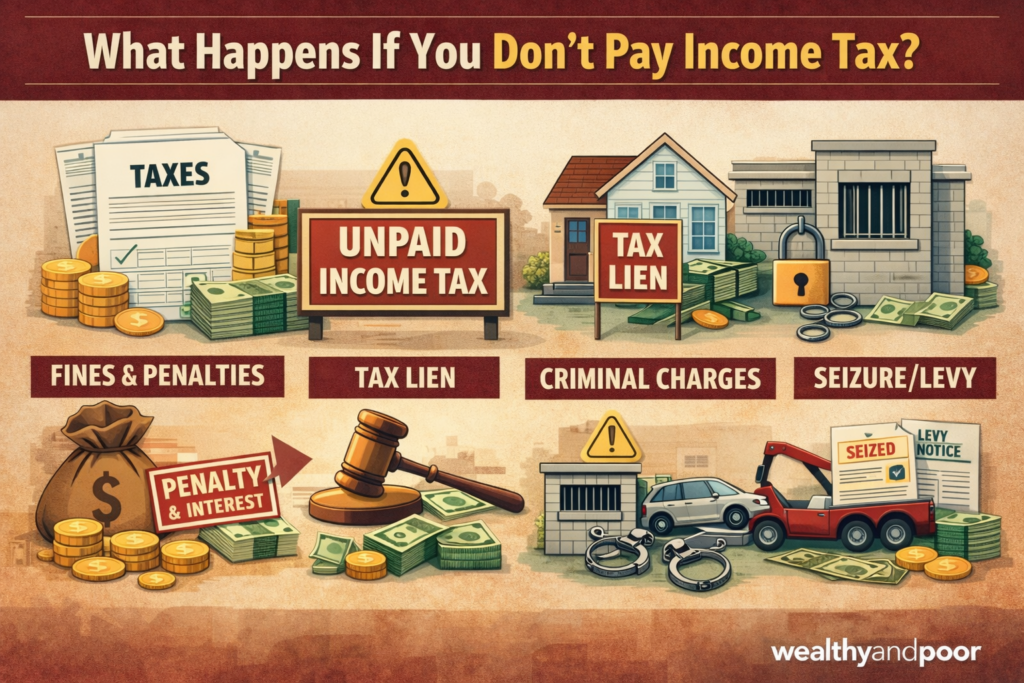
Penalties and Interest Begin to Accumulate
The first and most immediate consequence of not paying income tax is financial.
In Nigeria, the administration of income tax is guided by the Personal Income Tax Act (PITA) and enforced by the Federal Inland Revenue Service (FIRS) for federal taxes, alongside State Internal Revenue Services.
Under Nigerian tax law:
- Failure to file returns can attract monetary penalties.
- Failure to pay tax due can result in interest charges.
- The longer the delay, the more the total debt grows.
- Interest continues to accrue on unpaid taxes, meaning what began as a manageable liability can snowball into a significant financial burden.
Tax Audits and Investigations
Non-payment often increases the likelihood of scrutiny.
Tax authorities use data analytics, bank reporting systems, and third-party information to identify discrepancies between declared income and actual earnings. If red flags appear such as lifestyle patterns that do not match declared income tax authorities may initiate an audit.
An audit can require:
- Submission of bank statements
- Business transaction records
- Contracts and invoices
- Asset declarations
Audits are time consuming, stressful, and potentially expensive, especially if professional representation becomes necessary.
Legal Action and Prosecution
If unpaid taxes remain unresolved after notices and demands, the issue can escalate beyond administrative penalties.
In Nigeria, persistent tax evasion can lead to prosecution under the Federal Inland Revenue Service (Establishment) Act and other relevant statutes. Convictions may result in:
- Fines
- Seizure of assets
- Court-ordered repayment
- In extreme cases, imprisonment
Globally, the consequences are similar. In the United States, for example, the Internal Revenue Service (IRS) has the power to impose penalties, garnish wages, and pursue criminal charges in cases of willful tax evasion.
While most tax cases are resolved through payment arrangements, deliberate evasion especially involving falsified documents can carry criminal liability.
Freezing of Bank Accounts and Asset Seizure
Tax authorities may apply to the courts to recover unpaid taxes directly.
In Nigeria, there have been instances where tax authorities obtained court orders to:
- Freeze corporate bank accounts
- Seal business premises
- Recover unpaid tax from third-party financial institutions
For business owners, this can disrupt operations immediately. Salaries may go unpaid. Vendors may lose confidence. Contracts can be terminated.
The reputational damage can be as severe as the financial impact.
Damage to Creditworthiness and Financial Reputation
Although Nigeria’s credit system is still evolving, tax non-compliance can affect:
- Access to bank loans
- Participation in government contracts
- Business licensing and regulatory approvals
Many procurement processes now require Tax Clearance Certificates (TCC). Without proof of compliance, individuals and companies may be disqualified from lucrative opportunities.
The Tax Clearance Certificate serves as official evidence that taxes have been properly filed and paid for a specified number of years.
Compounding Financial Stress
One often overlooked consequence is psychological.
Unpaid tax debt does not disappear. It lingers. Letters from tax authorities, reminder notices, and potential enforcement actions create ongoing stress. For entrepreneurs already managing business uncertainty, tax debt can become an additional mental and emotional burden.
Ironically, early engagement with tax authorities is often less costly than silence. Many revenue services offer structured payment plans for taxpayers who come forward voluntarily.
The Difference Between Inability and Evasion
It is important to distinguish between two scenarios:
- Inability to pay due to financial hardship
- Intentional evasion, where income is deliberately hidden
Tax authorities generally treat voluntary disclosure and cooperation more favorably than concealment. Coming forward early, filing returns even if payment cannot be made immediately, and negotiating installment plans can significantly reduce penalties.
Intentional evasion, however, can attract harsher sanctions because it involves deception rather than delay.
Business Closure Risks
For small businesses, particularly sole proprietorships and informal enterprises transitioning into formal registration, unpaid tax can halt growth.
Banks, investors, and partners often conduct due diligence before entering agreements. Outstanding tax liabilities can appear during compliance checks, deterring funding opportunities.
In severe enforcement cases, authorities may temporarily close business premises pending resolution.
International Implications
For individuals with cross-border income remote workers, digital entrepreneurs, or those earning from foreign platforms non-payment of tax can create complications in multiple jurisdictions.
With increasing global cooperation on financial transparency and information sharing, undeclared income is harder to conceal. International reporting standards such as the Common Reporting Standard (CRS) enable countries to exchange financial account information.
Ignoring tax obligations locally may eventually affect visa applications, immigration processing, or overseas financial transactions.
Is It Ever Too Late to Fix It?
In most cases, no.
Tax systems are designed primarily to collect revenue not to imprison taxpayers. Authorities prefer voluntary compliance. If taxes have gone unpaid:
- File outstanding returns immediately.
- Calculate the total liability, including penalties.
- Engage the relevant tax authority.
- Request a structured payment plan if needed.
- Proactive engagement usually limits escalation.
A Practical Perspective
Income tax funds public services roads, healthcare, education, security infrastructure. While debates about government accountability and transparency are valid, non-payment rarely resolves those structural concerns. Instead, it exposes the taxpayer to escalating financial and legal risk.
For freelancers, entrepreneurs, and side hustlers especially those earning irregular income the safest strategy is to:
- Keep detailed records
- Separate personal and business finances
- Set aside a percentage of earnings for tax
- Consult a qualified tax professional when necessary
Ignoring tax does not make it disappear. It compounds.
Conclusion
Failing to pay income tax may begin as a simple delay but can evolve into penalties, audits, legal action, frozen accounts, and reputational damage. The longer the issue remains unresolved, the heavier the consequences become.
The smarter approach is early compliance, transparent communication, and structured resolution where necessary. Tax obligations are rarely pleasant but addressing them promptly is far less costly than facing enforcement.











Comments