
How to Register for Tax After CAC Registration
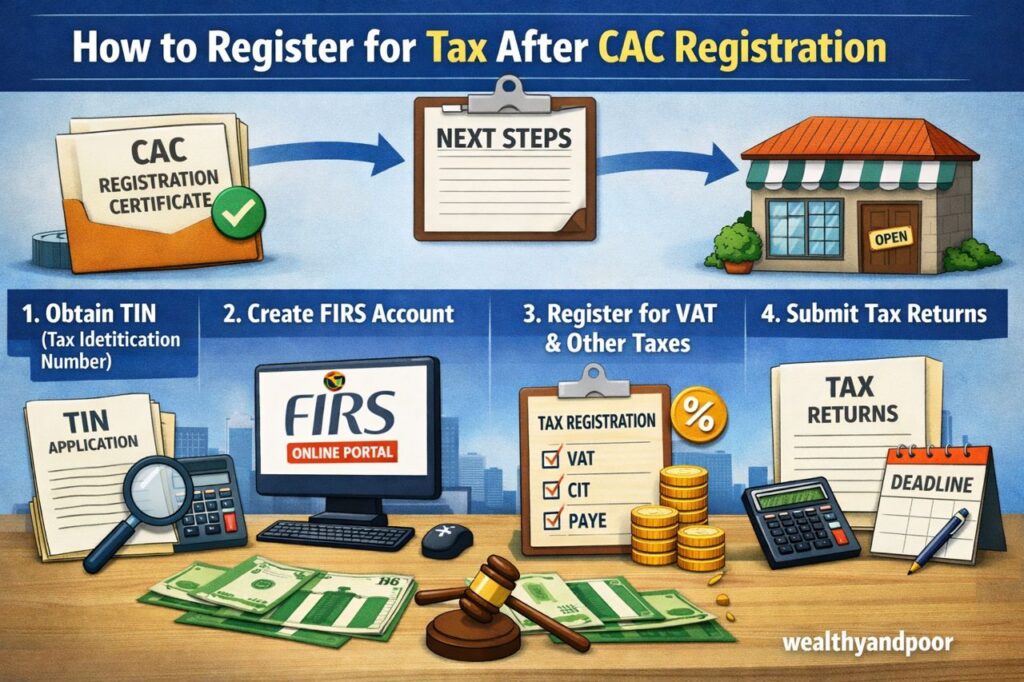

Registering your business with the Corporate Affairs Commission (CAC) is a major milestone. It gives your venture legal recognition and opens the door to corporate banking, contracts, and investor confidence. But CAC registration is only the first step. The next and equally important stage is tax registration.
Many new entrepreneurs assume that once they receive their CAC certificate, they are automatically registered for tax. That is not the case. In Nigeria, tax registration and compliance are handled by different authorities depending on the type of tax involved.
This article explains, in clear terms, what to do after CAC registration, where to go, and how to stay compliant.
Understand the Taxes That Apply to Your Business
After registering your business, the next step is identifying the taxes you are required to pay. The type of business structure you registered business name (sole proprietorship), partnership, or limited liability company determines your tax obligations.
Here are the major tax categories:
- Companies Income Tax (CIT) – For limited liability companies
- Personal Income Tax (PIT) – For sole proprietors and partnerships
- Value Added Tax (VAT) – If your business provides taxable goods or services
- Pay-As-You-Earn (PAYE) – If you employ staff
- Withholding Tax (WHT) – Deducted at source for certain transactions
The federal tax authority is the Federal Inland Revenue Service (FIRS), while state tax matters (such as personal income tax and PAYE) are handled by your state’s Internal Revenue Service. For example, businesses operating in Lagos deal with the Lagos State Internal Revenue Service (LIRS).
Obtain Your Tax Identification Number (TIN)
The Tax Identification Number (TIN) is essential for operating legally. You cannot open a corporate bank account without it, and you cannot file tax returns without it.
Is TIN Automatic After CAC Registration?
In recent years, CAC and FIRS integrated parts of their systems. For limited liability companies, a TIN is often generated automatically during incorporation. However, this does not replace the need to activate your tax profile with FIRS.
You should confirm your TIN by:
- Visiting a FIRS tax office nearest to you, or
- Checking via the FIRS TIN verification portal
Even if a TIN is generated automatically, you must still register your company’s tax account formally with FIRS.
Register with FIRS (For Limited Liability Companies)
If your business is registered as a limited liability company, you must register for Companies Income Tax and VAT with FIRS.
Documents Required:
- CAC Certificate of Incorporation
- Memorandum and Articles of Association
- Form CAC 1.1 (or CAC2 & CAC7 for older registrations)
- Means of identification of directors
- Utility bill (business address verification)
- Company stamp
At the FIRS office, you will complete relevant forms and open your tax file. You may also be assigned a tax officer.
You can begin registration online through the FIRS TaxPro Max platform.
Register for VAT (If Applicable)
If your business supplies goods or services subject to VAT, you must register for VAT and begin filing monthly returns even if you did not make sales in a particular month.
Under Nigerian law, businesses with annual turnover above ₦25 million are required to charge VAT. However, voluntary registration is also possible.
VAT returns must be filed monthly with FIRS on or before the 21st day of the following month.
Legal backing can be found under the VAT Act (as amended).
Register with Your State Internal Revenue Service (If Sole Proprietor or Employer)
If you registered a business name (not a limited liability company), your Personal Income Tax is handled by your State Internal Revenue Service, not FIRS.
For example:
In Lagos: LIRS
In Rivers State: Rivers State Internal Revenue Service
You must:
- Register for Personal Income Tax
- Obtain a Tax Clearance Certificate (TCC) when needed
- Register for PAYE if you employ staff
- PAYE deductions must be remitted monthly.
Open a Corporate Bank Account
Most Nigerian banks require:
- CAC documents
- TIN
- Tax registration evidence
Your bank may request your FIRS acknowledgment letter. Without tax registration, corporate banking may be delayed.
File Your First Tax Returns
Registration alone is not compliance. Filing returns is mandatory.
- Companies Income Tax (CIT)
Companies must file annual returns within six months after the end of their financial year.
Small companies (turnover below ₦25 million) are exempt from paying CIT but must still file returns.
VAT Returns
Filed monthly — even if NIL.
Failure to file attracts penalties, including fines and possible business restrictions.
Common Mistakes to Avoid
Ignoring Tax Registration After CAC
Many entrepreneurs stop at CAC and forget tax registration. This can create compliance issues later.
Waiting Until You Need a Tax Clearance Certificate
By then, penalties may have accumulated.
Not Filing NIL Returns
Even if your business is dormant, returns must be filed.
Mixing Personal and Business Finances
This complicates tax reporting and audits.
How Long Does the Process Take?
If documents are complete, FIRS registration can be completed within a few days to a couple of weeks, depending on the office and workload.
Online systems have improved efficiency, but physical verification may still be required.
Why Tax Registration Matters
Beyond compliance, proper tax registration:
- Enables access to government contracts
- Makes it easier to secure loans
- Improves investor confidence
- Prevents penalties and legal disputes
Nigeria’s tax system is gradually becoming more digitised and interconnected. Authorities now share data across agencies, making non-compliance riskier than ever.
Conclusion
CAC registration gives your business a legal identity. Tax registration gives it legitimacy in the eyes of regulators, banks, and serious partners.
If you have just incorporated your company or registered a business name, do not delay the next step. Visit FIRS (for companies) or your State Internal Revenue Service (for sole proprietors), confirm your TIN, activate your tax file, and understand your filing obligations.
Compliance may feel bureaucratic at first, but it protects your business in the long run.












Comments