
Does CAC Automatically Register You for Tax?
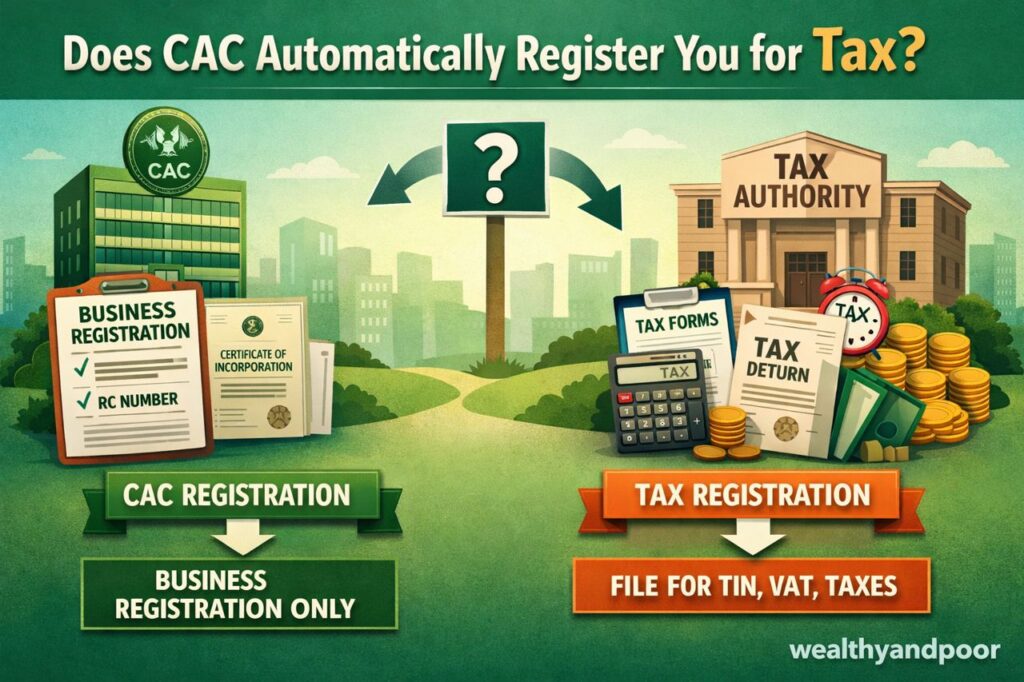

One of the most common questions new entrepreneurs ask after registering a business in Nigeria is simple: “Now that I’ve registered with CAC, am I automatically registered for tax?”
The short answer is not exactly but the process is now more integrated than it used to be.
Over the past few years, Nigeria’s business registration and tax systems have become more connected, particularly through collaboration between the Corporate Affairs Commission (CAC) and the Federal Inland Revenue Service (FIRS). However, business owners still need to understand what is automatic, what is not, and what responsibilities remain theirs.
This article breaks it down clearly.
The Evolution of Business Registration and Tax in Nigeria
Historically, registering a company with CAC and registering for tax with FIRS were two separate processes. After incorporation, business owners had to physically visit FIRS offices to obtain a Tax Identification Number (TIN) and complete tax registration.
That changed with reforms introduced under the Companies and Allied Matters Act (CAMA) 2020 and subsequent digital integration between CAC and FIRS. Today, when you register a company or business name through the CAC online portal, a Tax Identification Number is automatically generated and issued alongside your Certificate of Incorporation or Business Name Registration.
But here’s where clarity is important.
What Exactly Is Automatic?
When you register your company with CAC today:
- A Tax Identification Number (TIN) is automatically generated.
- Your basic company details are transmitted to FIRS.
- Your company is created on the FIRS Tax Pro Max system.
In practical terms, this means you do not need to apply separately for a TIN anymore. The integration between CAC and FIRS has eliminated that duplication.
According to FIRS, the automated TIN issuance was designed to improve Nigeria’s ease of doing business ranking and simplify compliance for new businesses.
What Is NOT Automatic?
Here’s where many business owners misunderstand the process.
While CAC registration triggers automatic TIN generation, it does not mean:
- You have filed your first tax return.
- You are exempt from future tax compliance.
- Your tax obligations are fully activated and completed.
- You have registered for VAT filing (where applicable).
- You have completed onboarding on the FIRS Tax Pro Max system.
You still need to:
- Log into the FIRS Tax Pro Max portal.
- Confirm and update your business details.
- Understand your applicable taxes (Company Income Tax, VAT, Withholding Tax, etc.).
- Begin filing returns even if your company has not made profit.
This is where compliance responsibility begins.
Does This Apply to Business Names Too?
Yes, but with nuances.
If you register a Business Name (sole proprietorship) with CAC, a TIN is also generated. However, sole proprietors typically fall under state tax authorities for personal income tax rather than FIRS for Company Income Tax.
For example:
Companies (Limited Liability Companies) pay Company Income Tax to FIRS.
Sole proprietors pay Personal Income Tax to their State Internal Revenue Service.
So while a TIN may be generated at federal level, your primary income tax obligation as a sole proprietor is usually at the state level.
Company Income Tax Obligations After CAC Registration
Under the Companies Income Tax Act (CITA), every registered company must file annual tax returns even if it has not commenced operations.
This means:
- If your company is dormant, you must file nil returns.
- If your company makes profit, you must calculate and pay Company Income Tax.
VAT registration and filing become mandatory if your turnover meets the threshold defined by law (currently ₦25 million annual turnover for VAT registration exemption threshold).
Relevant legislation reference (CITA overview)
Failure to file returns can attract penalties, regardless of whether tax was paid.
What About Startups and Small Businesses?
Nigeria’s Finance Acts have introduced some reliefs:
- Companies earning less than ₦25 million annually are classified as small companies and are exempt from Company Income Tax.
However, they are still required to file annual returns.
- This distinction is critical: exemption from payment does not mean exemption from filing.
Why the Confusion Persists
The confusion often arises because business owners receive their CAC certificate with a TIN included and assume everything tax-related has been “handled.”
In reality:
- CAC handles corporate registration.
- FIRS handles federal tax compliance.
- State Revenue Services handle personal income tax for individuals and sole proprietors.
The integration simply removes the duplication of applying separately for a TIN. It does not remove compliance obligations.
Practical Steps After Registering With CAC
If you just registered your business, here is what you should do next:
- Check your CAC registration documents for your TIN.
- Log into Tax Pro Max
- Complete your tax profile setup.
- Understand which taxes apply to your business structure.
- Set reminders for annual filing deadlines.
- If unsure, consult a tax professional early. The cost of early compliance advice is often far lower than penalties later.
Conclusion
So, does CAC automatically register you for tax?
Yes in terms of generating a TIN and creating a basic tax profile.
No in terms of completing your tax obligations.
Registration is just the starting point. Compliance is an ongoing responsibility.
Nigeria’s move toward digital integration between CAC and FIRS is a positive step for ease of doing business. But entrepreneurs must understand that automation does not replace accountability.
If you are building a business, tax compliance should not be treated as an afterthought. It is part of corporate governance, credibility, and long-term sustainability.
In today’s regulatory environment, ignorance is expensive but compliance is manageable when approached proactively.











Comments