
Tax Incentives for Small Businesses in Nigeria
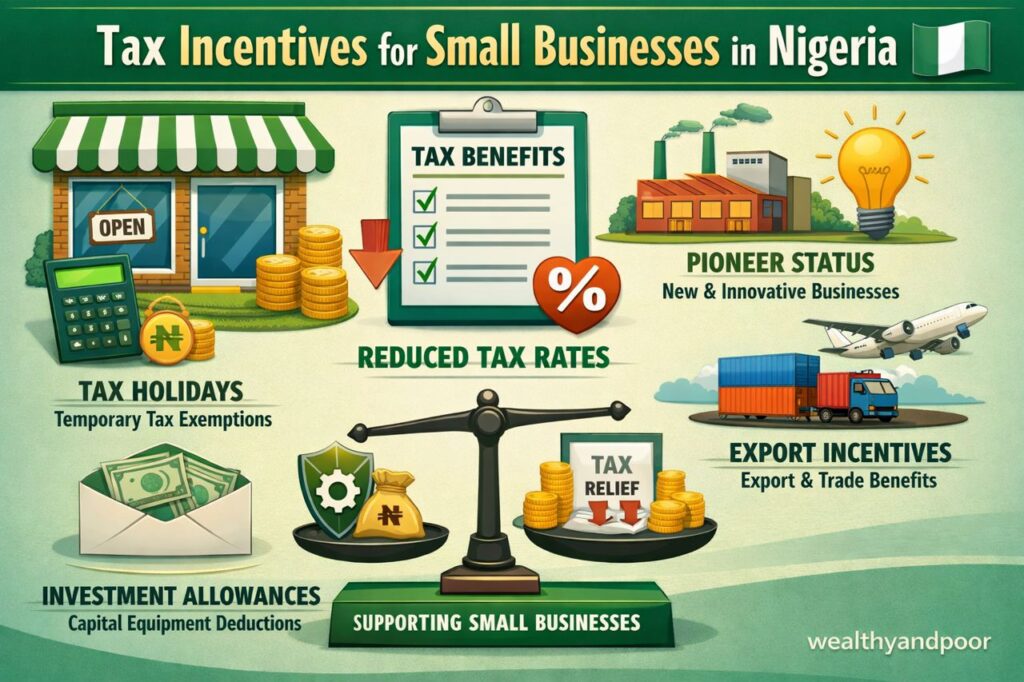

Small businesses are widely regarded as the backbone of Nigeria’s economy. From small retail shops and digital startups to manufacturing ventures and agricultural enterprises, these businesses play a critical role in job creation, innovation, and economic growth. However, the burden of taxation can be significant for emerging enterprises, especially in their early stages when profits are still uncertain.
To encourage entrepreneurship and support the growth of micro, small, and medium-sized enterprises (MSMEs), the Nigerian government has introduced several tax incentives through various laws, including the Finance Acts, the Companies Income Tax Act (CITA), and other fiscal policy reforms. These incentives are designed to reduce the tax burden on small businesses, stimulate investment, and create a more favorable business environment.
This article explores the key tax incentives available to small businesses in Nigeria and how entrepreneurs can benefit from them.
Understanding Small Businesses Under Nigerian Tax Law
Under Nigerian tax regulations, businesses are generally classified based on their annual turnover. A small company is typically defined as a company with an annual turnover not exceeding ₦25 million, although recent tax reforms have expanded this threshold in some frameworks. Businesses within this category enjoy several tax benefits and exemptions designed to support their growth.
Medium-sized companies, with turnover between ₦25 million and ₦100 million, also receive partial tax relief through reduced tax rates.
- Exemption from Company Income Tax (CIT)
One of the most significant tax incentives for small businesses in Nigeria is exemption from Company Income Tax (CIT).
Under Nigeria’s Finance Act reforms, companies with annual turnover below ₦25 million are exempt from paying company income tax, which is typically charged at 30% for large corporations.
Key benefits
- Small companies pay 0% Company Income Tax
- Encourages informal businesses to formalize their operations
- Allows startups to reinvest early profits into growth
For medium-sized companies earning between ₦25 million and ₦100 million annually, the CIT rate is reduced to 20% instead of 30%, providing further relief for growing enterprises.
This incentive helps ensure that smaller firms are not taxed at the same level as large corporations with significantly higher revenue.
- Capital Gains Tax Relief
Another important tax benefit available to small businesses is relief from Capital Gains Tax (CGT) in certain situations.
Capital Gains Tax normally applies to profits made from the sale of assets such as property, machinery, or vehicles. However, qualifying small companies can enjoy exemptions when proceeds from the sale of business assets are reinvested into new equipment or operational improvements.
Why this matters
This relief encourages businesses to:
- Upgrade machinery
- Replace outdated equipment
- Reinvest profits into expansion
As a result, businesses can restructure or modernize their operations without losing a portion of their capital to tax.
- Withholding Tax (WHT) Relief for SMEs
Withholding Tax deductions can create cash flow challenges for small businesses, especially when payments are withheld before profits are realized.
Recent reforms provide relief for small companies by reducing or eliminating withholding tax deductions in certain transactions. In some cases, qualifying small businesses may be exempt from WHT deductions on invoices below specific thresholds, provided they have valid tax identification numbers and maintain proper records.
Impact on SMEs
This incentive helps businesses:
- Improve liquidity
- Maintain working capital
- Reduce administrative tax burdens
For startups and service-based businesses, this can significantly ease financial pressure.
- Pioneer Status Tax Holiday
Nigeria has historically offered tax holidays through the Pioneer Status Incentive (PSI) administered by the Nigerian Investment Promotion Commission (NIPC).
Under this program, eligible companies operating in key sectors such as manufacturing, agriculture, technology, and infrastructure could enjoy a tax holiday of up to five years, beginning with an initial three-year exemption from company income tax.
Purpose of the incentive
The Pioneer Status scheme was designed to:
- Promote industrial development
- Encourage investment in strategic sectors
- Support economic diversification
However, the Nigerian government has begun transitioning from the Pioneer Status scheme to a new Economic Development Tax Incentive framework aimed at modernizing investment incentives.
Even with this transition, businesses in priority sectors may still benefit from tax credits and similar investment incentives.
Investment and Economic Development Tax Credits
Nigeria’s evolving tax system increasingly relies on tax credits tied to investments.
Under the new incentive framework replacing pioneer incentives, businesses making qualifying investments in infrastructure, manufacturing, or strategic sectors may receive tax credits of up to 5% annually over five years.
Benefits of tax credits
Unlike deductions, tax credits directly reduce the tax a business owes.
This means companies can:
- Recover part of their investment
- Lower overall tax liability
- Improve long-term profitability
For small and growing businesses making capital investments, this can significantly reduce operational costs.
Agricultural Tax Incentives
Agriculture is a priority sector in Nigeria’s economic policy, and businesses operating in this industry enjoy additional tax benefits.
Small or medium-sized agricultural companies may qualify for tax holidays of up to four years, with possible extensions depending on performance and compliance with regulatory requirements.
These incentives encourage investment in:
- Food production
- Agro-processing
- Agricultural technology
Given Nigeria’s focus on food security and import substitution, agricultural SMEs remain one of the most incentivized sectors.
VAT Exemptions on Essential Goods
Value Added Tax (VAT) is another area where small businesses may benefit from relief.
Certain goods and services especially those related to agriculture, education, healthcare, and exports are exempt from VAT under Nigerian tax law.
Examples include:
- Basic food items
- Agricultural equipment
- Medical products
- Exported goods and services
For small businesses operating in these sectors, VAT exemptions reduce operating costs and improve competitiveness.
Challenges in Accessing Tax Incentives
Despite the availability of these incentives, many Nigerian SMEs struggle to benefit from them.
Common challenges include:
- Lack of awareness among entrepreneurs
- Complex tax filing requirements
- Poor record-keeping
- Regulatory bureaucracy
Many businesses also operate informally, which prevents them from qualifying for official tax incentives.
Improving financial literacy and simplifying tax compliance processes could significantly increase SME participation in these programs.
Conclusion
Tax incentives remain a critical tool for promoting entrepreneurship and supporting small businesses in Nigeria. By offering exemptions, tax holidays, reduced tax rates, and investment credits, the government aims to reduce the financial pressure on startups and SMEs while encouraging economic expansion.
However, the success of these incentives depends largely on awareness and compliance. Entrepreneurs must ensure their businesses are properly registered, maintain accurate financial records, and stay informed about available tax benefits.
For Nigeria’s rapidly growing startup ecosystem, leveraging these incentives can make the difference between struggling to survive and achieving sustainable growth.












Comments