
Common Tax Mistakes Nigerian Businesses Make
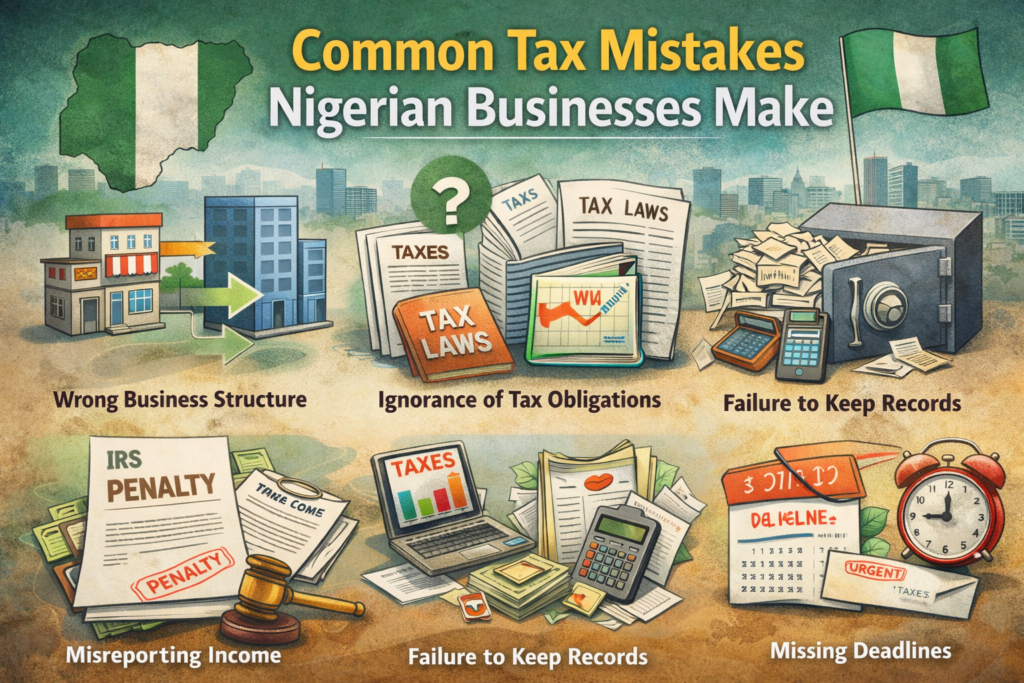

Tax compliance is a critical part of running a legitimate business in Nigeria. Yet many businesses especially small and medium-sized enterprises (SMEs) and startups often make avoidable tax mistakes that can lead to penalties, audits, and reputational damage. As Nigeria’s tax authorities increasingly adopt digital systems and stricter enforcement measures, the cost of non-compliance is rising.
From failing to remit taxes to poor record-keeping, these mistakes can disrupt operations and create unnecessary financial burdens for businesses. Understanding the most common tax errors Nigerian companies make is the first step toward avoiding them.
This article examines the most frequent tax mistakes Nigerian businesses make and how they can be avoided.
Failure to Register for Taxes and Obtain a TIN
One of the most basic but common mistakes Nigerian businesses make is failing to properly register with the relevant tax authorities.
Every company operating in Nigeria is expected to obtain a Tax Identification Number (TIN) from the Federal Inland Revenue Service (FIRS) or the appropriate State Internal Revenue Service. Without a TIN, businesses cannot legally file taxes or properly engage in many financial activities.
Many small businesses begin operations informally and delay tax registration until they encounter issues such as bank account restrictions, government contract requirements, or tax audits.
How to avoid this mistake
- Register your business with the Corporate Affairs Commission (CAC).
- Obtain a TIN from the FIRS immediately after registration.
- Ensure your business is properly registered for applicable taxes such as VAT, Companies Income Tax, and PAYE.
- Early registration ensures compliance and reduces future complications with tax authorities.
Poor Record-Keeping and Financial Documentation
Another widespread issue among Nigerian businesses is inadequate bookkeeping. Many entrepreneurs fail to maintain proper records of sales, expenses, invoices, and payroll.
Poor documentation makes it difficult to file accurate tax returns and may cause tax authorities to disallow certain deductions during audits.
In extreme cases, missing financial records can lead to “best-of-judgment assessments,” where tax authorities estimate a company’s tax liability due to insufficient documentation.
How to avoid this mistake
- Maintain detailed records of all financial transactions.
- Keep receipts, invoices, payroll records, and bank statements.
- Use accounting software to automate record-keeping.
- Retain records for at least six years for audit purposes.
Proper documentation protects businesses during tax audits and ensures accurate financial reporting.
Missing Tax Filing Deadlines
Late filing of tax returns is one of the most common compliance errors in Nigeria. Businesses are required to file and remit various taxes according to strict timelines, including:
- Monthly Value Added Tax (VAT) returns
- Pay-As-You-Earn (PAYE) deductions for employees
- Withholding Tax (WHT) remittances
- Annual Companies Income Tax (CIT) returns
Failure to meet these deadlines attracts penalties and interest charges.
For example, employers are required to remit PAYE deductions within a specific period after salary payments, and delays can trigger fines and enforcement actions.
How to avoid this mistake
- Maintain a tax compliance calendar.
- Set reminders for monthly and annual filing deadlines.
- Assign responsibility for tax compliance to a specific staff member or accountant.
Timely filing helps businesses avoid unnecessary penalties.
Failure to Deduct or Remit Withholding Tax
Withholding Tax (WHT) is commonly misunderstood by many Nigerian businesses. Companies are required to deduct WHT from certain payments made to contractors, suppliers, and service providers.
However, some businesses either fail to deduct the tax or deduct it but fail to remit it to the tax authority.
This mistake exposes businesses to additional tax liabilities because the tax authorities may demand payment again even if it was already deducted from vendors.
How to avoid this mistake
- Understand which transactions attract WHT.
- Deduct the correct WHT rates on qualifying payments.
- Remit the deductions to the relevant tax authority promptly.
Proper WHT management also ensures that vendors receive credit notes for their tax deductions.
Mismanaging Value Added Tax (VAT)
VAT compliance is another area where many Nigerian businesses make mistakes. Some companies collect VAT from customers but fail to remit it to the government, while others miscalculate VAT on taxable goods and services.
In Nigeria, VAT is currently charged at 7.5%, and businesses are required to file monthly VAT returns. Failure to remit VAT can lead to penalties, interest, and even enforcement actions by tax authorities.
How to avoid this mistake
- Ensure VAT is clearly included on invoices.
- Maintain accurate records of VAT collected.
- File monthly VAT returns and remit payments promptly.
Separating VAT collections from business revenue can also help ensure proper remittance.
Mixing Personal and Business Finances
Many small business owners use the same bank account for personal and business transactions. This practice makes it difficult to determine the true financial position of the business and complicates tax calculations.
Mixing funds can create confusion during tax audits and may lead to incorrect tax reporting.
How to avoid this mistake
- Maintain separate bank accounts for personal and business finances.
- Record all business expenses through the business account.
- Implement clear internal financial controls.
This separation helps maintain transparency and simplifies tax reporting.
Incorrect Tax Computations
Tax calculations can be complex, and errors often occur when businesses incorrectly compute their taxable profits or deductions.
Common mistakes include:
- Treating capital expenditure as deductible expenses
- Failing to reconcile accounting profit with taxable profit
- Incorrectly claiming capital allowances
Such errors may result in additional tax assessments and audits.
How to avoid this mistake
- Understand the difference between accounting profit and taxable profit.
- Consult tax professionals when preparing tax returns.
- Conduct periodic internal reviews of tax computations.
Professional guidance helps ensure accuracy and compliance.
Ignoring Tax Incentives and Reliefs
While some businesses underpay taxes due to errors, others unknowingly overpay because they fail to take advantage of available tax incentives.
Nigeria offers several tax relief programs, including:
- Pioneer Status Incentive for certain industries
- SME tax relief for small companies
- Capital allowances on qualifying assets
However, many businesses are unaware of these incentives or fail to properly claim them.
How to avoid this mistake
- Stay informed about government tax policies.
- Consult tax advisors to identify available incentives.
- Maintain documentation required to support claims.
- Taking advantage of legitimate incentives can significantly reduce a company’s tax burden.
Conclusion
Tax compliance remains a major challenge for many Nigerian businesses, particularly SMEs that lack dedicated accounting departments. However, most tax mistakes are preventable with proper financial management, professional advice, and awareness of tax regulations.
By registering properly, maintaining accurate records, meeting filing deadlines, and understanding tax obligations such as VAT, WHT, and PAYE, businesses can avoid costly penalties and maintain a good relationship with tax authorities.
As Nigeria continues to strengthen tax enforcement and digital reporting systems, companies that prioritize tax compliance will be better positioned to grow sustainably and avoid regulatory disruptions.










Comments