
Can FIRS Track Small Businesses?
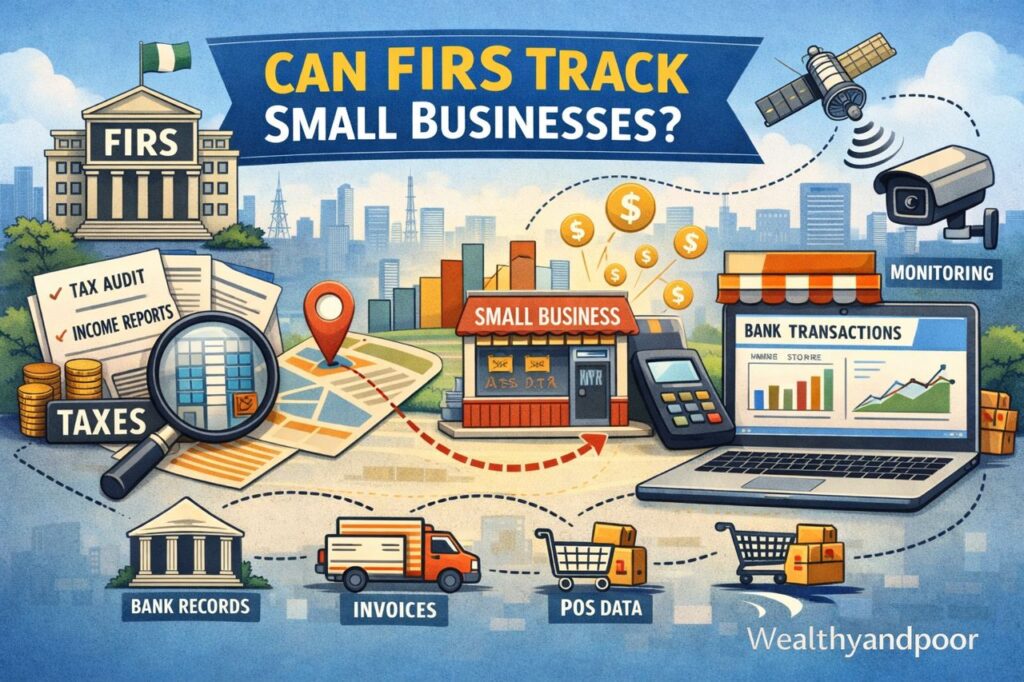

In Nigeria’s evolving tax environment, one question frequently asked by entrepreneurs and startup founders is whether the Federal Inland Revenue Service (FIRS) can track small businesses. Many small business owners assume that operating informally or running transactions through personal accounts makes them invisible to the tax authority. However, developments in Nigeria’s tax system suggest that this assumption is increasingly outdated.
In recent years, the Nigerian government has expanded the use of digital systems, inter-agency data sharing, and financial reporting frameworks to improve tax compliance. These tools make it significantly easier for authorities to identify businesses that should be paying taxes, even if they are small or operating informally.
This article explains how FIRS can track small businesses, the tools it uses, and what entrepreneurs should know to stay compliant.
Understanding the Role of FIRS in Nigeria
The Federal Inland Revenue Service (FIRS) is the agency responsible for assessing, collecting, and accounting for federal taxes in Nigeria. These include Company Income Tax (CIT), Value Added Tax (VAT), Withholding Tax (WHT), and other federal levies.
While large corporations historically contributed the majority of tax revenue, the government has increasingly focused on expanding the tax base by bringing small and medium-sized enterprises (SMEs) into the formal tax system.
According to tax experts, the goal is not necessarily to punish small businesses but to create a fair system where all economic participants contribute their share to national development.
How FIRS Can Track Small Businesses
- Bank Transaction Monitoring and Data Matching
One of the primary ways tax authorities identify businesses is through financial data. Nigerian banks operate under strict regulatory frameworks that require proper identification of account holders, including linking accounts to the Bank Verification Number (BVN) system.
When business transactions pass through bank accounts especially accounts that show consistent commercial inflows those transactions may attract regulatory attention.
Modern tax systems rely on data matching, where information from different databases is cross-checked. This can include links between:
- Bank accounts
- Corporate Affairs Commission (CAC) records
- Tax Identification Numbers (TIN)
- VAT and PAYE filings
When these records do not align for example, when a business receives large payments but files no tax returns tax authorities may flag the account for review.
Corporate Affairs Commission (CAC) Registration Data
When a business registers with the Corporate Affairs Commission, its information becomes part of a national corporate database. This information is often shared across government institutions.
Once a company is registered, it is expected to obtain a Tax Identification Number (TIN) and comply with tax filing obligations. Even small companies that qualify for tax exemptions are still required to file annual returns.
FIRS has emphasized that businesses with zero tax liability must still submit their tax computations and returns annually as part of compliance requirements.
Digital Tax Platforms and Real-Time Monitoring
Nigeria’s tax administration is undergoing a digital transformation aimed at improving transparency and reducing tax evasion.
One of the most significant developments is the National E- Invoicing Solution, a digital platform that standardises and validates business invoices electronically. Under this system, each transaction carries a unique verification code and timestamp, enabling tax authorities to confirm transactions more easily.
This technology shifts the system from delayed reporting to near real-time monitoring of commercial transactions, making it more difficult to hide income or manipulate sales records.
The system is designed to store detailed information about transactions, including:
- Supplier and buyer information
- Product descriptions
- Prices and tax amounts
- Transaction timestamps
These digital records significantly
improve the ability of tax authorities to audit businesses when necessary.
Artificial Intelligence and Risk Profiling
Another important tool used by tax authorities is data analytics and artificial intelligence.
Recent tax reforms have introduced technology-driven compliance tools that allow authorities to analyse financial patterns and identify possible tax risks. These systems can flag unusual activities such as:
- Consistent high bank inflows with no tax filings
- Repeated declarations of losses
- Inconsistent VAT returns
- Discrepancies between payroll
- records and tax submissions
Through automated risk profiling, authorities can identify businesses that may require audits or further investigation.
Inter-Agency Collaboration
FIRS does not operate alone in enforcing tax compliance. The agency collaborates with other government institutions such as:
- Economic and Financial Crimes
- Commission (EFCC)
- Independent Corrupt Practices
- Commission (ICPC)
- Financial institutions and regulatory bodies
These partnerships allow authorities to share intelligence and strengthen enforcement against tax evasion and financial crimes.
For example, suspicious financial activity detected by banks or anti-corruption agencies may be referred to tax authorities for investigation.
Does This Mean Every Small Business Is Monitored?
Not necessarily.
Nigeria has millions of small and informal businesses, making it practically impossible for authorities to monitor each one individually. Instead, the system focuses on risk-based enforcement.
Businesses are more likely to attract attention if they:
- Receive large or regular payments without filing taxes
- Register with CAC but fail to submit tax returns
- Collect VAT but fail to remit it
Show inconsistent financial records
When these red flags appear, automated systems may trigger a compliance review.
What Small Businesses Should Do
For entrepreneurs and startups, the safest approach is voluntary compliance.
This includes:
- Registering with the Corporate Affairs Commission.
- Obtaining a Tax Identification Number (TIN).
- Filing annual tax returns even if the business qualifies for zero tax.
- Keeping accurate financial records.
- Separating personal and business bank accounts.
These simple steps significantly reduce the risk of penalties or tax audits.
Conclusion
Yes, the Federal Inland Revenue Service can track small businesses especially as Nigeria adopts more digital tax systems and inter-agency data sharing.
However, the objective of these systems is not to target entrepreneurs unfairly but to create a more transparent and efficient tax environment.
For small businesses, the key takeaway is clear: operating informally no longer guarantees invisibility. As tax administration becomes more technology-driven, compliance is becoming easier and avoidance increasingly difficult.
Entrepreneurs who maintain proper records, file their returns, and understand their tax obligations will be better positioned to grow sustainably without regulatory challenges.










Comments