
Difference Between VAT, WHT, and Stamp Duty
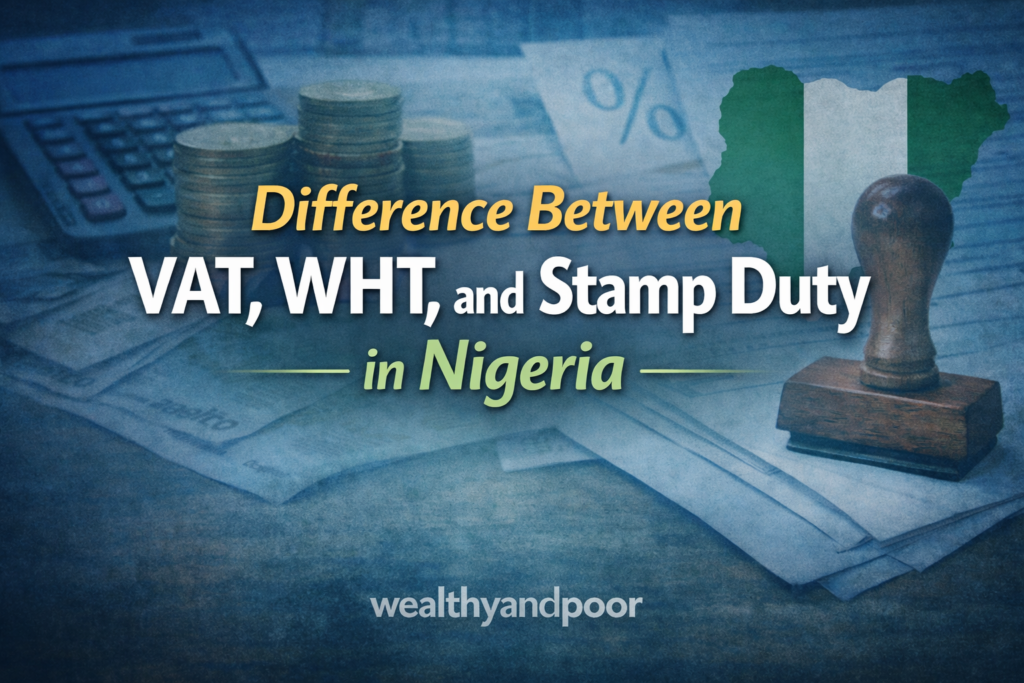

Taxes play a major role in Nigeria’s revenue system, helping the government finance infrastructure, public services, and economic development. Among the most common taxes that businesses and individuals encounter in Nigeria are Value Added Tax (VAT), Withholding Tax (WHT), and Stamp Duty.
Each tax operates under different laws, applies to different transactions, and is collected in different ways.
Understanding the difference between VAT, WHT, and Stamp Duty is important for business owners, entrepreneurs, and individuals who want to stay compliant with Nigeria’s tax regulations.
VALUE ADDED TAX

Value Added Tax (VAT) is a consumption tax charged on the supply of goods and services in Nigeria. It is governed by the Value Added Tax Act, and it is administered by the Federal Inland Revenue Service (FIRS). VAT is charged at a standard rate of 7.5% on most goods and services unless they are specifically exempted by law.
VAT operates as an indirect tax, meaning the final burden of the tax is borne by the consumer rather than the business collecting it. Businesses simply act as intermediaries that collect VAT from customers and remit it to the government. For example, when a customer purchases goods from a store or pays for a service, the seller adds VAT to the invoice and later remits it to the tax authority.
In Nigeria, VAT is applied at each stage of the supply chain. Businesses charge VAT on their sales (output VAT) and deduct the VAT they paid on purchases (input VAT). The difference between the output VAT and input VAT is what the business remits to the government.
However, not all goods and services attract VAT. Essential items such as basic food products, medical services, pharmaceutical products, books, and educational materials are exempted under the VAT Act.
WITHHOLDING TAX

Withholding Tax (WHT), on the other hand, is different from VAT because it is not a separate tax. Instead, it is an advance payment of income tax deducted at the source of a transaction. This means that when certain payments are made for services or contracts, the payer deducts a portion of the payment as tax and remits it to the tax authority on behalf of the recipient.
The primary purpose of Withholding Tax is to help the government track taxable income and reduce tax evasion. By deducting tax at the point of payment, the government ensures that part of the taxpayer’s income tax liability is already collected.
WHT commonly applies to transactions such as contract payments, professional fees, consultancy services, commissions, rent, royalties, and dividends. The rates vary depending on the nature of the transaction and whether the recipient is an individual or a company. For example, consultancy services may attract around 5% withholding tax, while dividends and interest payments may attract 10%.
Unlike VAT, which is borne by the final consumer, WHT is deducted from the income of the person receiving payment. The deducted amount is then used as a tax credit when the recipient files their annual tax returns. If the total tax payable exceeds the WHT already deducted, the taxpayer pays the remaining balance. If it exceeds the liability, it can be credited or refunded.
STAMP DUTY

Stamp Duty is a form of tax in Nigeria, but it applies to legal documents and instruments rather than goods or services. It is governed by the Stamp Duties Act, which requires certain documents to be stamped before they become legally valid or admissible in court.
Stamp Duty is charged on documents that record transactions such as contracts, loan agreements, property transfers, share transfers, leases, and other legal instruments. The duty can be charged either as a fixed fee or as a percentage of the transaction value, depending on the type of document involved.
In Nigeria’s banking system, Stamp Duty is commonly seen as a ₦50 charge on electronic transfers of ₦10,000 and above into bank accounts. This charge is part of the electronic money transfer levy introduced under recent amendments to the Stamp Duties Act.
Stamp Duty gives legal recognition to documents. If a document that should be stamped is not properly stamped, it may not be admissible as evidence in legal proceedings.
When comparing VAT, WHT, and Stamp Duty, the differences become clearer. VAT is a consumption tax on goods and services, WHT is an advance deduction of income tax on payments, and Stamp Duty is a tax on legal documents and instruments. VAT is paid by the final consumer but collected by businesses, WHT is deducted from payments made to individuals or companies, and Stamp Duty is charged when certain documents are executed or transactions are recorded.
VAT and Stamp Duty involving corporate entities are generally collected by the Federal Inland Revenue Service (FIRS), while Stamp Duty on transactions strictly between individuals may be administered by state tax authorities or as Ad-valorem Tax.
In conclusion, VAT, WHT, and Stamp Duty are three important components of Nigeria’s tax system, each serving a distinct purpose. VAT ensures that consumption contributes to government revenue, WHT helps the government track and collect income taxes efficiently, and Stamp Duty validates and regulates legal and financial transactions. Understanding how these taxes work is essential for proper financial planning, compliance with tax regulations, and avoiding penalties from tax authorities.











Comments