
How to File Withholding Tax in Nigeria
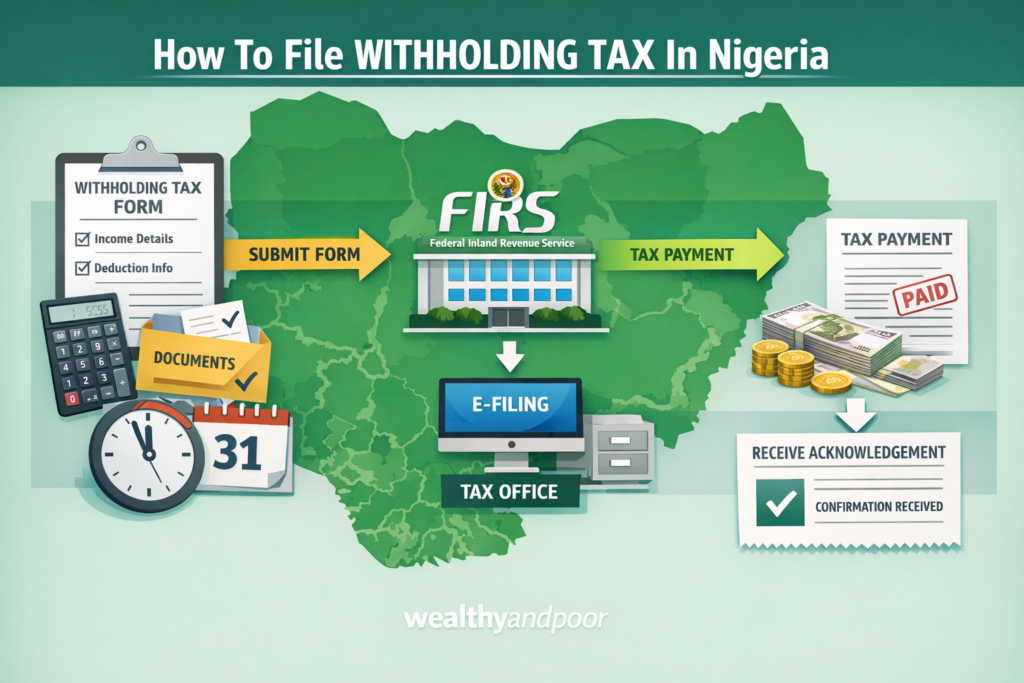

Filing Withholding Tax (WHT) in Nigeria is one of the most important compliance responsibilities for businesses, government agencies, and even some individuals. Yet, many taxpayers still struggle with the process especially as the Federal Inland Revenue Service (FIRS) continues to digitise tax administration through its Tax Pro- Max platform.
This article breaks down the process in a clear, practical way whether you are filing as a company, a contractor, or a freelancer.
Understanding What You Are Filing
Withholding Tax is not a separate tax it is an advance payment of income tax deducted at source from certain transactions such as contracts, rent, consultancy fees, dividends, and interest.
The responsibility to file WHT lies primarily with the payer (deductor), not the recipient. Once deducted, the tax must be remitted to the appropriate authority usually FIRS for companies or State Internal Revenue Services for individuals.
When to File Withholding Tax
Timing is critical. In Nigeria, WHT must be filed and remitted on or before the 21st day of the month following the deduction.
For example:
- WHT deducted in March → must be filed by April 21
- Failure to meet this deadline can attract penalties, interest, and compliance issues.
Step-by-Step: How to File Withholding Tax
- Register and Obtain a TIN
Before anything else, ensure your business or personal entity has a Tax Identification Number (TIN). This is mandatory for all tax filings in Nigeria and is issued upon registration with FIRS. - Deduct WHT at Source
When making payments for qualifying transactions (e.g., contracts or services), deduct the appropriate WHT rate before paying the vendor.
Keep records of: - Gross amount
- WHT deducted
- Net payment
This deduction is what you will later file and remit.
- Prepare Your WHT Schedule
A WHT schedule is a detailed breakdown of all deductions made within the period. It typically includes: - Names of beneficiaries
- TINs of both parties
- Nature of transaction
- Invoice details
- Applicable rate and amount deducted
Accuracy here is critical errors can delay processing or lead to penalties. - Log in to the FIRS Tax Pro- Max Portal
Most WHT filings today are done electronically via the Tax Pro- Max portal.
Steps include: - Log in using your TIN
- Navigate to “Withholding Tax Returns”
- Select the relevant period
- Upload your WHT schedule
Nigeria’s tax system has increasingly moved toward e-filing, making this the preferred method. - Generate Payment Reference and Pay
After completing your filing:
Generate a payment reference
Pay through approved channels (Remita, bank, or online transfer)
Always keep proof of payment this serves as evidence of compliance. - Submit and Obtain Receipt
Once payment is confirmed:
Submit your return on the portal
Download your acknowledgment receipt
This document is essential for audits and tax clearance processes. - Issue WHT Credit Notes to Beneficiaries
After remittance, the deductor must issue a WHT credit note to the beneficiary.
This document allows the recipient to: - Claim tax credit
- Offset future tax liabilities
Without this, the beneficiary cannot properly account for the tax deducted.
Filing WHT as a Recipient (Claiming Credits)
If WHT has been deducted from your income:
- Collect all credit notes
Include them when filing your annual tax return - Use them to reduce your total tax liability or request a refund
This step is often overlooked, leading to unnecessary tax overpayments.
Documents Required for Filing
To successfully file WHT, you typically need:
- TIN (for both payer and beneficiary)
WHT schedule - Invoices and contracts
- Payment evidence
- Bank records showing net payments
Having these documents organised makes the filing process smoother and faster.
Common Mistakes to Avoid
Even experienced businesses make errors when filing WHT. Some of the most common include:
- Late filing or remittance
- Incorrect WHT rates applied
- Failure to issue credit notes
- Incomplete or inaccurate schedules
Assuming WHT replaces annual tax filing
It’s important to remember that WHT is only a prepayment of tax, not a final obligation in most cases.
Manual Filing vs Digital Filing
While electronic filing via Tax Pro- Max is now standard, manual filing is still possible at tax offices. However:
Manual processes are slower
Documentation requirements are stricter
Digital filing is more efficient and traceable
For most businesses, e-filing is now the practical choice.
Why Proper Filing Matters
Filing WHT correctly is not just about compliance it also affects:
- Your ability to obtain a Tax
- Clearance Certificate (TCC)
- Your credibility in government contracts
- Your financial records and audit outcomes
- Failure to comply can result in penalties and restrict business opportunities.
Conclusion
Filing Withholding Tax in Nigeria may seem complex at first, but once the process is understood, it becomes a routine compliance task. The key is consistency deduct correctly, file on time, maintain accurate records, and always reconcile your tax position.
As Nigeria’s tax system becomes more digital and transparent, businesses that prioritise proper WHT filing will not only avoid penalties but also gain a strategic advantage in credibility and financial management.












Comments