
Is VAT Charged on Bank Transfers in Nigeria?
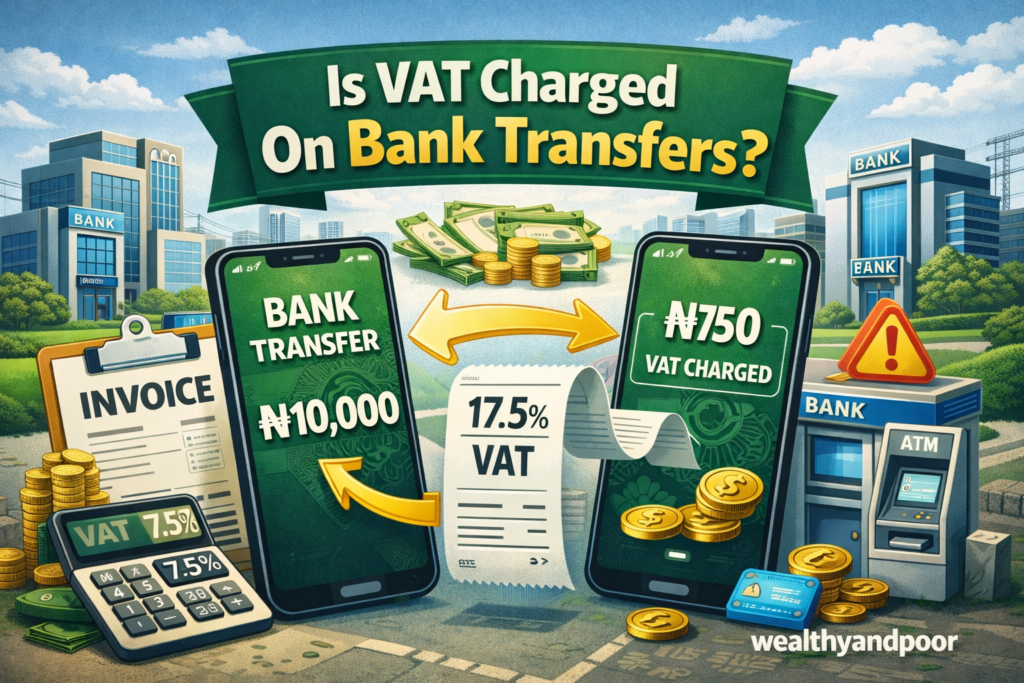

As digital banking continues to expand across Nigeria, many customers frequently notice small deductions on their bank statements and often wonder whether Value Added Tax (VAT) is charged directly on bank transfers. The answer is more nuanced than most people expect.
In reality, VAT is not charged on the money you transfer, but it can apply to certain banking services associated with the transaction. Understanding the difference between VAT, transfer fees, and government levies is essential for customers who want to better interpret the deductions appearing on their bank statements.
This article explains how VAT works in Nigerian banking transactions and whether it affects bank transfers.
Understanding VAT in Nigeria’s Banking System
Value Added Tax (VAT) is a consumption tax applied to goods and services in Nigeria. The tax is currently set at 7.5% and is regulated by the Federal Inland Revenue Service (FIRS). Financial institutions, including banks, are required to collect VAT on eligible services and remit the tax to the government.
However, it is important to understand that VAT is charged on services provided by the bank, not on the customer’s money itself.
For instance, if a bank charges a fee for a particular service such as account maintenance or SMS alerts, VAT is calculated as a percentage of that service charge.
Example:
Bank service fee: ₦1,000
VAT (7.5%): ₦75
Total deduction: ₦1,075
In this case, VAT is tied strictly to the service provided by the bank rather than the amount of money being transferred.
Are Bank Transfers Subject to VAT?
A bank transfer itself is not directly subject to VAT. If you transfer money from one account to another, the amount sent is not taxed by VAT.
However, VAT may apply to the bank’s service charge associated with the transfer. For example, if a bank charges a transfer processing fee, VAT may be added to that fee because it is considered a financial service.
This distinction explains why customers sometimes see small amounts such as ₦3.75, ₦6.98, or ₦11.25 appearing after transactions. These amounts typically represent VAT applied to service-related charges rather than the transfer itself.
Examples of services that may attract VAT include:
- Account maintenance fees
- Card issuance or card maintenance charges
- Transaction processing fees
- SMS alert services
- Teller-assisted services
- Some digital banking service charges
Because these services are optional or operational banking services, VAT becomes applicable when the bank charges a fee.
The ₦50 Transfer Deduction Is Not VAT
Another common misunderstanding among Nigerian bank customers is confusing VAT with the ₦50 deduction often seen after transfers.
This deduction is not VAT. Instead, it is a government levy known as the Electronic Money Transfer Levy (EMTL).
The levy applies when electronic transfers exceed ₦10,000 and is collected by banks on behalf of the Federal Government.
Key characteristics of the EMTL include:
- A flat charge of ₦50
Applies only to transfers above ₦10,000 - Charged once per qualifying transaction
- Collected by banks but remitted to the government
Unlike VAT, which is calculated as a percentage of a service fee, EMTL is a fixed statutory levy on electronic transfers.
Why Customers See Multiple Small Charges
Modern banking involves several digital services that generate small deductions over time. These charges can include VAT, service fees, and statutory levies.
According to financial analyses, many Nigerians regularly encounter micro-charges such as:
- ₦11.25 (VAT on certain service fees)
- ₦50 (Electronic Money Transfer Levy)
- ₦35 ATM withdrawal charge
- SMS alert fees
- Card maintenance charges
Because these deductions often appear together on bank statements, customers may mistakenly assume they are all taxes on their transfers. In reality, they originate from different regulatory or service-based charges.
When VAT May Appear After a Transfer
Customers might see VAT deductions shortly after completing a transfer in certain situations.
For example:
- SMS Transaction Alerts
Banks often charge a small fee for SMS notifications sent after each transaction. VAT is applied to the cost of the SMS service. - Transfer Processing Fees
Some banks charge a fee for electronic transfers, especially through certain channels. VAT may be applied to that fee. - Digital Banking Services
Charges for special banking services, such as token usage or specific online services, can also attract VAT.
These deductions are not taxes on the transferred money but taxes on the services supporting the transaction.
How Customers Can Reduce VAT-Related Bank Charges
While VAT itself cannot be avoided when applied to taxable services, customers can reduce the number of services that attract the tax.
Some practical strategies include:
- Use email alerts instead of SMS alerts
Email notifications are often free and do not attract SMS-related charges. - Choose low-fee banking products
Some account types have reduced service fees. - Avoid unnecessary teller transactions
Digital banking services usually have lower service charges. - Monitor bank statements regularly
Understanding each deduction helps customers manage their banking costs effectively.
These steps can help customers reduce overall transaction expenses and improve financial awareness.
Conclusion
VAT is not charged directly on bank transfers in Nigeria. Instead, the tax applies only to the banking services associated with those transactions, such as SMS alerts, account maintenance, and certain service fees.
The commonly observed ₦50 deduction after transfers is also not VAT, but rather the Electronic Money Transfer Levy imposed by the government on transfers above ₦10,000.
Understanding the difference between VAT, service charges, and statutory levies is crucial for Nigerian bank customers. As digital banking continues to grow, financial literacy about these deductions will help individuals and businesses better manage their accounts and avoid confusion over routine banking charges.












Comments