
Moniepoint Transfer Limit in Nigeria
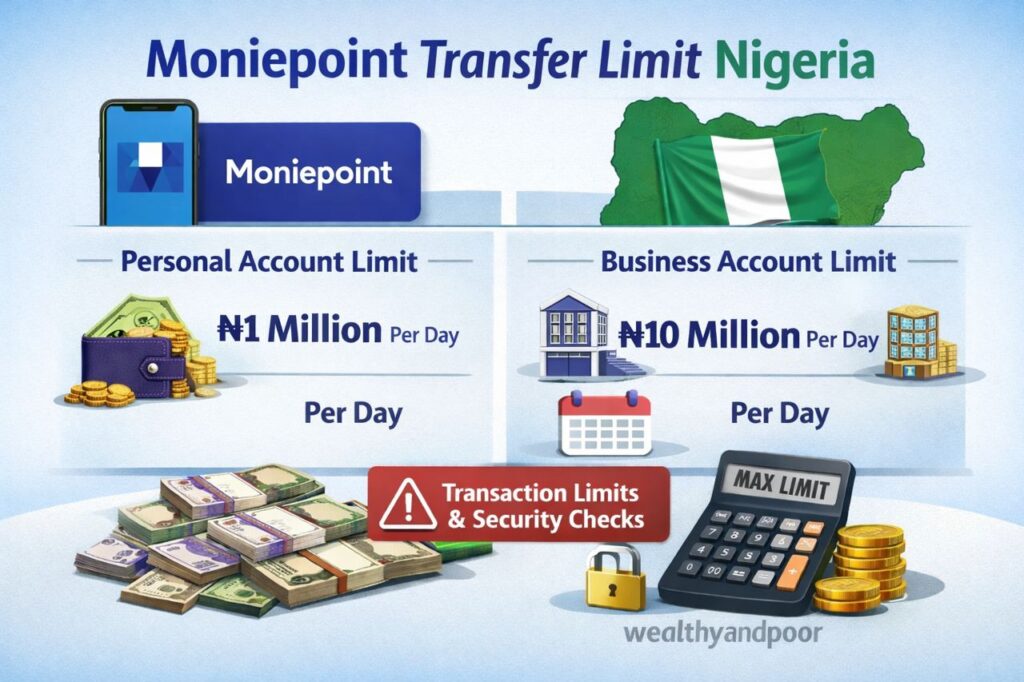

In Nigeria’s fast-evolving digital payments space, Moniepoint has emerged as one of the most widely used financial platforms for individuals and small businesses. From everyday transfers to POS transactions, the platform plays a critical role in enabling seamless money movement. However, like every regulated financial service, Moniepoint operates within clearly defined transfer limits rules that often confuse users when transactions suddenly fail.
Understanding these limits is not just a matter of convenience; it is essential for financial planning, business continuity, and avoiding disruptions at critical moments.
Why Moniepoint Sets Transfer Limits
Transfer limits on Moniepoint are not arbitrary. They are largely influenced by regulations from the Central Bank of Nigeria (CBN), which aims to promote a secure and cashless economy. These restrictions help:
- Prevent fraud and unauthorized transactions
- Reduce money laundering risks
- Encourage proper identity verification (KYC compliance)
While the CBN provides regulatory guidance, Moniepoint structures its limits based on account verification levels, commonly known as KYC (Know Your Customer) tiers.
Moniepoint Transfer Limits by Account Level
Moniepoint categorizes users into different KYC levels. Each level determines how much you can send (debit) or receive (credit) daily.
- Level 1 (Basic Account)
This is the entry-level account, typically for users who have provided minimal verification details.
- Single transfer limit: ₦50,000
- Daily transfer limit: ₦300,000
- Daily receiving limit: ₦300,000
This level is suitable for light users but can quickly become restrictive for anyone handling frequent or large transactions.
- Level 2 (Intermediate Account)
After linking key details like BVN or NIN, users are upgraded to Level 2.
- Single transfer limit: ₦100,000
- Daily transfer limit: ₦500,000
- Daily receiving limit: ₦500,000
This tier offers more flexibility and is ideal for salary earners, freelancers, and small traders.
- Level 3 (Fully Verified Account)
This is the highest level for personal accounts, requiring full KYC verification such as valid ID and proof of address.
- Single transfer limit: ₦5,000,000
- Daily transfer limit: Up to ₦25,000,000
- Receiving limit: Unlimited
At this level, users enjoy near-unrestricted transactions, making it suitable for high-value transfers and business use.
Moniepoint Business Account Limits
For merchants and business owners, Moniepoint offers even higher thresholds to support operational needs.
- Level 1–2: Same as personal accounts (₦300,000–₦500,000 daily)
- Level 3: ₦5 million per transaction, ₦25 million daily
- Level 4: ₦10 million per transaction, ₦25 million daily
- Level 5: Up to ₦100 million per transaction and ₦250 million daily
These higher limits reflect the realities of business transactions such as supplier payments, bulk transfers, and customer inflows.
Key Factors That Affect Your Transfer Limit
Several variables determine how much you can send on Moniepoint:
- KYC Verification Level
This is the most important factor. The more verified your account, the higher your limits.
- Transaction Type
Limits may differ depending on whether you are using:
- Mobile app transfers
- POS terminals
- Agent banking services
- Regulatory Policies
Changes in CBN policies can influence transaction ceilings across all financial institutions.
What Happens When You Hit Your Limit?
If you exceed your transfer limit, your transaction will typically fail with a “limit reached” notification. This can be frustrating, especially during urgent payments such as rent or business settlements.
In some cases, repeated attempts to exceed limits may temporarily restrict your account until compliance requirements are met.
How to Increase Your Moniepoint Transfer Limit
The most effective way to unlock higher limits is by upgrading your KYC level. This usually involves:
- Linking your BVN or NIN
- Uploading a valid government-issued ID
- Providing proof of address
- Completing additional verification steps
Once verified, your account is automatically upgraded, and higher transfer thresholds are applied.
Practical Tips for Managing Transfer Limits
To avoid disruptions, users should adopt a few smart strategies:
- Plan large transactions ahead: Split payments across multiple days if necessary
- Upgrade early: Don’t wait until you hit a limit before verifying your account
- Use business accounts for business needs: They offer significantly higher limits
- Monitor your daily usage: Keep track of cumulative transfers
The Bigger Picture: Limits as a Safety Net
While transfer limits may feel restrictive, they are ultimately designed to protect users and the financial system. In a country where digital banking adoption is growing rapidly, these safeguards help maintain trust and stability.
For most users, the real solution is simple: complete your verification and unlock the full potential of the platform.
Conclusion
Moniepoint transfer limits in Nigeria are structured around user verification levels, balancing accessibility with security. From ₦300,000 daily caps at entry-level accounts to ₦25 million or more for fully verified users, the platform offers flexibility for both individuals and businesses.
Understanding where your account stands and how to upgrade it can mean the difference between a smooth transaction and a frustrating delay. In today’s fast-paced financial environment, that knowledge is not just useful; it is essential.












Comments