
Savings vs Investment in Nigeria: Which Should You Prioritize First?
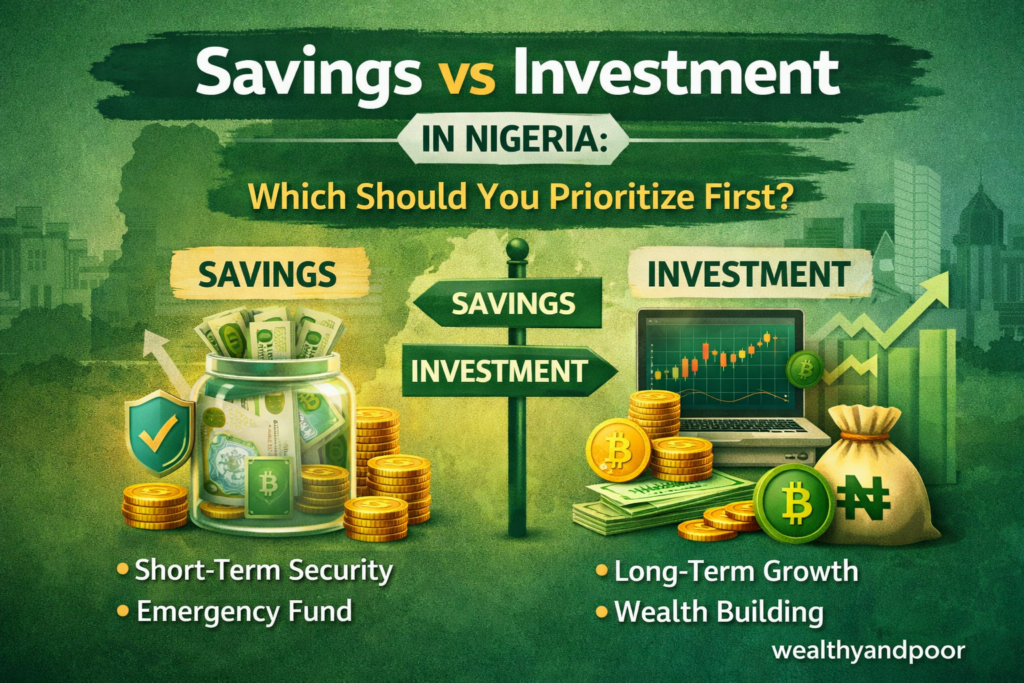

In Nigeria’s evolving financial landscape marked by inflationary pressure, currency volatility, and rising interest in digital finance the question of whether to prioritize savings or investment has become more relevant than ever. For individuals seeking financial stability or wealth creation, understanding the distinction between these two concepts is not just helpful; it is essential.
This article breaks down the differences, examines their roles within the Nigerian context, and provides a clear, practical answer to the question: which should come first?
Understanding the Basics
At its core, savings and investment serve two different financial purposes.
Savings refer to money set aside in safe, easily accessible accounts for short-term needs or emergencies. These funds are typically low-risk and offer modest returns.
Investment, on the other hand, involves committing money to assets such as stocks, bonds, real estate, or mutual funds with the expectation of generating higher returns over time.
Put simply: saving protects money; investing grows it.
The Nigerian Context: Why This Debate Matters
Nigeria presents a unique financial environment. With inflation often eroding purchasing power and limited social safety nets, individuals must take personal responsibility for their financial future.
Savings alone may not be sufficient in the long term. Low interest rates on traditional savings accounts often fail to outpace inflation, meaning money can lose value over time.
At the same time, investment opportunities ranging from treasury bills to equities and real estate offer higher returns but come with risks and require patience.
This creates a dilemma: Should Nigerians focus on protecting what they have or growing it?
Savings: The Foundation of Financial Stability
Savings play a critical role, especially in a country where unexpected expenses medical bills, job loss, or family obligations are common.
Key Benefits of Saving:
- Liquidity: Easy access to funds in emergencies
- Low risk: Minimal chance of losing money
- Financial discipline: Encourages structured money habits
Savings are particularly important for:
- Emergency funds (3–6 months of expenses)
- Short-term goals (rent, school fees, travel)
- Individuals with unstable income
Financial experts often emphasize that savings act as a safety net, ensuring you don’t fall into debt when life happens.
Investment: The Path to Wealth Creation
While savings provide security, investment is what builds wealth over time.
Key Benefits of Investing:
- Higher returns: Potential to outperform inflation
- Wealth accumulation: Long-term financial growth
- Passive income opportunities
In Nigeria, investment options have expanded significantly in recent years, including:
- Treasury bills and government bonds
- Stocks listed on the Nigerian Exchange
- Real estate and property crowdfunding
- Digital investment platforms
However, investing comes with risks. Market fluctuations, economic instability, and poor decision-making can lead to losses.
Which Should You Prioritize First?
The honest answer is not “either/or”—but “both, in the right order.”
- Start with Savings
Before investing, you need a financial cushion. Without savings:
- You may be forced to withdraw investments prematurely
- You risk falling into debt during emergencies
- You lack financial stability
As a rule of thumb, build an emergency fund covering at least 3–6 months of living expenses before considering investments.
This aligns with a widely accepted principle: you cannot invest effectively without first securing your financial base.
- Transition to Investment
Once your savings foundation is solid, the next step is to invest.
Why? Because:
- Inflation reduces the value of idle cash
- Long-term goals (retirement, wealth building) require growth
Investments help your money “work for you”
At this stage, you can allocate a portion of your income toward investment vehicles based on your risk tolerance and goals.
A Practical Strategy for Nigerians
Rather than choosing one over the other, a balanced approach works best:
- 20–30% of income: Savings (until emergency fund is complete)
- Afterward: Shift focus to investing while maintaining savings discipline
For example:
- Keep emergency funds in savings or fixed deposits
- Invest surplus income in diversified assets
- This hybrid strategy ensures both security and growth.
Common Mistakes to Avoid
- Investing without savings
This exposes you to financial shocks and unnecessary risk.
- Saving without investing
Over time, inflation erodes your money’s value.
- Ignoring risk tolerance
Not all investments are suitable for everyone.
- Short-term thinking
Investments require patience to yield meaningful returns.
Conclusion
In Nigeria’s financial reality, savings should come first but not last.
Savings provide the stability you need to survive economic uncertainty. Investment provides the growth you need to thrive.
The smartest approach is sequential:
Build a solid savings foundation
Gradually transition into investments
Maintain both simultaneously
Ultimately, financial success is not about choosing between saving and investing it is about understanding when to use each tool and how to balance them effectively.












Comments