
Common Nigerian Tax Myths Debunked
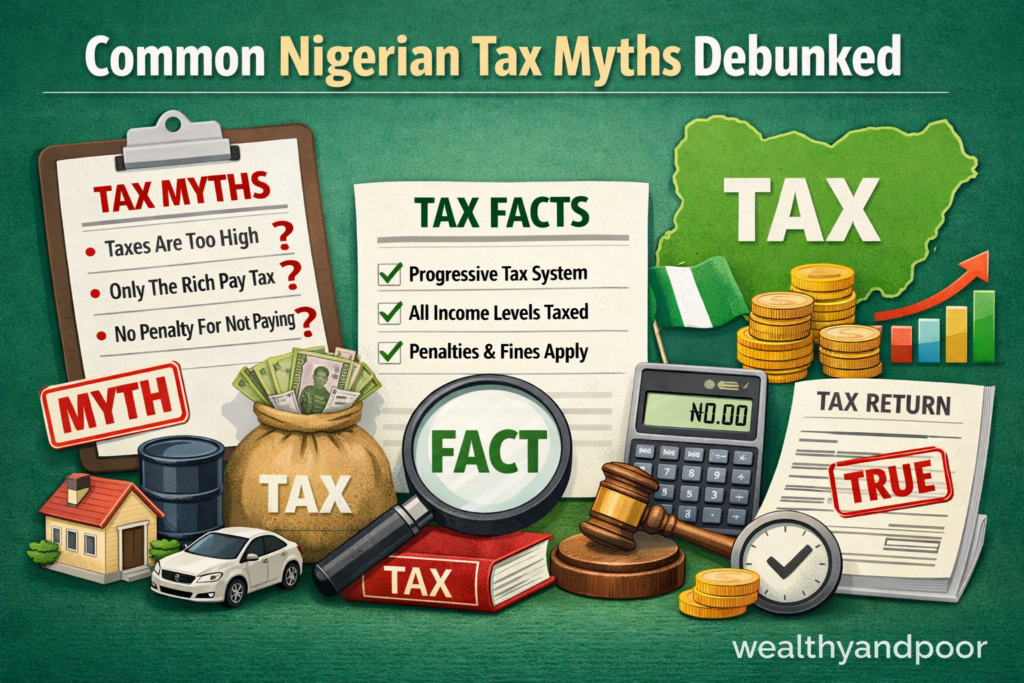

In Nigeria, conversations about taxation are often shaped more by perception than by reality. From market stalls to corporate boardrooms, deeply rooted myths continue to influence how individuals and businesses approach their tax obligations. Unfortunately, these misconceptions not only weaken compliance but also undermine national development.
This article takes a closer look at some of the most common Nigerian tax myths and separates fact from fiction.
Myth 1: “Only Salaried Workers Pay Tax”
One of the most widespread beliefs is that tax obligations apply only to individuals in formal employment particularly those on payroll under PAYE (Pay As You Earn).
Reality:
- Taxation in Nigeria extends far beyond salaried workers. Self-employed individuals, business owners, freelancers, and even informal sector operators are legally required to pay taxes.
In fact, evidence suggests that many informal workers already pay multiple levies often in fragmented and informal ways. A policy analysis shows that small traders and artisans are subject to numerous taxes and levies, sometimes disproportionately.
The real issue is not whether they pay tax, but how structured and equitable the system is.
Myth 2: “The Rich Pay Most of the Taxes”
It is commonly assumed that Nigeria’s wealthiest individuals shoulder the largest share of tax responsibility.
Reality:
- Data tells a very different story. Reports indicate that over 99% of Nigeria’s wealthiest individuals either evade or avoid taxes, leaving a disproportionately higher burden on lower and middle-income earners.
This imbalance highlights a systemic issue: tax compliance is often weaker among high-net-worth individuals than among salaried workers whose taxes are deducted at source.
Myth 3: “If Government Services Are Poor, You Don’t Need to Pay Tax”
Many Nigerians believe that poor infrastructure and public services justify tax non-compliance.
Reality:
- While concerns about governance are valid, tax payment is a legal obligation, not a conditional one. Refusing to pay taxes reduces government revenue further, creating a cycle where public services remain underfunded.
Experts argue that improving compliance especially among high earners is critical to funding infrastructure, healthcare, and education.
In simple terms: avoiding tax does not punish the government it weakens the entire system.
Myth 4: “Small Businesses Don’t Need to Pay Tax”
There is a belief among small business owners that taxes are only for large corporations.
Reality:
- All businesses operating in Nigeria regardless of size have tax obligations. While some small businesses may qualify for exemptions or reduced rates, they are still required to register, file returns, and comply with tax laws.
Failure to do so can result in penalties, fines, or even business closure.
Myth 5: “Tax Evasion Is a Smart Financial Strategy”
Some individuals see tax evasion as a clever way to preserve wealth.
Reality:
- Tax evasion is illegal and carries serious consequences, including penalties, audits, and reputational damage.
More importantly, widespread evasion contributes to inequality. When the wealthy avoid taxes, the burden shifts to ordinary citizens, deepening the gap between rich and poor.
Rather than being “smart,” tax evasion ultimately harms the broader economy.
Myth 6: “Nigeria Has One Simple Tax System”
Many assume Nigeria operates a straightforward, unified tax system.
Reality:
- Nigeria’s tax structure is complex, involving federal, state, and local government taxes. This includes personal income tax, company income tax, VAT, and numerous levies.
This complexity often creates confusion, which in turn fuels myths and non-compliance. It also opens the door for inefficiencies and uneven enforcement.
Myth 7: “If You’re Not Registered, You Don’t Owe Tax”
Some individuals believe that staying outside the tax system exempts them from liability.
Reality:
- Tax liability is based on income and economic activity not registration status.
Remaining unregistered may delay enforcement, but it does not eliminate the obligation. With increasing digital tracking and reforms, authorities are gradually improving their ability to identify and bring more taxpayers into the net.
Why These Myths Persist
Several factors contribute to the persistence of tax myths in Nigeria:
- Lack of public awareness and education
- Complex tax regulations
- Weak enforcement mechanisms
- Low trust in government institutions
These issues create an environment where misinformation thrives and compliance suffers.
The Bigger Picture: Why Debunking These Myths Matters
Nigeria’s tax-to-GDP ratio remains one of the lowest globally, limiting the government’s ability to fund essential services. At the same time, inequality continues to widen, partly because of uneven tax compliance.
Addressing tax myths is not just about correcting misinformation it is about building a fairer and more effective fiscal system. When citizens understand their obligations and trust the system, compliance improves, and the benefits become more visible.
Conclusion
Tax myths in Nigeria are more than harmless misconceptions they shape behavior in ways that affect the entire economy. From the false belief that only the rich pay taxes to the idea that evasion is acceptable, these narratives weaken compliance and deepen inequality.
The truth is simple: taxation is a shared responsibility. Debunking these myths is a crucial step toward building a system that is fair, transparent, and capable of supporting Nigeria’s long-term development.






Comments