
How to File Personal Income Tax in Nigeria
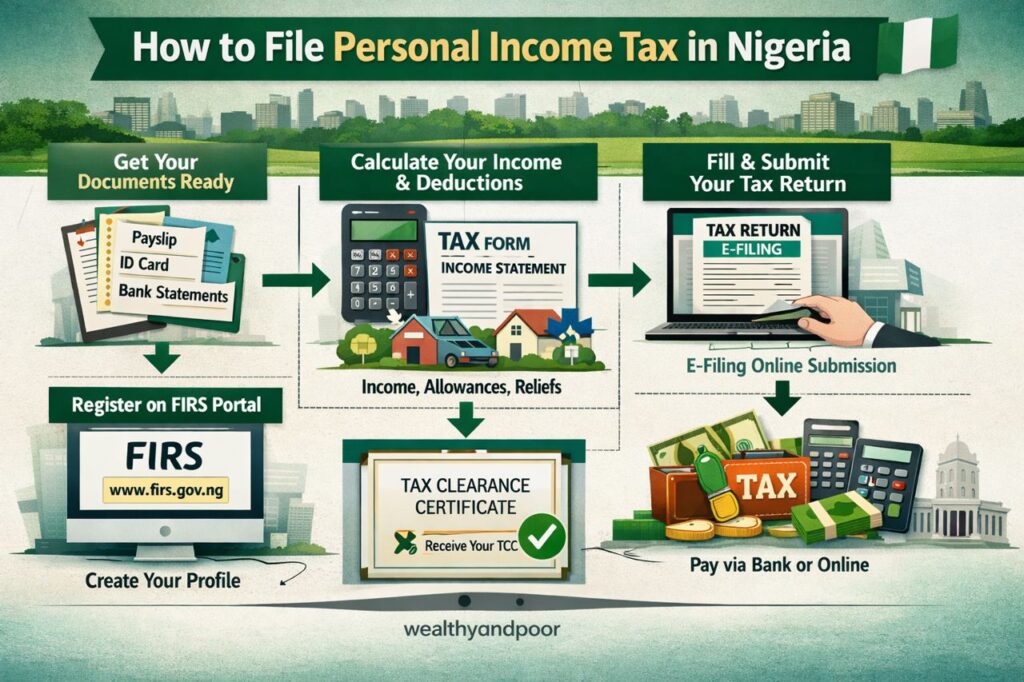

Filing Personal Income Tax (PIT) in Nigeria is one of those responsibilities many people postpone until it becomes urgent. Yet the process is not as complicated as it seems especially when you understand who to pay, what to declare, and how to file correctly.
Whether you’re a salaried employee in Lagos, a freelancer in Port Harcourt, or a business owner operating across states, this guide walks you through the essentials in a clear, practical way.
Understanding Personal Income Tax in Nigeria
Personal Income Tax in Nigeria is governed by the Personal Income Tax Act (PITA). It applies to income earned by individuals, sole proprietors, partners in partnerships, and trustees.
Under Nigeria’s tax structure, personal income tax is administered by:
- The State Internal Revenue Service (SIRS) in the state where you reside
- The Federal Inland Revenue Service (FIRS) for specific categories such as members of the armed forces, police officers, foreign service officers, and residents of the Federal Capital Territory
Who Needs to File Personal Income Tax?
You are required to file if you are:
- A salaried employee (even if your employer deducts PAYE)
- A self-employed individual
- A freelancer or consultant
- A sole proprietor
- A partner in a business partnership
- Earning rental, investment, or other taxable income
Many people assume that if their employer deducts PAYE (Pay-As-You-Earn), they don’t need to do anything else. While PAYE covers monthly deductions, individuals are still expected to ensure annual compliance and file returns.
- Determine Your Tax Residency
In Nigeria, you pay personal income tax to the state where you reside as of January 1 of the assessment year not necessarily where you work.
For example, if you live in Rivers State but work in Bayelsa, you typically file with the Rivers State Internal Revenue Service.
This matters because filing with the wrong state can delay processing or create compliance issues.
- Register with the Tax Authority (If You Haven’t)
If you’re self-employed or running a sole proprietorship, you must register with your State Internal Revenue Service to obtain a Tax Identification Number (TIN).
TIN registration can be done through:
- Your state’s tax office
Employees usually already have a TIN through their employer.
- Understand What Income Is Taxable
Under PITA, taxable income may include:
- Salary and wages
- Business profits
- Professional fees
- Rent and royalties
- Bonuses and allowances
- Investment income
Nigeria operates a progressive tax rate system, meaning the more you earn, the higher the percentage applied to portions of your income.
Current progressive rates (as provided under PITA):
- 7% on first ₦300,000
- 11% on next ₦300,000
- 15% on next ₦500,000
- 19% on next ₦500,000
- 21% on next ₦1,600,000
- 24% above ₦3,200,000
However, before applying these rates, you are entitled to reliefs and allowances.
- Apply Reliefs and Allowances
One of the most important deductions is the Consolidated Relief Allowance (CRA), which is:
- ₦200,000 or
1% of gross income (whichever is higher), plus
20% of gross income
Other allowable deductions may include:
- Pension contributions
- National Housing Fund contributions
- National Health Insurance Scheme contributions
- Life assurance premiums
These deductions significantly reduce taxable income, so accurate documentation is essential.
- Prepare Your Annual Tax Return
The annual return is a formal declaration of your income for the preceding year.
Under the law, individuals must file annual returns on or before March 31 of each year.
Your return typically includes:
- Statement of income
- Details of allowances and deductions
- Evidence of PAYE (if employed)
- Tax computation (if self-employed)
Some states allow online filing, while others may require submission at tax offices.
Example (Lagos e- Tax portal):
- Make Payment (If Applicable)
If you are self-employed or owe additional tax after PAYE deductions, you must make payment directly to your State Internal Revenue Service.
Payments can usually be made through:
- Designated banks
- Online tax portals
- Official state tax platforms
Always request and keep official receipts as proof of payment.
- Obtain Your Tax Clearance Certificate (TCC)
After filing and paying your taxes, you can apply for a Tax Clearance Certificate (TCC).
A TCC is often required for:
- Government contracts
- Visa applications
- Loan processing
- Business licensing
- Property transactions
Without proper filing, obtaining a TCC becomes difficult.
What If You Don’t File?
Failure to file personal income tax returns can lead to:
- Monetary penalties
- Interest on unpaid tax
- Legal action
- Inability to obtain a Tax Clearance Certificate
- Under PITA, failure to file annual returns may attract fines and possible prosecution.
Special Note for Freelancers and Side Hustlers
If you earn income outside your primary employment consulting, digital services, online trading that income is taxable.
Nigeria’s tax authorities are increasingly tightening compliance systems, especially with digital payments and banking records becoming easier to track.
If you’re unsure how to compute your taxes, engaging a licensed tax consultant can save you stress and penalties.
Practical Tips for Stress-Free Filing
- Keep proper records of income and expenses.
- Separate business and personal accounts.
- File early don’t wait until March 31.
- Retain receipts and payment confirmations.
- Stay updated on tax reforms.
Conclusion
Filing personal income tax in Nigeria is not just a legal obligation it’s part of responsible citizenship and financial discipline. When done properly, it protects you from penalties and opens doors to opportunities that require proof of tax compliance.
The key is understanding your obligations, maintaining proper documentation, and filing before the deadline.












Comments