
Where to Pay Personal Income Tax in Nigeria
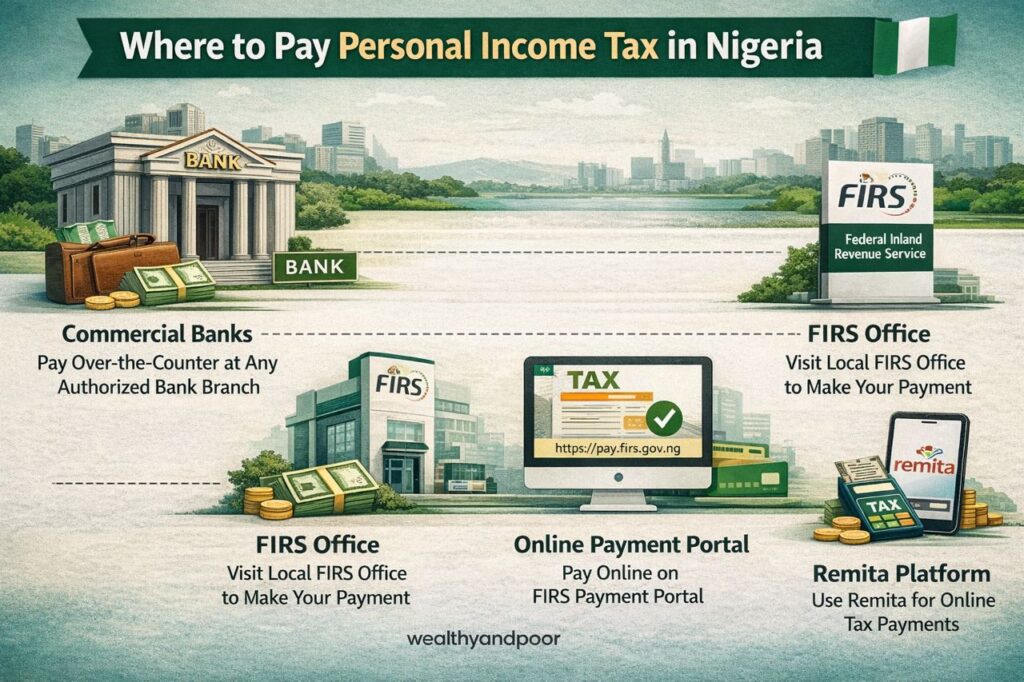

One of the most common questions Nigerians ask about taxes is simple but important: Where exactly do I pay my personal income tax?
The confusion is understandable. Nigeria operates a federal system, and tax administration is shared between federal and state authorities. If you pay to the wrong agency, you may struggle to obtain a Tax Clearance Certificate (TCC), correct tax records, or even resolve disputes later.
This article explains clearly and practically where personal income tax (PIT) should be paid in Nigeria, depending on your category and location.
Understanding Who Collects Personal Income Tax
Personal Income Tax in Nigeria is governed by the Personal Income Tax Act (PITA). Under the law, most individuals pay their tax to the State Internal Revenue Service (SIRS) of the state where they reside.
However, there are important exceptions.
Tax collection is handled by:
- State Internal Revenue Services (SIRS) – for most individuals
- Federal Inland Revenue Service (FIRS) – for specific categories of persons
Most Nigerians Pay to Their State Internal Revenue Service
If you are:
- A salaried employee (private or public sector)
- Self-employed
- A freelancer or consultant
- A sole proprietor
- A partner in a partnership
- A landlord earning rental income
You pay your personal income tax to the State Internal Revenue Service in the state where you reside as of January 1 of the assessment year.
Example
- If you live in Port Harcourt, you pay to the Rivers State Internal Revenue Service.
- If you reside in Lagos, you pay to the Lagos State Internal Revenue Service.
Each state has its own tax office and, increasingly, its own online payment platform.
Who Pays Personal Income Tax to FIRS?
Not everyone pays to the state government. Under Nigerian law, the following categories pay personal income tax to FIRS instead of a state tax authority:
- Members of the Nigerian Armed Forces
- Members of the Nigeria Police Force
- Officers of the Nigerian Foreign Service
- Residents of the Federal Capital Territory (Abuja)
- Non-resident individuals earning income in Nigeria
In these cases, payment is made directly to the Federal Inland Revenue Service (FIRS).
If you live in Abuja (FCT), your personal income tax goes to FIRS not to a state IRS.
How Employees Pay (PAYE System)
If you are employed, your tax is usually deducted monthly under the PAYE (Pay-As-You-Earn) system.
Here’s how it works:
- Your employer calculates your tax.
- The employer deducts it from your salary.
- The employer remits it to the appropriate tax authority (State IRS or FIRS, depending on your category).
You do not personally walk into a bank to pay monthly tax your employer handles remittance. However, you are still responsible for ensuring that the tax is properly filed annually.
If your employer is in Lagos and you live in Lagos, the payment goes to Lagos State Internal Revenue Service.
How Self-Employed Individuals Pay
If you are self-employed, you are responsible for:
- Registering with your State IRS
- Filing annual returns
- Paying directly to the appropriate tax authority
You can pay through:
- Designated commercial banks
- State tax offices
- Official online tax portals
For example, Lagos residents can use the LIRS eTax platform.
Many states now offer electronic payment systems to reduce physical visits.
Can You Pay Through a Bank?
Yes. Traditionally, personal income tax payments are made through designated banks using:
- Tax payment reference numbers
- Official assessment notices
- After payment, the bank issues a receipt, and the tax authority updates your records.
However, digital payment systems are becoming more common. Most state IRS platforms now support:
- Online card payments
- Bank transfers
- Direct portal remittances
Always ensure that:
- The payment is made to an official government account
- You receive a government-issued receipt
- Your Tax Identification Number (TIN) is correctly captured
What About Freelancers and Side Hustlers?
Freelancers, consultants, digital service providers, and small business owners often make a critical mistake they assume tax applies only to large companies.
If you earn income independently, you must:
- Register with your State IRS
- File annual returns
- Pay your personal income tax directly
- Your residence not where your client is located determines where you pay.
If you live in Rivers State but your client is in Lagos, you still pay to Rivers State.
How to Confirm the Correct Place to Pay
To avoid mistakes:
- Confirm your state of residence as of January 1.
- Visit your State IRS official website.
- Verify your TIN through the Joint Tax Board portal.
- Contact the tax office if unsure.
Why Paying to the Right Authority Matters
Paying to the wrong tax authority can lead to:
- Inability to obtain a Tax Clearance Certificate
- Disputes between states
- Double taxation issues
- Delays in government contracts or visa applications
A Tax Clearance Certificate is often required for:
- Government tenders
- Business licenses
- Loan applications
- Immigration processes
- Ensuring proper payment protects your financial credibility.
Conclusion
In Nigeria, where you pay personal income tax depends largely on where you reside and your employment category.
For most Nigerians, payment goes to their State Internal Revenue Service.
For special categories such as Abuja residents and members of the armed forces payment goes to the Federal Inland Revenue Service.
The process is becoming more streamlined, with online portals replacing long queues at tax offices. But accuracy remains crucial. Confirm your tax authority, use official platforms, and keep proper records of every payment.
When in doubt, consult your state tax office directly or seek professional advice. Paying correctly is not just about compliance it safeguards your reputation and keeps future opportunities open.









Comments