
Is Tax Optional in Nigeria?
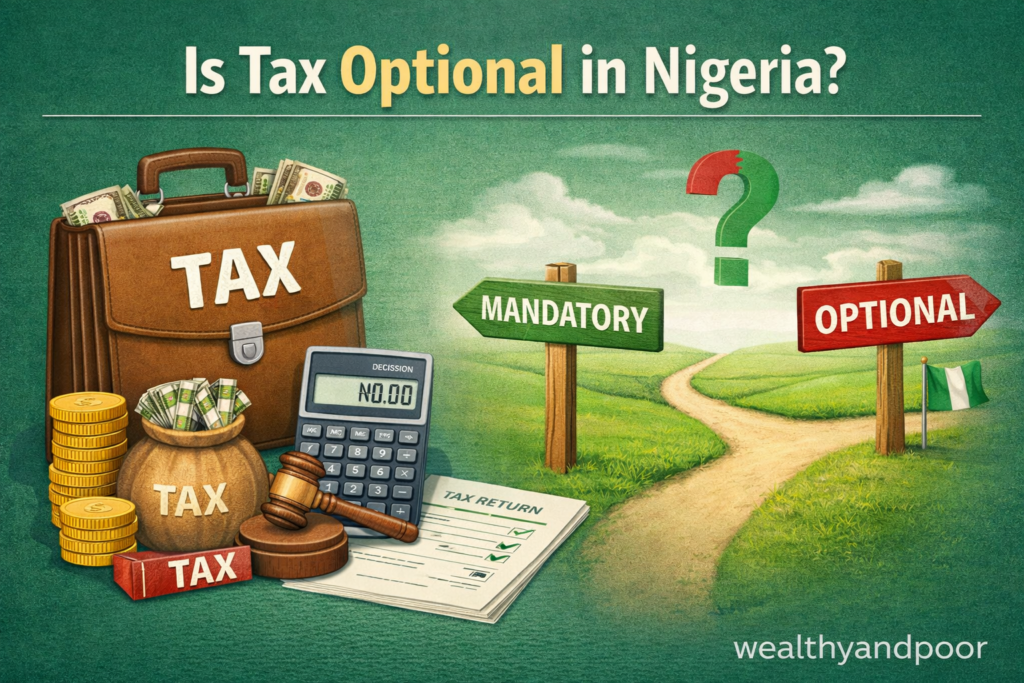

In everyday conversations across Nigeria, a familiar question often arises: “Do I really have to pay tax?” For many individuals and even small business owners, taxation can feel distant, confusing, or, in some cases, negotiable. But beneath that uncertainty lies a clear legal and economic reality tax is not optional in Nigeria.
This article breaks down the truth behind tax obligations in Nigeria, why the misconception persists, and what it means for individuals and businesses operating within the country.
The Legal Position: Tax Is Mandatory
Under Nigerian law, taxation is a statutory obligation, not a voluntary contribution. Taxes are enforced by government agencies at federal, state, and local levels. The most notable among them is the Federal Inland Revenue Service (FIRS), alongside various State Internal Revenue Services.
Whether you are a salaried worker, entrepreneur, or corporate entity, the law requires you to pay applicable taxes, including:
- Personal Income Tax (PIT)
- Company Income Tax (CIT)
- Value Added Tax (VAT)
- Withholding Tax (WHT)
Failure to comply can result in penalties, interest charges, audits, and in severe cases, prosecution.
In simple terms: you may delay tax, avoid tax, or ignore tax but legally, you cannot opt out of it.
Why Many Nigerians Think Tax Is Optional
Despite the legal clarity, the perception that tax is optional remains widespread. Several factors contribute to this belief:
- Weak Enforcement and Compliance Culture
Nigeria’s tax system struggles with enforcement, especially in the informal sector, which makes up a large portion of the economy. Many individuals operate outside formal tax structures, reinforcing the idea that tax payment is discretionary.
Reports show that tax compliance is significantly low. In fact, studies have revealed that a large proportion of high-income earners do not fully comply with tax obligations. One report even found that up to 99% of Nigeria’s wealthiest individuals evade or avoid taxes, highlighting systemic gaps in enforcement.
- Lack of Visible Public Benefits
A major psychological barrier to tax compliance in Nigeria is the perceived absence of value. Citizens often question:
- Where are the roads?
- Why is electricity unstable?
- Why are public hospitals underfunded?
When taxpayers do not see tangible returns on their contributions, compliance tends to drop. This creates a cycle where low trust leads to low revenue, which in turn affects public service delivery.
- Complexity of the Tax System
Nigeria’s tax structure can be complex and fragmented, with multiple taxes and collecting authorities. For small businesses and individuals without professional guidance, navigating the system can be overwhelming.
This complexity sometimes leads people to disengage entirely, mistaking confusion for exemption.
- Income-Based Exemptions
Another reason for the misconception is that not everyone is required to pay tax but this does not make tax optional.
Recent fiscal reforms indicate that low-income earners below certain thresholds may be exempt from paying personal income tax. For instance, individuals earning relatively low monthly income may not be taxed as part of efforts to protect vulnerable citizens.
However, this is not a choice; it is a legally defined exemption. Once your income rises above the threshold, tax obligations apply automatically.
The Economic Importance of Taxation
Tax is not just a legal requirement it is a cornerstone of national development.
Countries rely on tax revenue to fund:
- Infrastructure (roads, bridges, transport systems)
- Education and healthcare
- Security and governance
- Social welfare programs
Nigeria, however, faces a significant challenge in this regard. The country has one of the lowest tax-to-GDP ratios globally, partly due to widespread non-compliance and a narrow tax base.
This shortfall forces the government to rely heavily on borrowing and oil revenue, both of which are volatile and unsustainable in the long term.
Consequences of Treating Tax as Optional
Ignoring tax obligations can have serious implications, both for individuals and the broader economy.
For Individuals and Businesses:
- Accumulation of tax liabilities
- Penalties and fines
- Difficulty accessing loans or government contracts
- Risk of legal action
For the Economy:
- Reduced government revenue
- Poor infrastructure development
- Increased national debt
- Widening inequality
When taxes are not paid, the burden often shifts disproportionately to compliant citizens, especially low- and middle-income earners.
Changing the Narrative: From Obligation to Responsibility
While enforcement is important, sustainable tax compliance depends on changing public perception.
Tax should not be viewed merely as a government demand but as a civic responsibility tied to national development. At the same time, the government must improve transparency, accountability, and service delivery to rebuild trust.
Encouragingly, ongoing tax reforms aim to simplify the system, expand the tax net, and ensure fairness particularly by targeting high-income earners who have historically avoided taxation.
Conclusion
So, is tax optional in Nigeria?
The answer is no. Tax is a legal obligation backed by law, even though enforcement gaps and systemic challenges have created the illusion of choice.
The real issue is not whether Nigerians are required to pay tax but whether the system is fair, efficient, and trustworthy enough to encourage compliance.
As reforms continue and awareness grows, the future of taxation in Nigeria will depend on a delicate balance: stronger enforcement on one hand, and improved governance on the other.
Until then, one thing remains clear tax is not optional; compliance is inevitable.







Comments