
Penalty for Not Paying Withholding Tax
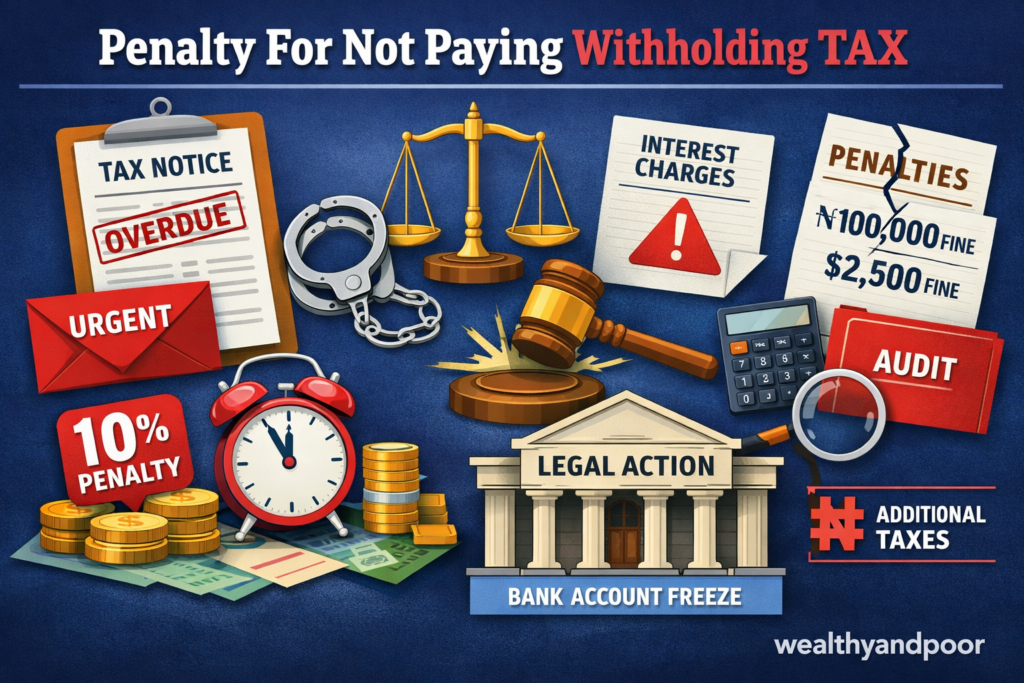

Withholding Tax (WHT) remains one of the most effective tools used by Nigerian tax authorities to ensure early and consistent tax collection. It is not a separate tax, but rather an advance payment deducted at source from qualifying transactions. However, failure to deduct, remit, or file WHT appropriately attracts a range of penalties that can significantly increase a company’s financial exposure.
For businesses operating in Nigeria especially Smes and contractors understanding these penalties is not just about compliance; it is about protecting cash flow, reputation, and long-term viability.
Understanding the Nature of Default
Before examining penalties, it is important to distinguish the three major forms of WHT non-compliance:
- Failure to deduct WHT at source
- Failure to remit deducted WHT
- Late filing or non-filing of WHT returns
Each of these offences carries different financial and legal consequences under Nigerian tax laws and regulations.
- Failure to Deduct Withholding Tax
Where a company or individual fails to deduct WHT from a qualifying transaction, the law treats the payer as liable for that tax.
- A 10% penalty on the amount not deducted is commonly applied
- Interest is also charged at the prevailing Central Bank of Nigeria (CBN) rate
In some cases, the expense related to the transaction may be disallowed for tax purposes, increasing overall tax liability
More severe interpretations by some state tax authorities go further:
- Penalties may reach up to 200% of the tax not withheld
This variation reflects differences in enforcement across jurisdictions, but the message is clear: non-deduction is treated as a serious compliance failure.
- Failure to Remit Withheld Tax
This is considered a more serious offence because the taxpayer has already deducted money that belongs to the government.
Penalties typically include:
- Payment of the full amount deducted but not remitted
- A 10% penalty on the unpaid amount
- Additional interest at the CBN monetary policy rate
In stricter enforcement scenarios:
- Fines may rise to 200% of the withheld but unremitted tax
- There may be legal consequences, including potential prosecution in extreme cases
The law treats unremitted WHT almost like misappropriation of public funds.
- Late Payment of Withholding Tax
WHT must typically be remitted by the 21st day of the following month after deduction. Failure to meet this deadline triggers:
- A 10% penalty on the outstanding amount
- Accrued interest until full payment is made
Over time, these charges compound, especially for businesses that delay compliance for several months.
- Late Filing of WHT Returns
Even if the tax is deducted and remitted, failure to file returns properly can attract penalties:
- ₦25,000 for the first month of default
- ₦5,000 for each subsequent month
This highlights that compliance is not only about payment but also proper documentation and reporting.
Administrative and Extended Penalties
Beyond the basic fines, Nigerian tax laws impose additional consequences:
- Administrative penalties for non-compliance
- Interest accumulation that increases total liability over time
- Tax disallowance, meaning certain expenses cannot be claimed
- Increased audit scrutiny from tax authorities
Under newer tax frameworks, penalties may also include:
- Fixed fines (e.g., hundreds of thousands of naira)
- Additional percentage penalties on unpaid tax
- Possible criminal liability, including fines or imprisonment in extreme cases
Legal and Operational Consequences
Failure to comply with WHT obligations goes beyond financial penalties. Businesses may also face:
- Reputational damage, especially with regulators and partners
- Difficulty obtaining tax clearance certificates, which are required for contracts and loans
- Contract disqualification, particularly for government or corporate bids
- Regulatory enforcement actions, including audits and recovery proceedings
Tax authorities in Nigeria are increasingly leveraging digital platforms and data matching systems, making it harder for businesses to evade detection.
Why Compliance Matters More Than Ever
Recent reforms in Nigeria’s tax system have placed greater emphasis on enforcement and transparency. The Federal Inland Revenue Service (FIRS) and State Internal Revenue Services are adopting stricter compliance measures, supported by technology and expanded reporting requirements.
For businesses, this means:
- Less room for error
- Faster detection of defaults
- Higher cumulative penalties over time
In essence, non-compliance is no longer a short-term cash flow strategy it is a costly risk.
Practical Steps to Avoid Penalties
To stay compliant and avoid penalties, businesses should:
- Deduct WHT correctly at the point of payment
- Remit promptly before the monthly deadline
- File accurate returns with complete documentation
- Maintain proper records, including invoices and tax credit notes
- Use digital tax platforms like Tax Pro- Max for timely submissions
Engaging a tax professional or consultant can also help ensure compliance, especially for companies handling multiple transactions.
Conclusion
The penalties for not paying withholding tax in Nigeria are both significant and multifaceted. From a basic 10% surcharge and interest to potential fines of up to 200% and legal consequences, the cost of non-compliance can quickly escalate beyond the original tax liability.
For businesses, the takeaway is simple: withholding tax is not optional. It is a statutory obligation backed by strict enforcement. Staying compliant is not just about avoiding penalties it is about maintaining financial discipline and credibility in an increasingly regulated business environment.












Comments