
Simple Tax Checklist for Nigerians
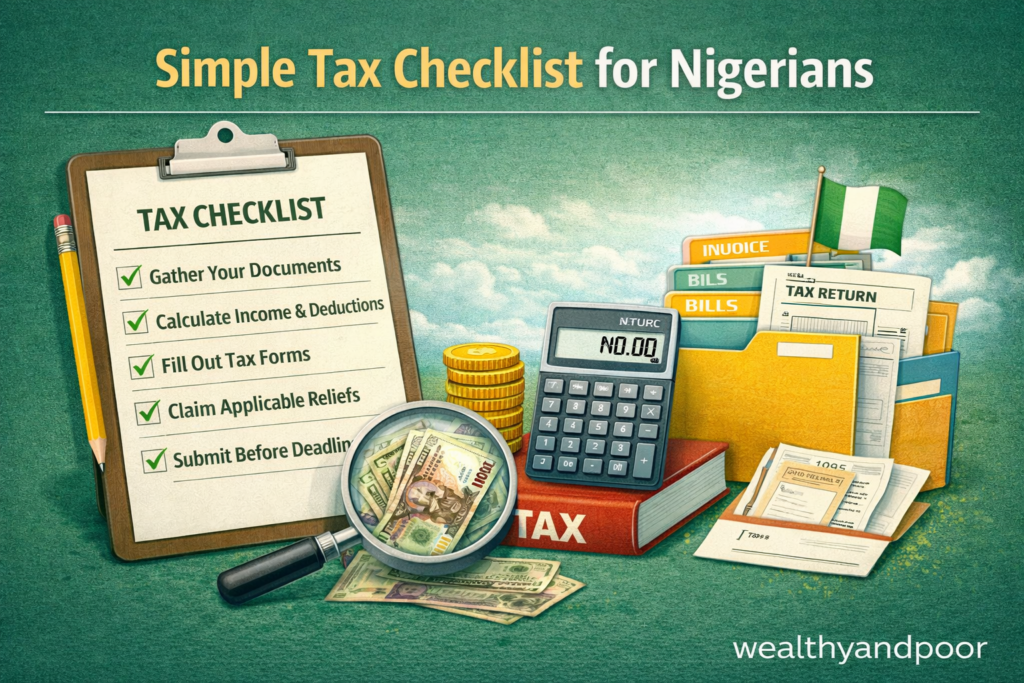

In a country where tax compliance remains uneven and often misunderstood, having a clear, practical checklist can make all the difference. Recent reports suggest that a significant portion of high-income earners either avoid or underpay taxes, contributing to Nigeria’s low tax-to-GDP ratio and widening inequality.
Yet for everyday Nigerians salary earners, entrepreneurs, and small business owners staying tax-compliant is less about complexity and more about awareness and consistency. This guide provides a simple, structured checklist to help individuals and businesses meet their obligations without unnecessary stress.
- Confirm Your Tax Status
The first step is understanding whether you are a taxable individual under Nigerian law.
You are required to pay tax if you:
- Earn income from employment, business, or investments
- Operate a registered or unregistered business
- Receive rental income or other passive income
Even informal sector participants traders, freelancers, artisans are expected to pay personal income tax under state tax authorities.
- Register with the Appropriate Tax Authority
Before paying any tax, you must be properly registered.
Employees are usually registered through their employer under the PAYE (Pay-As-You-Earn) system
Self-employed individuals must register with their State Internal Revenue Service
Businesses must register with the Corporate Affairs Commission (CAC) and the Federal Inland Revenue Service (FIRS)
Without registration, tax payments may not be properly recorded, and you could face penalties later.
- Get Your Tax Identification Number (TIN)
A Tax Identification Number (TIN) is essential for all taxpayers in Nigeria. It is required for:
- Opening certain bank accounts
- Filing tax returns
- Applying for government contracts
Most registered businesses receive a TIN automatically, while individuals can obtain one through tax offices or online platforms.
- Understand Your Tax Type
Not all taxpayers pay the same kind of tax. Knowing your category helps you avoid errors.
Common tax types include:
- Personal Income Tax (PIT) – for individuals
- Company Income Tax (CIT) – for registered businesses
- Value Added Tax (VAT) – for goods and services
- Withholding Tax (WHT) – deducted at source
Understanding which applies to you ensures you don’t overpay or worse, underpay.
- Keep Accurate Financial Records
Poor record-keeping is one of the biggest reasons Nigerians fall into tax trouble.
Maintain:
- Income records (salary, business revenue, side income)
- Expense receipts
- Bank statements
- Invoices and contracts
Good records not only simplify tax filing but also protect you during audits.
- File Your Tax Returns Annually
Filing returns is just as important as paying taxes.
Individuals must file annual tax returns, even if tax is deducted at source
Businesses must file audited financial statements and tax returns yearly
Late filing can attract penalties even if no tax is owed.
- Pay the Right Amount of Tax
Tax rates in Nigeria are progressive, meaning higher income attracts higher rates.
Recent policy discussions have also emphasized protecting low-income earners while ensuring fairness across income groups.
To avoid issues:
- Calculate your tax correctly
- Use approved channels for payment
- Keep payment receipts
- Claim Available Reliefs and Allowances
Many Nigerians overpay taxes simply because they are unaware of deductions.
You may be eligible for:
- Consolidated relief allowance
- Pension contributions
- National Housing Fund contributions
- Life insurance premiums
These can significantly reduce your tax burden legally.
- Monitor Tax Communications
Do not ignore messages or letters from tax authorities.
Whether it’s from FIRS or your state revenue service, always:
- Open and read correspondence
- Respond promptly
- Seek clarification if needed
Ignoring tax notices can escalate into penalties or enforcement actions.
- Obtain Your Tax Clearance Certificate (TCC)
A Tax Clearance Certificate is proof that you are up to date with your taxes. It is often required for:
- Government contracts
- Loan applications
- Immigration processes
Ensure your records are accurate so you can obtain your TCC without delays.
- Use Professionals When Necessary
If your finances are complex especially for business owners it may be wise to consult:
- Accountants
- Tax consultants
- Financial advisors
Professional guidance can save money and prevent costly mistakes.
- Stay Updated on Tax Changes
Nigeria’s tax system is evolving, with ongoing reforms aimed at improving fairness and compliance.
For instance, new policies are being introduced to expand the tax base while reducing the burden on low-income earners.
Staying informed helps you adapt quickly and remain compliant.
Why This Checklist Matters
Nigeria faces a persistent challenge with tax compliance, particularly among high earners, which limits government revenue and public investment.
For the average Nigerian, however, the issue is less about evasion and more about navigating a system that can seem complex. A simple checklist like this transforms tax compliance from a stressful obligation into a manageable routine.
Conclusion
Tax compliance in Nigeria does not have to be overwhelming. With the right knowledge, proper documentation, and a proactive approach, individuals and businesses can meet their obligations smoothly.
More importantly, consistent compliance contributes to national development funding infrastructure, education, and public services that benefit everyone.







Comments