
Small Company Tax Rate in Nigeria
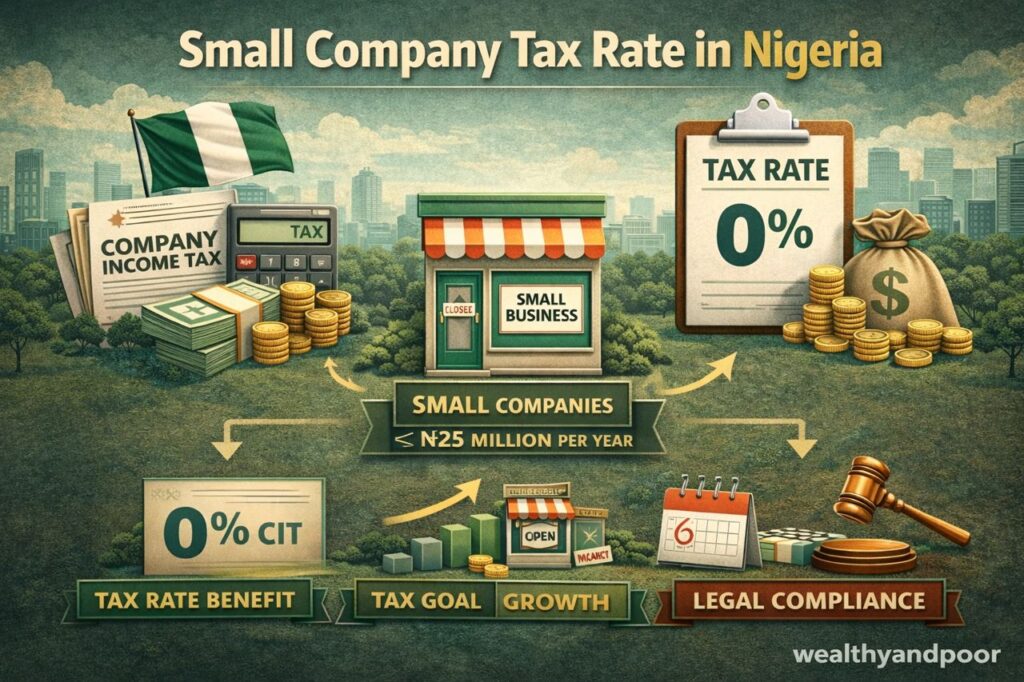

Nigeria’s tax system is structured to support the growth of small businesses by offering preferential tax rates and exemptions. In recent years, the Federal Government has implemented reforms aimed at reducing the tax burden on small companies while encouraging compliance and business expansion. Understanding how the small company tax rate works is essential for entrepreneurs, startups, and small and medium-sized enterprises (SMEs) operating in Nigeria.
This article explains the current small company tax rate in Nigeria, the criteria that define a small company, the tax obligations that still apply despite exemptions, and the broader implications for business growth.
Understanding Company Income Tax in Nigeria
Company Income Tax (CIT) is a major tax imposed on the profits of companies operating in Nigeria. It is governed primarily by the Companies Income Tax Act (CITA) and administered by the Federal Inland Revenue Service (FIRS).
The tax is charged on a company’s taxable profits, which are calculated after deducting allowable business expenses from total revenue. In simple terms, businesses are taxed on profit rather than total income.
Nigeria uses a tiered company income tax system, meaning the tax rate depends on the company’s annual turnover. This structure is designed to ensure that smaller businesses face lower tax burdens compared to large corporations.
Definition of a Small Company in Nigeria
Under Nigeria’s current tax framework, a small company is defined primarily by its annual gross turnover.
Generally, a company is classified as a small company if its annual turnover does not exceed ₦25 million. Businesses within this category benefit from significant tax incentives.
However, more recent reforms and policy proposals have broadened the threshold in some tax interpretations to include companies with turnover up to ₦100 million, particularly when considering exemptions from certain additional levies.
Regardless of the threshold used in specific tax provisions, the core objective of the policy remains the same: reduce the financial burden on small businesses and encourage entrepreneurship.
Small Company Tax Rate in Nigeria
The company income tax system in Nigeria is divided into three categories:
- Company Category
- Annual Turnover
- CIT Rate
Small companies therefore enjoy a 0% Company Income Tax rate, meaning they are exempt from paying tax on their profits.
This policy was introduced as part of broader reforms aimed at improving Nigeria’s ease of doing business and supporting the development of startups and SMEs.
Why Nigeria Offers Zero Tax to Small Companies
Small businesses play a crucial role in Nigeria’s economy. According to various economic studies, SMEs account for the majority of businesses in the country and contribute significantly to employment generation and economic development.
The zero-tax policy for small companies serves several key purposes:
- Encouraging Entrepreneurship
By eliminating corporate income tax for small businesses, the government reduces the financial pressure on startups and early-stage companies. This allows entrepreneurs to reinvest profits into business expansion.
- Supporting Business Growth
Young businesses often struggle with cash flow and operating costs. A tax exemption helps them stabilize and scale before entering higher tax brackets.
- Improving Tax Compliance
When taxes are more manageable, businesses are more likely to register formally and comply with tax regulations.
Tax Obligations That Still Apply to Small Companies
Although small companies enjoy a 0% company income tax rate, this does not mean they are entirely exempt from the Nigerian tax system. They still have several obligations.
Filing Annual Tax Returns
Small companies must still file annual tax returns with the Federal Inland Revenue Service, even if they are not required to pay company income tax. Failure to file can lead to penalties.
Value Added Tax (VAT)
Businesses that supply taxable goods or services must charge and remit Value Added Tax (VAT), which is currently 7.5% in Nigeria.
Pay-As-You-Earn (PAYE)
Companies that employ staff must deduct and remit PAYE tax from employees’ salaries to the relevant state tax authority.
Withholding Tax (WHT)
Small businesses may also be required to deduct withholding tax when making certain payments such as contractor fees or consultancy services.
Additional Tax Reliefs for Small Companies
Recent tax reform proposals in Nigeria have introduced additional incentives for small businesses.
For instance, some reforms provide exemptions from:
- Capital Gains Tax (CGT)
Development levies introduced to replace certain existing taxes
These exemptions are aimed at simplifying the tax environment and reducing the number of taxes small businesses must deal with.
Importance of Proper Record Keeping
Even though small companies are exempt from company income tax, maintaining proper financial records remains critical.
Accurate bookkeeping helps businesses:
- Prove eligibility for small-company tax status
- Calculate profits correctly
- Avoid disputes with tax authorities
- Prepare for future tax obligations as the company grows
Without proper documentation, tax authorities may estimate profits or impose penalties.
When a Small Company Starts Paying Tax
A small company will move into the medium company tax bracket once its annual turnover exceeds ₦25 million.
At this stage, the company becomes liable for 20% company income tax on its taxable profits. If the turnover eventually exceeds ₦100 million, the company will fall into the large company category and pay 30% CIT.
For growing businesses, this transition is often a sign of financial progress, but it also requires stronger financial planning and tax management.
Conclusion
Nigeria’s small company tax rate is one of the most business-friendly aspects of the country’s tax system. By granting a 0% company income tax rate to small companies, the government provides startups and SMEs with the financial breathing room needed to grow and compete.
However, the exemption does not eliminate all tax responsibilities. Small companies must still file annual tax returns and comply with other obligations such as VAT, PAYE, and withholding tax where applicable.
For entrepreneurs and business owners, understanding these tax rules is essential for maintaining compliance and making informed financial decisions. As Nigeria continues to reform its tax system to encourage investment and business growth, small companies remain a key focus of policy support.











Comments