
Does Everyone Pay VAT in Nigeria?
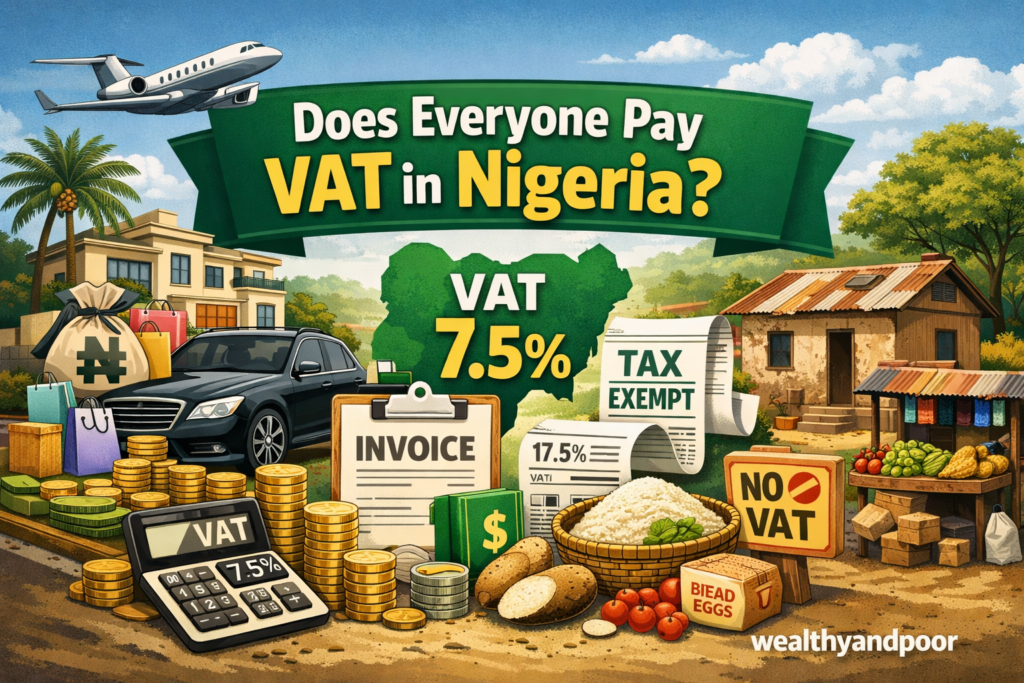

Value Added Tax (VAT) remains one of the most important non-oil revenue sources for Nigeria, contributing trillions of naira annually to the federal, state, and local governments. Yet, despite its widespread presence in everyday transactions, many Nigerians still ask a common question: does everyone actually pay VAT in Nigeria?
The short answer is no not everyone pays VAT directly, and not every transaction attracts VAT. Nigeria’s VAT system is designed as a consumption tax, meaning it is charged on specific goods and services rather than on individuals themselves. Understanding how VAT works helps explain why some Nigerians encounter VAT frequently in bank statements, purchases, or digital services, while others may rarely notice it.
Understanding VAT in Nigeria
VAT is a consumption tax imposed on goods and services at each stage of production and distribution. In Nigeria, the VAT rate currently stands at 7.5%, following an increase from 5% under the Finance Act of 2019. Businesses charge VAT on eligible goods and services and remit the collected tax to the government through the Federal Inland Revenue Service (FIRS).
Importantly, businesses do not bear the cost of VAT themselves. Instead, they serve as collection agents for the government, passing the tax to the final consumer who purchases the goods or services.
For example, if a service costs ₦1,000, VAT of ₦75 may be added, bringing the total cost to ₦1,075. The seller then remits the ₦75 VAT to the tax authorities.
Who Actually Pays VAT?
In practice, the final consumer pays VAT, even though businesses collect and remit it. This means anyone who buys taxable goods or services in Nigeria is indirectly paying VAT.
Consumers commonly encounter VAT in several areas:
- Banking service charges
- Telecommunications services
- Online subscriptions
- Professional services
- Retail purchases of taxable goods
For instance, banks may apply VAT on service fees such as card maintenance, SMS alerts, or transaction charges. These deductions appear in account statements because the bank is legally required to collect the tax on qualifying services.
Similarly, digital platforms, streaming services, and software subscriptions now fall under Nigeria’s VAT framework as the government expands taxation to the growing digital economy.
Why Not Everyone Pays VAT
Despite its broad application, VAT does not apply to every product, service, or individual in Nigeria. Several exemptions exist under Nigerian tax laws to protect essential consumption and reduce the burden on lower-income households.
- Exempt Goods and Services
Certain essential goods and services are exempt from VAT to keep basic living costs affordable. These often include:
- Basic food items
- Educational services
- Medical and pharmaceutical products
- Residential rent
- Public transportation services
Because these goods are exempt, consumers purchasing them do not pay VAT.
- Small Business Exemptions
Small businesses with annual turnover below ₦25 million are generally exempt from charging VAT under Nigeria’s tax laws.
This means that while these businesses may still pay VAT when buying goods or services themselves, they are not required to charge VAT to their customers or remit it to the government.
The exemption was introduced to encourage entrepreneurship and reduce administrative burdens for small enterprises.
- Informal Sector Activities
Nigeria’s informal sector accounts for a significant portion of economic activity. Many micro-businesses operate outside the formal tax system, meaning VAT collection may not occur consistently in those transactions.
However, when these businesses purchase goods from VAT-registered suppliers, VAT may still be embedded in the cost.
VAT in the Digital Economy
Nigeria has recently expanded VAT coverage to digital transactions as part of efforts to boost revenue and modernize the tax system.
Under new rules, both local and foreign digital service providers must register for VAT and remit taxes on services used by Nigerians, including online subscriptions and software services.
This expansion reflects the rapid growth of Nigeria’s digital economy. In fact, a notable share of VAT revenue now comes from foreign digital platforms serving Nigerian users.
VAT and Government Revenue
VAT plays a crucial role in funding government spending across the country. Revenues collected are shared among the federal, state, and local governments through the Federation Account Allocation Committee (FAAC).
Recent data shows that VAT allocations distributed to the three tiers of government reached about ₦7.73 trillion in 2025, highlighting the tax’s growing importance to Nigeria’s fiscal stability.
The funds support infrastructure development, public services, and government operations across the country.
Common Misconceptions About VAT
- “Everyone pays VAT on their money”
This is incorrect. VAT is not charged on income or savings. It applies only when taxable goods or services are purchased.
- “Banks are taking VAT from customer balances”
Banks only apply VAT to service charges, not to deposits or transfers themselves.
- “VAT is the same as stamp duty”
VAT is a percentage tax on services, while stamp duty or electronic transfer levies are flat charges applied to certain bank transfers.
Conclusion
Not everyone pays VAT directly in Nigeria, but most consumers encounter it indirectly through purchases of taxable goods and services. The system ensures that businesses act as tax collectors while the final consumer bears the cost.
At the same time, exemptions for essential goods, small businesses, and certain services mean that VAT is not universally applied across the economy.
As Nigeria continues to diversify its revenue sources away from oil, VAT is expected to remain a cornerstone of the country’s fiscal framework particularly as authorities expand coverage to the digital economy and improve tax collection systems.










Comments