
What Is Tax Clearance Certificate in Nigeria?
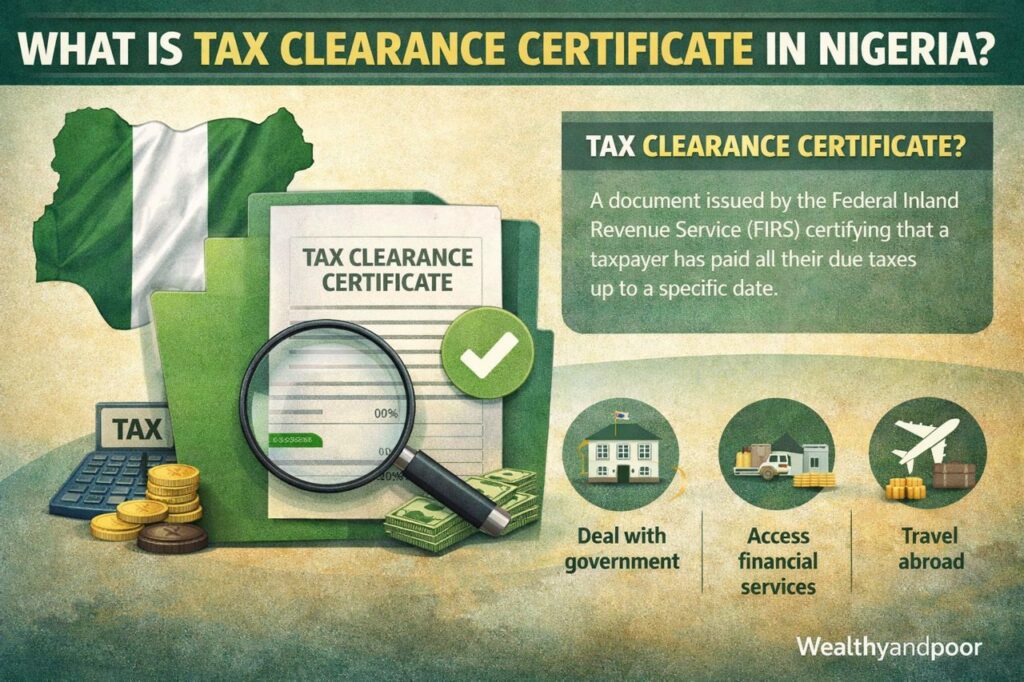

In Nigeria’s increasingly formalised financial and regulatory environment, the Tax Clearance Certificate (TCC) has evolved from a routine document into a critical proof of compliance. Whether for individuals, entrepreneurs, or corporate entities, possessing a valid TCC is often the difference between accessing opportunities and being locked out of them.
This article explains what a Tax Clearance Certificate is, why it matters, who needs it, and how it functions within Nigeria’s tax system.
Understanding the Tax Clearance Certificate (TCC)
A Tax Clearance Certificate (TCC) is an official document issued by a relevant tax authority confirming that a taxpayer individual or corporate has fully met their tax obligations for a specified period.
Typically, the certificate covers the three years preceding the year of application, and it serves as verifiable proof that taxes due on income have been properly assessed and paid.
In simple terms, a TCC answers one key question:
- “Is this person or business up to date with their taxes?”
- If the answer is yes, the certificate is issued.
Legal Basis and Regulatory Importance
The importance of the Tax Clearance Certificate in Nigeria is rooted in law, particularly under the Personal Income Tax Act (PITA). Government agencies, financial institutions, and even private organisations rely on it as a compliance requirement.
In fact, authorities in places like the Federal Capital Territory have made TCC a mandatory pre-condition for many official transactions, including business dealings, loans, and licensing.
This legal backing underscores a broader policy direction:
- Nigeria is steadily tightening its tax compliance framework, and the TCC sits at the centre of that system.
Why the Tax Clearance Certificate Matters
A Tax Clearance Certificate is far more than a piece of paper it is a gateway document. Its relevance spans multiple areas:
- Access to Government Contracts
Contractors bidding for public sector jobs are usually required to present a valid TCC. Without it, bids are often automatically disqualified.
- Banking and Financial Transactions
Banks may request a TCC when processing loans, opening certain accounts, or approving large financial transactions.
- Business Registration and Licensing
Regulatory approvals such as trade licences or permits often depend on proof of tax compliance.
- Immigration and Travel
Some embassies and foreign missions require a TCC when processing visa applications.
- Property and Asset Transactions
Activities like obtaining a certificate of occupancy or registering assets may require tax clearance evidence.
Failure to present a valid TCC can result in delays, denial of services, or outright disqualification from key opportunities.
Who Needs a Tax Clearance Certificate?
A common misconception is that only large companies or government contractors need a TCC. In reality, it applies broadly to:
- Salaried employees
- Self-employed professionals and freelancers
- Small and medium-sized business owners
- Corporate organisations
- Directors and shareholders of companies
Essentially, anyone earning taxable income in Nigeria is expected to be tax compliant and therefore eligible for a TCC.
What Does a TCC Show?
A standard Tax Clearance Certificate contains key information about the taxpayer, including:
- Name of the individual or company
- Tax Identification Number (TIN)
- Tax office that issued the certificate
- Breakdown of income and taxes paid over the last three years
- Confirmation of compliance status
This structured information makes it easy for institutions to verify authenticity and assess financial credibility.
How Tax Clearance Certificates Are Issued
TCCs are issued by the relevant tax authority, depending on the taxpayer:
- State Internal Revenue Services (IRS) for individuals and unincorporated businesses
- Federal Inland Revenue Service (FIRS) for companies
Traditionally, obtaining a TCC could take days or even weeks. However, with digital reforms such as the Tax pro Max platform, taxpayers can now request and receive their certificates much faster sometimes almost instantly once compliance is confirmed.
Is a Tax Clearance Certificate Free?
Technically, yes. The issuance of a TCC itself does not attract a statutory fee.
However, applicants often incur costs related to:
- Outstanding tax liabilities
- Penalties for late filing
- Professional or consultancy fees
In essence, while the certificate is free, compliance is not optional and that is where the real cost lies.
Validity and Renewal
A Tax Clearance Certificate is valid for one year but reflects tax compliance for the previous three years. This means taxpayers must renew it annually to maintain an up-to-date compliance status.
Failure to renew can quickly render the certificate invalid for official use.
The Shift to Electronic Tax Clearance (e- TCC)
Nigeria is increasingly moving toward digital tax administration. Many states and federal agencies now issue electronic Tax Clearance Certificates (e- TCC), often embedded with security features such as QR codes to prevent forgery.
This transition offers several benefits:
- Faster processing time
- Reduced human interference
- Improved transparency
- Easier verification
Conclusion
The Tax Clearance Certificate has become a cornerstone of financial legitimacy in Nigeria. It is no longer just a bureaucratic requirement it is a strategic asset for individuals and businesses navigating the formal economy.
In a system where compliance increasingly determines access to opportunities, the message is clear:
stay tax compliant, or risk being excluded.











Comments