
What Is VAT in Nigeria and How It Works
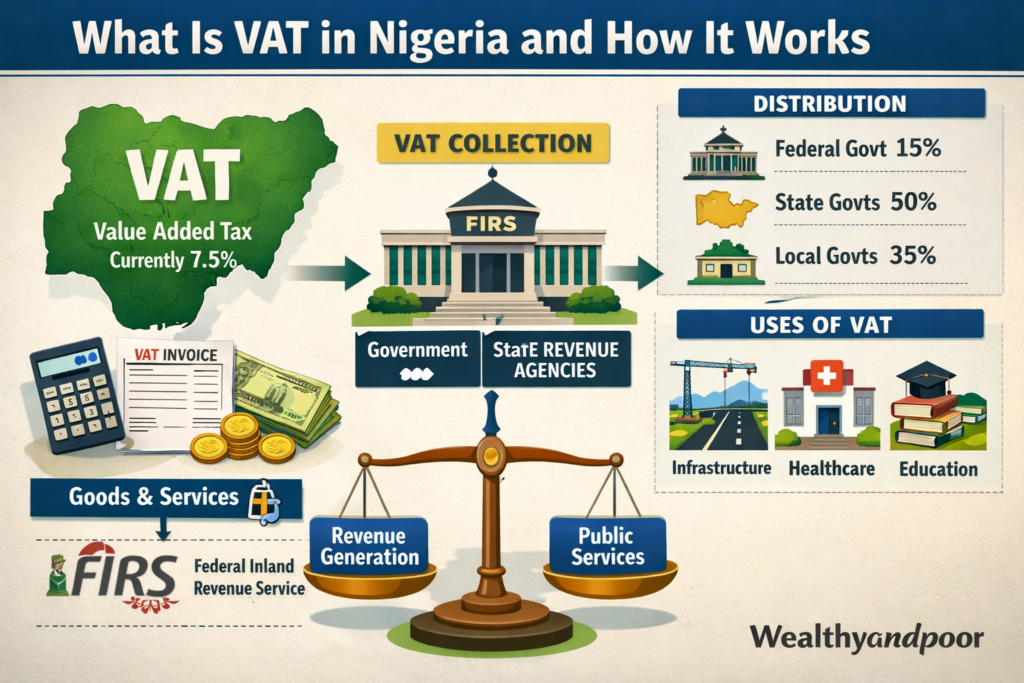

Value Added Tax (VAT) is one of the most important sources of government revenue in Nigeria. It is a consumption tax charged on goods and services at different stages of production and distribution, but ultimately borne by the final consumer. VAT plays a crucial role in financing government operations and supporting public infrastructure, especially as Nigeria seeks to reduce its dependence on oil revenue.
In recent years, VAT has become even more significant as the government expands its tax net to include digital services, online platforms, and other emerging sectors of the economy. This article explains what VAT is, how it works in Nigeria, who pays it, and why it matters for businesses and consumers.
What Is Value Added Tax (VAT)?
Value Added Tax (VAT) is a tax imposed on the value added to goods and services at each stage of the supply chain from production to final sale. In Nigeria, VAT is regulated by the Federal Government and administered by the Federal Inland Revenue Service (FIRS).
The current VAT rate in Nigeria is 7.5 percent, which applies to most taxable goods and services. Businesses collect VAT from customers when they sell products or provide services and then remit the collected tax to the government.
Unlike income tax, which is paid directly by individuals or companies based on earnings, VAT is an indirect tax. Consumers pay it whenever they purchase taxable goods or services, although the businesses selling those goods act as intermediaries responsible for collecting and remitting the tax.
Legal Framework Governing VAT in Nigeria
VAT in Nigeria is governed primarily by the Value Added Tax Act, which sets out the rules for taxation, registration, compliance, and enforcement. The law requires businesses that supply taxable goods or services to register with the tax authorities and charge VAT accordingly.
The Federal Inland Revenue Service (FIRS) is responsible for administering the tax, monitoring compliance, and ensuring businesses remit the VAT they collect from customers.
This centralized system means that VAT collected across the country is pooled together and later shared among the federal, state, and local governments through the Federation Account Allocation Committee (FAAC).
How VAT Works in Nigeria
VAT operates through a structured process involving businesses, consumers, and tax authorities. The system can be understood through the following steps:
- VAT Is Charged on Goods and Services
When a business sells goods or provides services that are subject to VAT, it adds 7.5% VAT to the price charged to the customer.
For example:
Price of a service: ₦10,000
VAT (7.5%): ₦750
Total price paid by customer: ₦10,750
The ₦750 collected represents VAT that must later be remitted to the government.
- Businesses Act as VAT Collection Agents
Businesses do not keep the VAT they collect. Instead, they act as collection agents for the government. After collecting VAT from customers, businesses must remit the tax to the Federal Inland Revenue Service.
This applies across many sectors, including:
- Retail and wholesale trade
- Professional services
- Telecommunications
- Financial services
- Digital platforms and subscriptions
- VAT Is Charged Throughout the Supply Chain
One key feature of VAT is that it applies at multiple stages of production and distribution.
For example:
- Manufacturer sells goods to distributor and charges VAT.
- Distributor sells to retailer and charges VAT again.
- Retailer sells to final consumer and charges VAT.
At each stage, businesses remit the VAT they collect after deducting the VAT they previously paid on purchases. This prevents double taxation and ensures that only the value added at each stage is taxed.
- Government Shares VAT Revenue
Once VAT is collected, the funds are distributed among Nigeria’s three tiers of government through FAAC.
Recent data show that VAT allocations to federal, state, and local governments rose to ₦7.73 trillion in 2025, reflecting improvements in tax collection and rising consumption across the economy.
These revenues help fund public services such as:
- Infrastructure projects
- Education
- Healthcare
- Government salaries and administration
Why You See VAT Deductions on Bank Transactions
Many Nigerians first notice VAT when they see small deductions on their bank statements. This occurs because certain banking services attract VAT.
Banks charge VAT on services such as:
- SMS alert fees
- Debit card maintenance charges
- Token services
- Transaction processing fees
For instance, if a bank charges a service fee of ₦150, the VAT on that service (7.5%) equals ₦11.25, which is why customers often see this amount deducted on their accounts.
It is important to note that VAT is not charged on the money in your account, but on the banking service provided.
VAT and the Digital Economy
Nigeria has recently expanded VAT enforcement to include digital services such as streaming platforms, software subscriptions, online marketplaces, and payment platforms.
Under the updated system, both local and foreign companies offering digital services to Nigerian consumers must register for VAT, issue VAT-inclusive invoices, and remit the tax to Nigerian authorities.
This expansion reflects the rapid growth of Nigeria’s digital economy. Data show that a significant portion of VAT revenue now comes from digital services used by Nigerians, highlighting the increasing importance of online transactions to the country’s tax base.
VAT Exemptions in Nigeria
Not all goods and services are subject to VAT. The Nigerian tax system exempts certain essential items to reduce the financial burden on low-income households.
Examples of VAT-exempt items include:
- Basic food items
- Medical services and medicines
- Educational materials
- Some agricultural products
These exemptions are designed to protect vulnerable populations and ensure that essential goods remain affordable.
Why VAT Matters for Nigeria’s Economy
VAT has become one of Nigeria’s most reliable sources of non-oil revenue. As oil revenues fluctuate, the government increasingly relies on consumption taxes like VAT to fund public spending.
Several factors explain why VAT is important:
- Revenue diversification
Nigeria’s heavy dependence on oil revenue has historically exposed the economy to global price volatility. VAT helps create a more stable and predictable revenue stream.
- Broad tax base
Because VAT applies to consumption, it captures revenue from a wide segment of the population, including businesses and consumers across different sectors.
- Economic modernization
Expanding VAT to digital services ensures the tax system keeps pace with technological and economic changes.
Conclusion
Value Added Tax (VAT) is a central pillar of Nigeria’s tax system. Charged at a rate of 7.5 percent on most goods and services, it is collected by businesses and remitted to the government to fund public services and infrastructure.
Although consumers ultimately bear the cost of VAT when purchasing goods and services, the system ensures that taxes are collected efficiently across the economy. With ongoing reforms and the expansion of VAT into the digital economy, the tax is likely to play an even greater role in Nigeria’s fiscal future.
For businesses, understanding VAT compliance is essential to avoid penalties and maintain regulatory compliance. For consumers, recognizing how VAT works helps explain why small deductions appear on bank statements or why prices often include an additional tax component.









Comments