
Who Pays Withholding Tax in Nigeria?
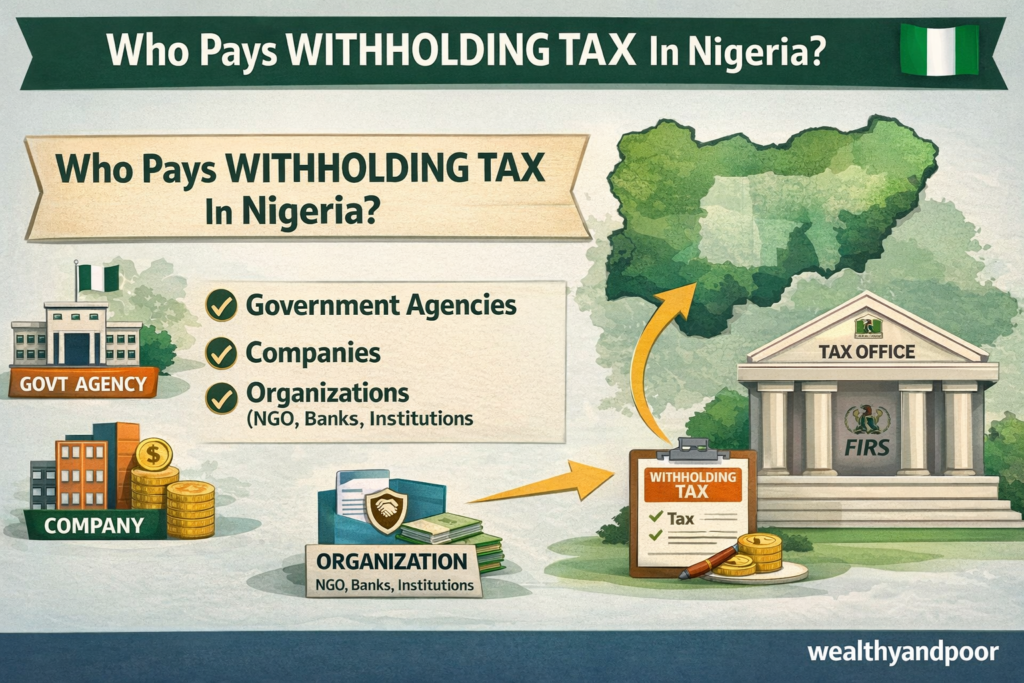

In Nigeria’s tax system, withholding tax (WHT) is often misunderstood not because it is complex, but because of how it is collected. Many taxpayers assume it is the responsibility of the person earning income to pay it. In reality, the structure is quite different. Understanding who actually pays withholding tax is essential for businesses, contractors, and even individuals navigating financial transactions in Nigeria.
This article explains, in clear terms, who bears the burden of withholding tax, who deducts it, and how the system works in practice.
Understanding the Basics of Withholding Tax
Withholding tax in Nigeria is not a standalone tax. It is an advance payment of income tax, deducted at the point where income is generated.
In simple terms, when a payment is about to be made whether for services, contracts, rent, or commissions a portion of that payment is deducted and sent directly to the tax authority. The recipient of the income can later use that deducted amount as a credit against their final tax liability.
This structure is designed to:
- Reduce tax evasion
- Ensure early collection of government revenue
- Track taxable transactions across the economy
Who Actually Pays Withholding Tax?
The answer depends on how you define “pay.”
- The Person Earning the Income (The Real Taxpayer)
The true bearer of withholding tax is the recipient of the income that is:
- Contractors
- Consultants
- Suppliers
- Landlords
- Service providers
This is because the tax is deducted from their earnings. For example, if a contractor is owed ₦1,000,000 and 5% WHT applies, ₦50,000 is deducted and remitted to the government. The contractor receives ₦950,000 but is credited with ₦50,000 already paid as tax.
So, in substance:
- The income earner pays the withholding tax.
- The Person Making Payment (The Collecting Agent)
While the recipient bears the cost, the responsibility to deduct and remit withholding tax lies with the payer.
This includes:
- Companies (large and small)
- Government ministries, departments, and agencies
- Partnerships and business entities
- Individuals making qualifying payments
Under Nigerian tax law, these payers act as agents of the government, required to:
Deduct the appropriate WHT
- Remit it to the relevant tax authority (FIRS or State IRS)
- Issue a withholding tax credit note to the recipient
- Failure to deduct or remit can attract penalties.
As one tax authority explains, any person or organization making payments for certain services must deduct withholding tax and remit it accordingly.
A Simple Illustration
Consider this scenario:
- A company hires a consultant for ₦500,000
- Applicable WHT rate: 5%
- WHT deducted: ₦25,000
What happens next?
- The consultant receives ₦475,000
- The company remits ₦25,000 to the tax authority
- The consultant uses ₦25,000 as tax credit later
This clearly shows the dual structure:
- Consultant → pays the tax (via deduction)
- Company → deducts and remits the tax
Key Principle: “Deduction at Source”
The core idea behind withholding tax is taxation at source.
Instead of waiting for taxpayers to declare income at year-end, the government collects part of the tax immediately when income is generated.
This is why:
- The payer must deduct before making payment
- The recipient cannot avoid the tax once deducted
- Special Cases and Clarifications
- Government and Large Organizations
Government bodies and large corporations are among the most active withholding agents. They are legally required to deduct WHT on most qualifying payments and remit promptly.
- Small Businesses and Exemptions
Recent regulations have introduced relief for small businesses. For example:
Some small companies may be exempt from WHT if conditions such as transaction thresholds and valid tax identification are met.
This is aimed at reducing compliance burden and encouraging small business growth.
- Non-Residents
Non-resident individuals or companies earning income from Nigeria are also subject to withholding tax. In many cases:
The tax deducted may serve as a final tax, especially on passive income like dividends or royalties.
- When Withholding Tax Becomes Final
Although WHT is generally an advance tax, there are situations where it becomes the final tax liability, meaning no further tax is required. This often applies to:
- Dividends
- Interest
- Royalties (especially for non-residents)
- Common Misconception
A frequent misunderstanding is:
- “The company paying for a service is the one paying withholding tax.”
This is not accurate.
The company is only acting as a collection agent. The tax is deducted from the income of the service provider. Economically and legally, the burden rests on the recipient.
Why This Distinction Matters
Understanding who pays withholding tax is important for several reasons:
- Cash Flow Planning
Businesses and freelancers must anticipate deductions from their earnings.
- Tax Compliance
Failure to track WHT credits can lead to overpayment of taxes.
- Contract Negotiation
Professionals often negotiate whether fees are quoted:
- “Gross” (before WHT)
- “Net” (after WHT deduction)
Conclusion
Withholding tax in Nigeria operates on a dual-responsibility system:
The income earner pays the tax (through deduction)
The payer deducts and remits the tax (as a legal obligation)
This system ensures that tax is collected efficiently and transparently, while also providing a credit mechanism for taxpayers when filing their annual returns.
For businesses and individuals alike, the key takeaway is simple:
If you are earning income, withholding tax affects your earnings. If you are making payments, you are responsible for deducting it.












Comments