
Can Tier 1 Accounts Receive Salary?

When you first open a bank account in Nigeria whether as a student finishing school, a graduate starting work, or simply someone who wants basic banking services you’ll likely be offered what is called a Tier 1 account.
These accounts are marketed as easy to open with minimal requirements, and that can be incredibly attractive. But then a common question pops up:
Can a Tier 1 account receive salary?
It seems simple, yet across social media, WhatsApp groups, and everyday conversations, opinions differ. Some people insist it works, others say it doesn’t.
This article cuts through the confusion and explains what Tier 1 accounts are, how they work, and whether they can receive salary payments especially in the Nigerian context.
By the end, you’ll understand the rules, the limits, and what’s best for your situation.
Why This Question Matters to Nigerians
In Nigeria today, many young people are entering the workforce, starting internships, or joining organisations that pay monthly salaries. At the same time, digital and mobile banking are expanding rapidly.
Tier 1 accounts also known as limited profile accounts are often the first account many Nigerians open because they require only a National Identification Number (NIN) or even just a phone number and basic ID to set up.
But when your first salary is due, you may wonder:
- Can that money go into my Tier 1 account?
- Will the employer’s payroll system accept a Tier 1 account number?
- Are there limits that could stop the salary from going in?
This isn’t just a theoretical question it affects how people get paid, plan their budgets, pay rent, or even qualify for loans later on.
What Is a Tier 1 Account?
A Tier 1 account in Nigeria is a basic bank account with limited banking features. It was introduced to increase financial inclusion making banking accessible to more Nigerians with fewer barriers.
According to guidelines interpreted from Nigerian banking practice:
- Minimum documentation is required often just your NIN and basic identification.
- Account balance and transactions are limited.
This type of account is usually called Tier 1 under a three tier classification (Tier 1, Tier 2, Tier 3).
A Tier 1 account typically has these Features;
Usually ₦300,000
- Maximum single deposit
Around ₦50,000
- Daily transaction cap
Around ₦50,000
- Documentation
Minimal (NIN, phone number)
These are general figures specific limits vary slightly from bank to bank.
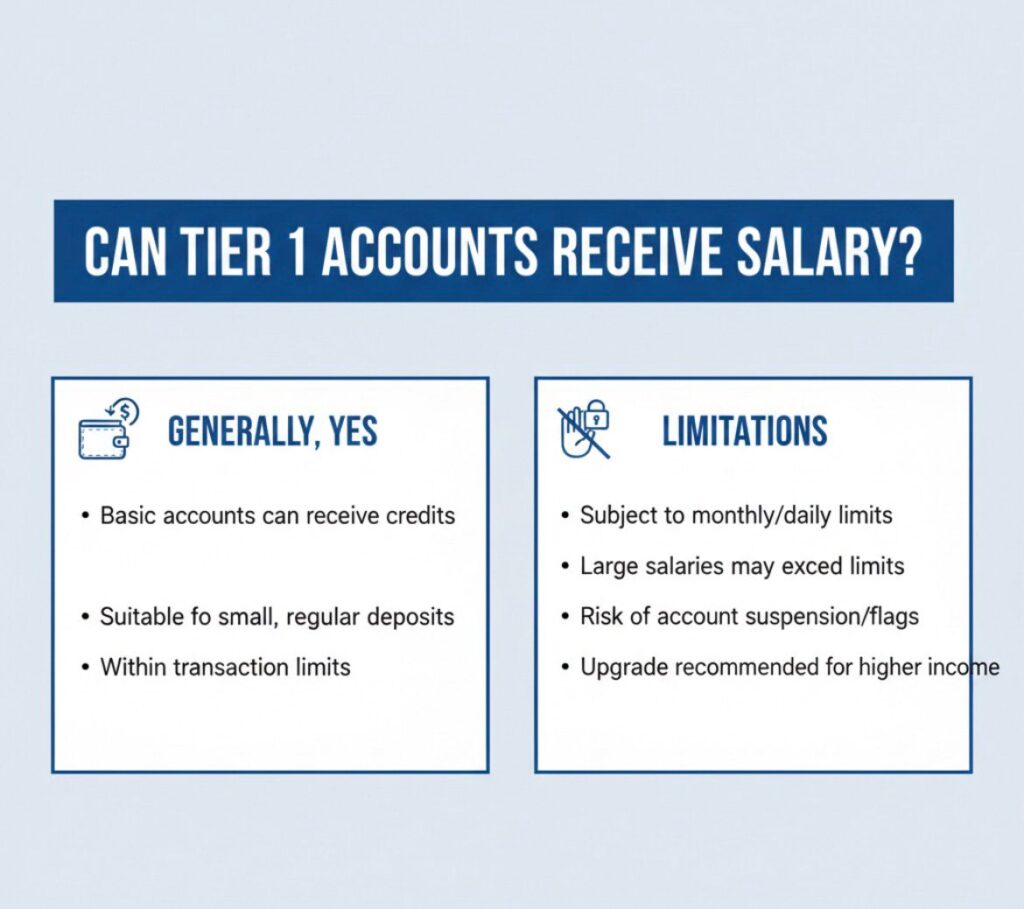
Can Tier 1 Accounts Receive Salary?
The Short Answer is Yes, a Tier 1 account can receive salary.
There is no rule in Nigerian banking regulations that bans salary payments into a Tier 1 account. In practice, many employers can and do pay salaries into Tier 1 accounts, as long as the employee provides account details that the payroll system accepts.
However, practical issues can make this complicated, and this is where confusion often arises.
Practical Challenges That Can Affect Salary Payments to Tier 1 Accounts
Even though the rules don’t forbid salary payments into Tier 1 accounts, here are common reasons people experience problems:
- Employer Payroll Systems May Reject Tier 1 Accounts
Most companies in Nigeria use software to process salaries. Some payroll systems are programmed to only validate certain account types usually those with full documentation or codes associated with Tier 2 / Tier 3 accounts.
In other words, payroll software might flag the Tier 1 account number as “non-standard” or “not eligible for salary credit.”
This is not a banking rule, but a technical configuration in payroll software. It can be changed if HR or finance teams allow it.
- Some Banks Limit Incoming Transfers in Tier 1
Tier 1 accounts have receiving limits, which can affect large deposits. If someone tries to credit an amount above the allowed balance or transaction limit, the payment might be rejected or returned.
For example, if your account balance is already near the maximum allowed, your payroll might bounce back.
This is not about the money being salary it’s about transaction ceilings.
- Nigerian Banks’ Tier Upgrade Expectations
Many banks encourage customers to upgrade to Tier 2 or Tier 3 accounts once they begin earning a salary. That’s because higher tier accounts allows
- Larger or unlimited account balances
- Higher transfer and deposit limits ,
- Full banking privileges (loans, higher online limits, etc.)
So if you’re earning a salary, the bank itself may recommend that you upgrade.
What Happens if Salary Payments Are Rejected?
If a salary payment is rejected when attempting to credit a Tier 1 account, one of the following usually occurs:
- The payroll department is notified and asked to re enter the bank details manually.
Payroll teams may switch to a Tier 2/3 account once they understand why it failed.
- The bank automatically returns the funds to the employer’s account, and the employer must pay again.
This happens when the transfer pushes the Tier 1 account beyond its limits.
- The account is upgraded to allow salary
Some employers ask employees to upgrade to a full tier account (Tier 2 or Tier 3) before salary payments are processed.
How to Make a Tier 1 Account Accept Salary
Here are practical steps to improve your chances of getting paid into a Tier 1 account:
- Talk to Your Employer’s Payroll Team
Ask HR or finance if Tier 1 account numbers are acceptable in their system. Many payroll platforms allow customization.
- Check Your Account Balance
If your balance is near the Tier 1 maximum limit, clear some funds first.
- Upgrade to Tier 2 or Tier 3
Even if you want to keep the Tier 1 account, upgrading improves your banking rights:
Tier 2: Requires proof of address (utility bill, tenancy agreement)
Tier 3: Requires full documentation including proof of address and verified identity
Upgrading will remove most limits.
When a Tier 1 Account Is Still Okay for Salary
Tier 1 accounts can work well for salary in certain situations:
- If your salary is below the account’s maximum allowed balance
- If your employer’s system supports Tier 1 account types
- If you use the Tier 1 account initially and upgrade later
In other words, yes, Tier 1 accounts can receive salary but they are not always the most convenient option once regular monthly payroll begins.
What Financial Experts and Banks Say
Most Nigerian financial guidance sites and bank references emphasize that:
- Tier 1 accounts are basic entry accounts with limits.
- They are meant to promote financial inclusion especially for unbanked Nigerians.
- For regular salary, savings, and significant transactions, higher tiers are recommended.
conclusion
a Tier One account can indeed receive salary credits, making it a practical and inclusive banking option for individuals with limited documentation. As long as the account complies with basic KYC requirements, employers can transfer salaries directly without restriction. While Tier One accounts may have transaction or balance limits, these do not affect the receipt of regular income such as wages or salaries. This facility plays a vital role in promoting financial inclusion by ensuring that even entry level account holders can participate fully in the formal banking system.
As financial needs grow, account holders also have the flexibility to upgrade their account to access enhanced banking features.











Comments