
Can Banks Freeze Accounts Without Notice?
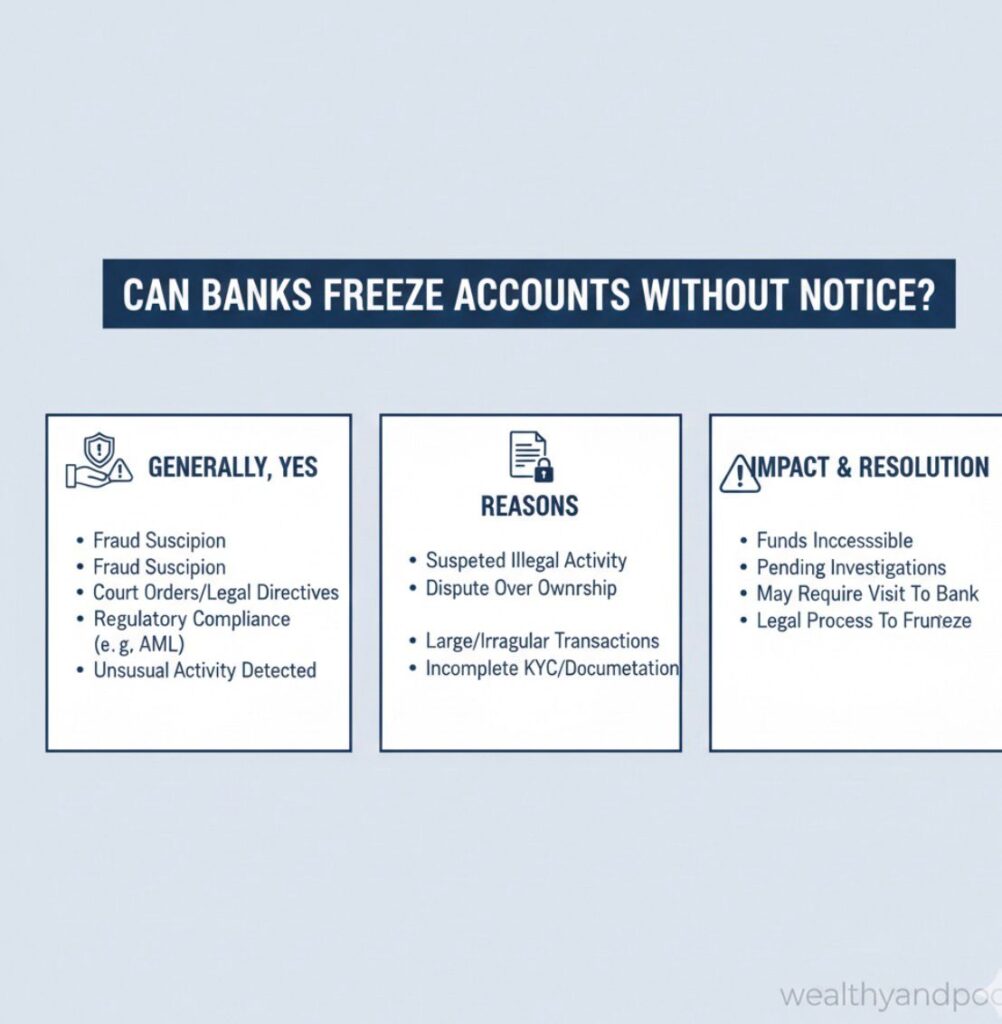

In Nigeria, the question of whether a bank can freeze a customer’s account without prior notice involves both banking law and constitutional rights.
While banks and regulatory agencies often act to protect funds and prevent abuse, recent legal developments and court rulings have clarified the limits of their powers.
The Legal Basis for Freezing Bank Accounts
There are laws in Nigeria that allow authorities to take action against suspicious funds but the manner and requirements for doing so are strictly defined:
- Central Bank of Nigeria and BOFIA
Under the Banks and Other Financial Institutions Act (BOFIA) 2020, law enforcement actions involving bank accounts must generally be backed by a court order. BOFIA allows an application to the Federal High Court to freeze an account if it appears transactions may involve criminal conduct; but the court must grant the order first. - EFCC and ICPC Oversight
Agencies like the Economic and Financial Crimes Commission (EFCC) and the Independent Corrupt Practices and Other Related Offences Commission (ICPC) can initiate investigations into suspected financial crime. However, legal authorities emphasise that neither EFCC nor ICPC can unilaterally instruct a bank to freeze accounts without a valid court order. Any such instruction without court backing is considered illegal or a breach of due process.
Nigerian Courts on Account Freezing Without Notice
Recent court decisions have brought significant clarity:
- High Court Judgment on EFCC and Banks
In a 2024 Federal Capital Territory High Court ruling, a judge held that a bank freezing a customer’s account without a court order was an abuse of due process and a breach of the banking relationship. The court emphasised that EFCC must first obtain a court order to freeze an account, even if the bank was acting on suspected criminal activity. The judge awarded damages against the bank for unlawfully freezing the account. - ICPC Limited to Temporary Freeze
A separate ruling restricted the ICPC’s power to freeze bank accounts to a maximum of 72 hours pending court application. This limits how long an account can be affected without judicial oversight, reinforcing that long term freezes must be court ordered. - Magistrates and Other Officers Have No Power
Courts have also ruled that magistrates and internal police units cannot issue valid freezing orders where Nigerian law does not grant them that authority. Banks relying on such orders have been directed to unfreeze accounts.
Notice: Is It Required?
While banks may have internal procedures for alerting a customer when an account action is taken, the core legal requirement is not about notice it’s about legal authority.
In Nigeria:
Banks cannot freeze accounts on their own authority merely because they suspect fraud or irregular transactions.
Official investigative agencies cannot freeze accounts without the sanction of a court order.
Banks acting on instructions without such orders risk being held liable for violating constitutional property rights and due process.
A legal commentator summarised this position: under the Constitution, an individual’s bank account is a form of property. Unilateral interference by a bank or agency without a court order constitutes unlawful infringement of that right and can be challenged in court.
What This Means for Bank Customers
Although banks and enforcement agencies may have legitimate reasons to act such as money laundering concerns customers cannot lawfully be deprived of access to their funds without due process.
If an account has been frozen without a court order, affected individuals or businesses have legal avenues including:
- Seeking judicial review or enforcement of fundamental rights in the Federal High Court.
- Claiming damages for unlawful deprivation of access to funds and breach of contract.
- Requesting immediate evidence of a valid court order authorising the freeze.
Legal professionals advise that any freeze communicated without a copy of a court order should be closely scrutinised and may be subject to legal challenge.
Balancing Security and Rights
It’s important to recognise that regulatory bodies pursue account freezes to combat financial crime. However, the Nigerian legal system emphasises that security measures must be balanced with constitutional rights including the right to fair hearing and protection of property. Court rulings in Nigeria increasingly reflect this balance by limiting broad or indefinite account freezes without judicial oversight.
Conclusion
So, can Nigerian banks freeze your account without notice?
Not legally. Under Nigerian law and recent case law:
Banks and law enforcement agencies cannot lawfully freeze accounts without a valid court order.
A court order not an internal bank instruction or agency directive is the constitutional requirement.
Any account freeze executed without such authority can be challenged, and may be overturned by the courts.
These legal principles safeguard customers against arbitrary loss of access to their funds while still allowing authorities to act against financial misconduct but only within the rule of law.












Comments