
How To Unfreeze A Restricted Bank Account
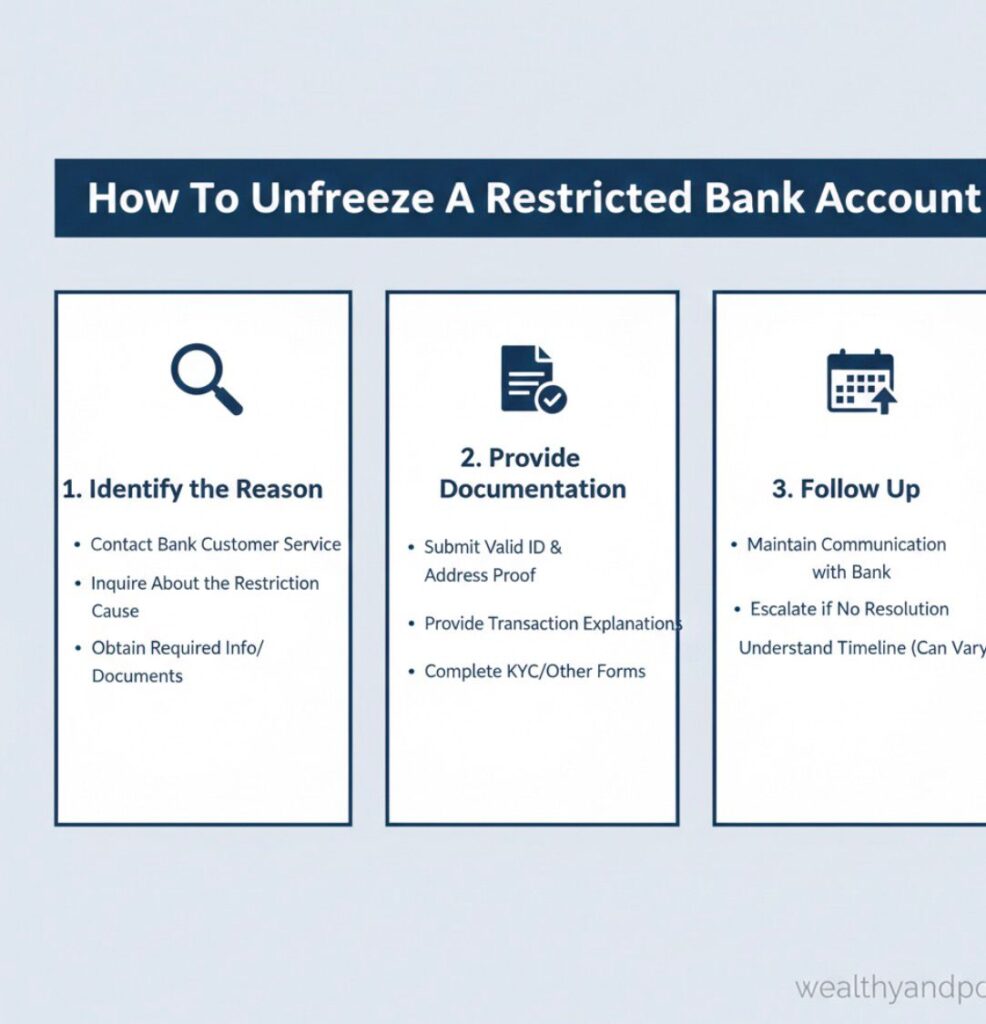

When Your Money Is Locked — What Happens Next?
Few things are more unsettling than discovering that your bank account has been restricted or frozen. Suddenly, you can’t withdraw money, make payments, or manage your finances.
In Nigeria, this situation usually arises when a bank, law enforcement agency (like the EFCC), or a court places a restriction on the account often due to suspicion of fraud, ongoing investigations, or legal orders.
While this is meant to protect funds or ensure legal compliance, it can be very stressful for the account owner especially if the restriction seems unjustified. That’s why knowing how to unfreeze your bank account in practical and legal terms is crucial.
This article explains why accounts get frozen, how the law treats these freezes in Nigeria, and the most reliable ways to get your account unfrozen.
Why Do Bank Accounts Get Restricted or Frozen?
A bank account might be restricted for several reasons:
- Court Order
If a court, usually on application by an agency like the EFCC (Economic and Financial Crimes Commission), suspects illegal activity involving the funds, it may issue an order directing the bank to freeze the account. The bank then must comply.
- Law Enforcement Investigations
Agencies investigating fraud, money-laundering, or other offences can request a restriction, but they generally must first obtain a valid court order.
- Internal Bank Compliance and Fraud Alerts
Sometimes banks freeze accounts due to suspicious activity, unusual transaction patterns, or outdated KYC (Know Your Customer) documents. These actions are usually temporary and tied to internal compliance checks.
Regardless of the cause, the account holder often receives little or no prior notice leading to confusion, financial disruption, and sometimes panic.
What Nigerian Law Says About Freezing Accounts
A key principle in Nigerian law is that neither banks nor enforcement agencies have the right to permanently freeze an account without valid legal backing:
- Court Orders Required: Multiple legal documents and judicial decisions confirm that agencies like the EFCC must obtain a valid court order before freezing an account longer than a short duration.
- Temporary Holds for Investigation: Some laws allow a temporary stop (often limited to about 72 hours) during urgent investigations, but any continued restriction requires judicial approval.
- Unlawful Freezes Can Be Challenged: If an account is frozen without proper legal authority, the account holder may challenge the action in court or seek other legal remedies.
This legal framework is important because it gives you the right to question and undo an account restriction that lacks appropriate legal backing.
Steps to Unfreeze Your Bank Account in Nigeria
Below is a comprehensive and practical guide you can follow if your bank account has been restricted:
Step 1: Find Out Why the Account Was Frozen
- Visit your bank branch or contact customer service.
- Ask why the account was frozen and who ordered it.
- Request a written notice or official document showing the authority behind the restriction.
Knowing the reason is critical, because how you unfreeze your account depends on this.
Step 2: Ask for Documentation
- If it was a court order ask for a copy of the court order served on the bank.
- If it was a law enforcement request ask which agency and ask for a reference number.
- If it was due to internal bank policy ask what documents you must submit to resolve it.
Banks must be transparent about the legal authority behind a freeze; they cannot arbitrarily keep your money inaccessible.
Step 3: Provide Required Documents or Clarifications
Depending on the reason, you will likely need to submit supporting documents:
- Updated KYC (ID, address proof)
- Proof of legitimate source of funds
- Transaction statements or explanations
- Any letters or notices you received
Providing correct documentation often resolves issues related to compliance or internal fraud flags.
Step 4: Engage a Legal Practitioner (if Needed)
If the restriction came from law enforcement or a court order, consulting a lawyer experienced in banking or financial crime matters is usually necessary.
Your lawyer can help you with:
- Drafting formal applications to court to vacate or set aside the freezing order
- Filing motions asserting that the freeze was unnecessary or improperly obtained
- Presenting evidence of legitimate funds or resolved investigations
- Obtaining official court orders requiring the bank to unfreeze your account
In Nigeria, where many freezes stem from court orders, this legal intervention is often the most effective solution.
Step 5: Apply to Court to Vacate the Freezing Order
If a court order is behind the freeze:
- Your lawyer files an application or motion with that same court.
- The court reviews evidence that the freeze should be lifted (e.g., investigation complete, order was faulty, or wrong information was provided).
- If successful, the court issues an order directing the bank to unfreeze the account.
Once a court order is served on the bank, the bank must comply.
Step 6: Follow Up With Your Bank
After obtaining a court order or official clearance:
- Submit the order or clearance to your bank in person.
- Keep copies of all documents.
- Follow up politely but persistently until the bank has restored access.
Banks generally must comply within a few business days once the proper order is shown.
What If the Bank Didn’t Follow Proper Legal Process?
If your account was frozen without a valid court order or legal authority, Nigerian law allows you to:
- File a lawsuit to enforce your rights
- Seek damages for unlawful freezing of funds
- Report the matter to the Banking Ombudsman or Consumer Protection channels
Under Nigerian law especially where fundamental rights are affected people have recourse to the courts even when banks or agencies overstep their authority.
Real-Life Example: Legal Challenges to Account Freezes
In Nigeria, courts have held that banks cannot lawfully freeze accounts without a valid court order obtained through proper legal process. One High Court judgment declared that freezing an account without a court order was a violation of the account holder’s rights and awarded damages to the customer when the bank acted wrongly.
Cases like these underscore two important truths:
- Banks must respect legal limits.
- Customers have rights and legal remedies when those limits are breached.
Conclusion
Turning the Page on a Frozen Account
Getting your Nigerian bank account unfrozen especially when the cause is legal or investigatory often requires patience, documentation, and sometimes legal intervention. But the law does offer pathways to restore access:
Understand the source of the freeze
Get written documentation from the bank
Submit required documents or explanation
Engage a lawyer to challenge improper restrictions
Apply to court to vacate or set aside orders if needed
Your money belongs to you and Nigerian law protects your right to access it when restrictions are unwarranted or legally unsupported.












Comments