
Kuda vs GTBank Transfers: Which Is Faster?
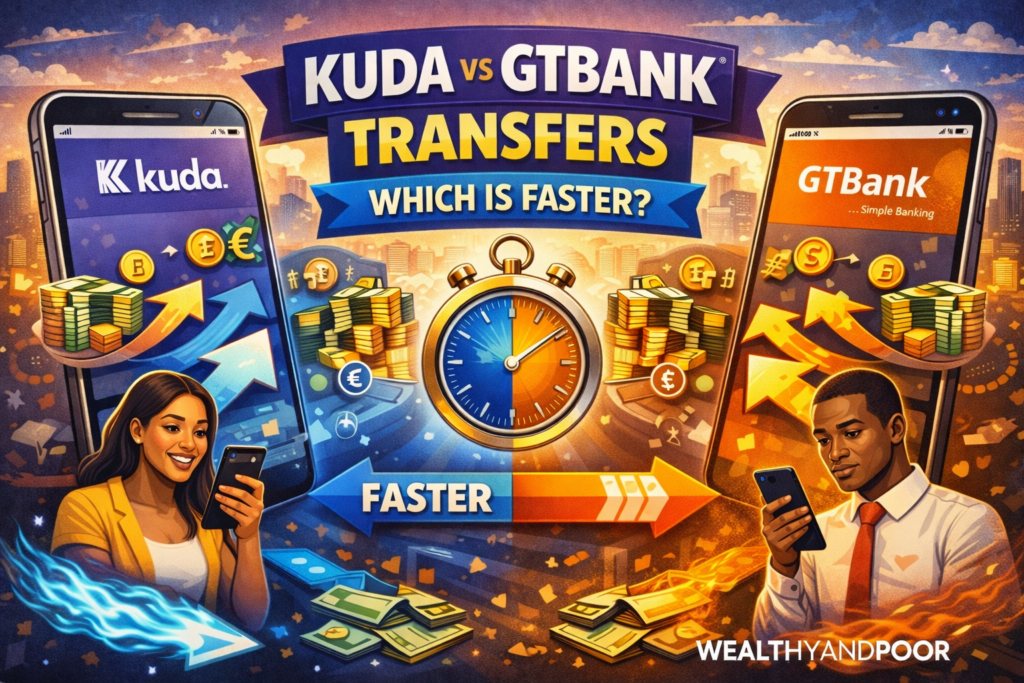

In Nigeria’s digital banking landscape, the speed of money transfers can make a real difference. Whether you’re paying school fees, topping up accounts, settling bills, or sending money to friends and family, how fast your money arrives matters.
Two popular choices for Nigerians are Kuda (a fully digital bank with a modern mobile app experience) and GTBank (one of Nigeria’s largest and longest established commercial banks).
Many users ask: Which one is actually faster Kuda or GTBank transfers? In this article, we break down how each system works, what affects their speed, and which one typically gets your funds to the recipient sooner based on real, verifiable information.
How Each System Works
- Kuda Transfers :
Kuda is a digital only bank that sends money through Nigeria’s national electronic payment system. When you send money to another bank:
Kuda sends the transfer request to NIBSS (Nigeria Inter-Bank Settlement System), the central settlement platform that moves funds between banks in real time.
If NIBSS confirms the transfer quickly, the money will appear in the recipient’s account just seconds after you send it.
If NIBSS can’t confirm immediately, Kuda will continue trying for up to about two hours before reversing the transfer back to your account.
Transfers between Kuda accounts are generally instant because the transaction updates the internal account ledger before full settlement.
Key point: Kuda transfers can be instant, but under certain conditions (like network issues or delayed NIBSS responses) they may take a little longer.
- GTBank Instant Transfers
GTBank (Guaranty Trust Bank) offers a service called Instant Transfer, accessible through its mobile app (GTWorld), internet banking, or the *737# USSD code. GTBank states that when you make an instant transfer, the beneficiary receives the funds immediately upon successful processing.
This is possible because GTBank also uses NIBSS’s instant payment system the same infrastructure that Nigerian banks and digital banks use for real-time electronic transfers.
The service is available 24/7, and money usually shows up in the recipient’s account within seconds.
Key point: GTBank’s instant transfer service is designed for near real-time delivery to any Nigerian bank account.
What this means:
On paper, both Kuda and GTBank transfers can be received within seconds because they rely on the same underlying system (NIBSS’s instant payment infrastructure).
However, there are some practical differences based on how they handle confirmation and settlement:
- Kuda’s speed can feel faster for transfers inside the Kuda ecosystem, because the app updates your recipient’s balance immediately even before final settlement confirmation.
- GTBank’s transfers are typically instant as soon as the system processes them, and because they are tied directly into the traditional banking network and NIBSS, they show the credited amount immediately when successful.
What Can Slow Down Transfers?
- System or Network Issues :
Both Kuda and GTBank rely on the NIBSS instant payment system. When NIBSS experiences downtime or technical issues, any bank’s transfers including Kuda’s and GTBank’s can be delayed.
For example:
Reports show occasional NIBSS slowdowns that affect transfers across multiple banks. Some transfers can be delayed for hours until the system finishes processing.
Practical Tip: In Nigeria’s digital banking landscape, the speed of money transfers can make a real difference. Whether you’re paying school fees, topping up accounts, settling bills, or sending money to friends and family, how fast your money arrives matters. Two popular choices for Nigerians are Kuda (a fully digital bank with a modern mobile app experience) and GTBank (one of Nigeria’s largest and longest established commercial banks). Many users ask: Which one is actually faster Kuda or GTBank transfers? In this article, we break down how each system works, what affects their speed, and which one typically gets your funds to the recipient sooner based on real, verifiable information.
Summary: Which Is Faster?
Short Answer:
For transfers within the same platform (Kuda → Kuda): Almost instant because of internal ledger updates.
For transfers to other banks (Kuda or GTBank): Both are usually instant or near instant because they use the NIBSS instant payment infrastructure.
Overall speed difference: In everyday use, the perceived speed is similar any difference is usually too small to matter unless there’s a system issue.
In comparing Kuda vs GTBank transfers, speed often comes down to the context of the transaction. For everyday peer to peer transfers within the same bank, Kuda’s digital first platform tends to be faster because it processes transactions instantly within its ecosystem.
GTBank is also competitive, especially for intra bank transfers, but can sometimes take slightly longer due to traditional banking processes and batch clearing systems. When it comes to inter bank transfers, both banks rely on Nigeria’s shared payment infrastructure, making speeds more comparable.
In the end, Kuda generally feels quicker for mobile users who value speed and simplicity, while GTBank’s transfer times reflect the robustness and reach of an established banking system.











Comments