
Why Fintech Cards Fail Online
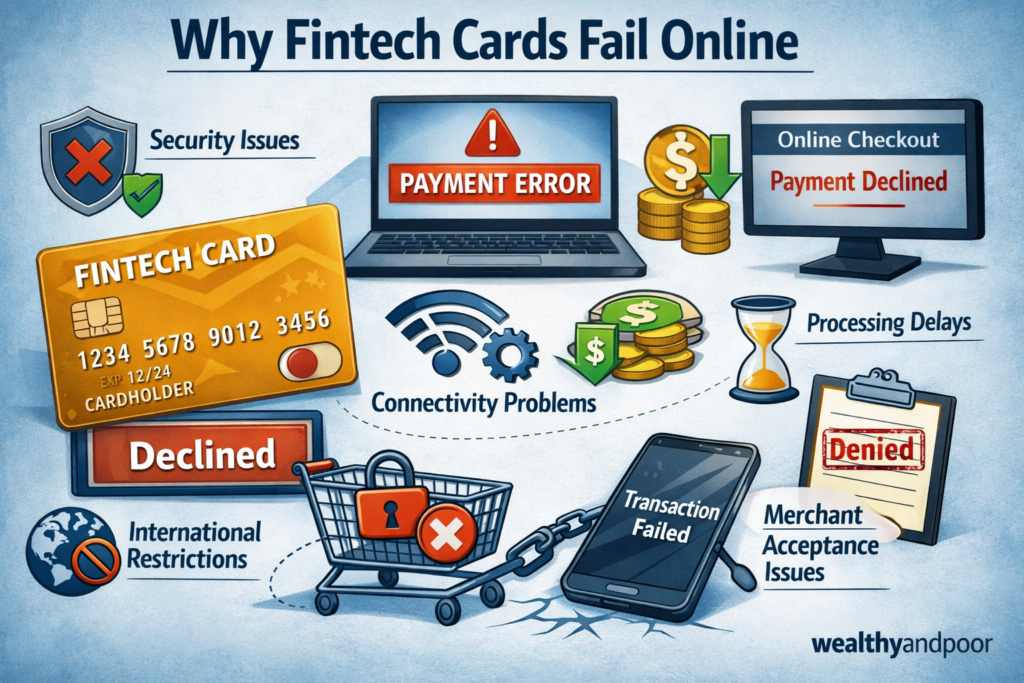

In the digital era, fintech cards debit, credit, and prepaid cards issued by financial technology companies promised a revolution.
Sleek app interfaces, real time analytics, low fees, and instant card freezes made them instantly popular, especially among digitally native consumers.
Yet despite their appeal and rapid adoption, a surprising number of transactions with fintech cards fail at online checkout. This isn’t just annoying it can impact consumer trust, merchant revenue, and the reputation of emerging financial brands.
Understanding why these payments fail is crucial for fintech startups, developers, merchants, and users. In this article, we’ll explore the most important technical, regulatory, and operational causes behind fintech card failures, explain how they manifest in real life.
- Security and Fraud Prevention Systems
The Root of Many Declines
Fintech companies invest heavily in fraud prevention often more aggressively than traditional banks. While this protects consumers, it also frequently flags legitimate purchases as suspicious.
For example:
- A small foreign purchase from a new online merchant,
- Rapid repeated transactions,
- Unusual shipping addresses.
All of these can trigger protective rules that automatically block the payment.
Why it happens:
- Machine learning models can be overly cautious.
- Rules may prioritize security over user experience.
Example source:
The Federal Reserve Bank confirmed fraud algorithms are a common reason for transaction declines.
- Card Network Rules and 3-D Secure Authentication
Extra Verification That Interrupts Flow
Visa, Mastercard, and other networks require certain online payments to be validated through security protocols like 3-D Secure (e.g., “Verified by Visa” or “Mastercard Identity Check”). Fintech apps sometimes struggle to implement these smoothly.
Common outcomes:
- Redirects that confuse the user,
- Forgetting challenge screens,
- Expired security tokens.
This results in the user abandoning the purchase or the transaction failing outright.
Example source:
An article from the European Central Bank on challenges with 3 – D Secure adoption.
- Insufficient Authorization Data
Missing Details = Declined Payment
Online gateways require accurate data:
- Billing address (AVS),
- CVV security code,
- Card expiry date.
If the fintech card app delays synchronizing this information with the payment processor, the gateway declines the charge.
Example source:
The American Bankers Association explains how AVS and CVV help prevent fraud and why mismatches cause declines.
- Currency and Country Restrictions
Fintech’s Global Ambition vs. Local Rules
Many fintech cards are designed for international use. However:
- Some cards aren’t enabled for certain currencies,
- Anti money laundering laws require local registrations,
- Cross border settlement can be blocked.
So buying from a foreign merchant may fail even if the user has funds available.
Example source:
An analysis on payment regulation in the European Union.
- Insufficient Funds or Reserved Balances
This might seem obvious, but fintech cards often use real time holds or authorizations.
For example:
- A hotel pre auth may block $200.
- A purchase attempt for $150 then fails because only $50 remains.
Traditional banks often allow overdraft or pending credit, while fintech systems typically do not.
Example source:
Explainer on authorization holds from Investopedia.
- Outdated Card Metadata (Tokenization Issues)
Tokenization = Security; But Sometimes Breaks Things
Many fintech cards use tokenization replacing the real card number with a temporary digital token for online purchases. This is good for security, but:
- Tokens can expire,
- Merchants may not support certain token formats,
- App upgrades may not refresh old tokens.
- When a token mismatch occurs, the payment fails.
- Poor Merchant Integration or Gateway Support
Not all merchants and payment gateways support the wide variety of fintech card types equally well.
For instance:
- New digital only banks may not be recognized by older payment systems,
- Uncommon BIN (Bank Identification Number) ranges may be rejected.
This technical incompatibility can cause automatic declines even if the card is valid.
- Real Time Risk Models and Velocity Limits
Many fintech platforms throttle transactions to prevent abuse:
- More than 3 expensive purchases in an hour,
- Rapid multiple login attempts,
- Geographic changes in IP.
When these risk thresholds are crossed, the system automatically rejects the payment.
Example source:
McKinsey overview of risk management in fintech.
Conclusion
Fintech cards fail online for many interconnected reasons. What often appears as a simple “decline” message can be the result of: advanced fraud detection logic,
authentication requirements,
data mismatches,
currency limits,
or technical incompatibilities.
These systems are constantly evolving, and both fintech providers and merchants are working to reduce failures. For users, understanding these limitations helps reduce confusion and improves the online experience.












Comments