
States Face Rising Pressure to Boost Spending as VAT Revenue Hits N2.28tn
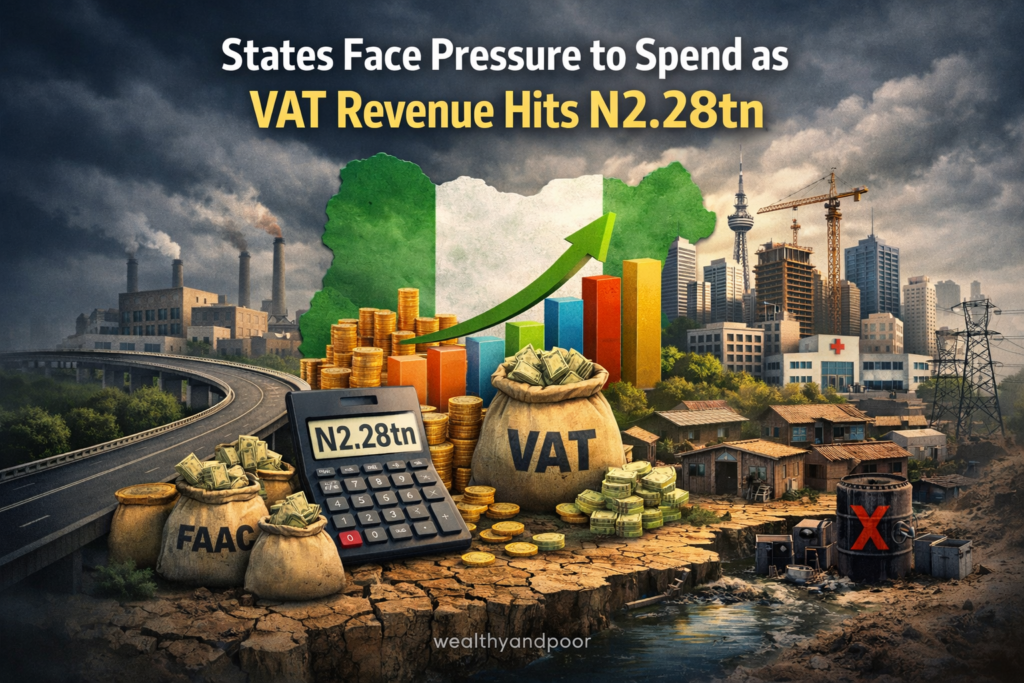

Rising Value Added Tax (VAT) collections in Nigeria are expected to significantly boost allocations to state governments, raising expectations that subnational administrations will channel the additional funds into improved infrastructure, social services, and economic development.
Recent fiscal data shows that the country’s VAT revenue reached N2.28 trillion in the third quarter of 2025, reflecting stronger consumption activity and improved tax administration across several sectors of the economy.
The increase represents a 10.66 percent quarter-on-quarter growth from the N2.06 trillion recorded in the previous quarter, while year-on-year collections rose by 28.10 percent compared with the same period in 2024, according to the National Bureau of Statistics.
Analysts say the sustained expansion in VAT receipts is creating more fiscal space for state governments, many of which rely heavily on allocations from the Federation Account to fund their budgets.
A breakdown of the latest VAT data shows that local VAT payments accounted for the largest share of the total, contributing about N1.12 trillion. Foreign VAT payments generated N680.23 billion, while import VAT added N479.79 billion to the revenue pool.
The figures highlight the breadth of consumption-driven tax contributions across Nigeria’s economy, particularly from sectors such as manufacturing, information and communication, and mining.
Economists and tax experts note that the rising VAT inflows come at a time when the structure for distributing consumption taxes is evolving, allowing states to retain a greater share of the revenue generated within their jurisdictions.
This shift, they argue, could strengthen the fiscal capacity of state governments, enabling them to address long-standing development challenges, meet salary obligations, and invest more aggressively in capital projects that stimulate economic growth.
However, the increase in allocations has also intensified calls for greater transparency and accountability in the management of public funds.
Fiscal policy experts stress that the inflow of higher VAT revenue places greater responsibility on state governments to demonstrate prudent financial management and deliver tangible improvements in infrastructure, education, healthcare, and security.
According to tax consultant Oluwasegun Osundina, the additional revenue accruing to subnational governments means citizens and businesses will increasingly demand better governance and more visible development outcomes.
For years, many state administrations had argued that limited allocations from the Federation Account constrained their ability to execute large-scale development projects and provide adequate public services.
With VAT collections now rising and revenue flows improving, analysts say that argument may become less persuasive if the additional funds do not translate into measurable improvements in economic welfare and public infrastructure.
The implications extend beyond state governments to local councils, which are also expected to benefit from higher VAT distributions under the revised fiscal arrangement.
Greater revenue at the grassroots level could potentially strengthen economic activity, improve service delivery, and support community-level development initiatives if the funds are managed effectively.
Despite the optimism surrounding higher VAT allocations, policy analysts caution that stronger monitoring mechanisms will be necessary to ensure that the windfall is used efficiently.
Recent FAAC data shows that states’ share of VAT has already surged significantly in recent months, highlighting the need for improved fiscal discipline, transparent budgeting, and active citizen oversight to ensure that the increased revenue ultimately benefits the broader population.
Overall, Nigeria’s growing VAT collections signal resilience in consumption activity and an expanding tax base, offering state governments an opportunity to strengthen development spending.
Whether the increased allocations translate into meaningful economic progress, however, will depend largely on how effectively states manage the additional resources and prioritize investments that improve living standards and support sustainable growth.
Read Also: Fintech and other commercial banks to charge 7.5% VAT on Transfers, USSD Payments












Comments