
OPay account limits explained
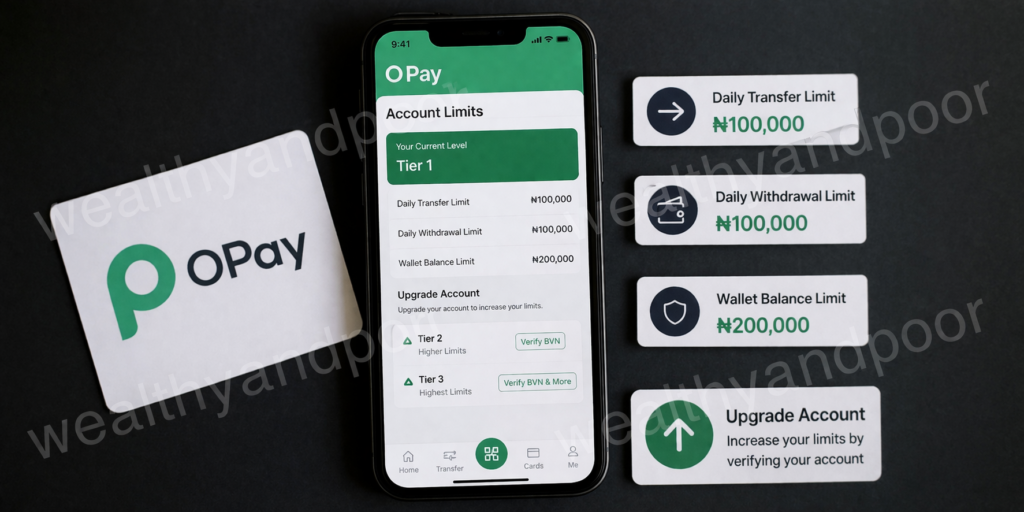

In Nigeria’s fast-growing digital finance space, platforms like OPay have become essential tools for everyday transactions from transfers and bill payments to savings and business collections. However, one critical aspect that many users overlook is account limits. These limits determine how much money you can send, receive, or hold in your wallet and they can directly impact your financial flexibility.
Understanding how OPay account limits work is not just useful it’s necessary for avoiding failed transactions, managing funds effectively, and unlocking the platform’s full potential.
What Are OPay Account Limits?
OPay account limits refer to the maximum amount of money you can transact or store in your wallet within a given period. These restrictions are not arbitrary they are guided by regulations from the Central Bank of Nigeria (CBN) and are tied to your account’s Know Your Customer (KYC) level.
In simple terms, the more verified your account is, the higher your limits.
Why OPay Imposes Limits
OPay’s tiered limit system is designed for three main reasons:
- Security: To reduce fraud and unauthorized transactions
- Regulatory compliance: To align with CBN policies on digital banking
- User protection: To ensure traceability and accountability in financial activities
As of 2024, Nigerian regulations now require users to link a BVN or NIN to operate fully functional accounts, making identity verification mandatory.
Breakdown of OPay Account Tiers and Limits
OPay operates a three-tier system. Each tier comes with different transaction ceilings and wallet capacities.
- Tier 1 (Basic Account)
This is the entry-level account, typically created with minimal information.
- Daily transaction limit: ₦50,000
- Maximum wallet balance: ₦300,000
Previously, Tier 1 accounts could operate without BVN, but current regulations now require identity verification for active usage.
This tier is suitable for:
- Light users
- Small daily transactions
- Beginners testing the platform
- Tier 2 (Intermediate Account)
This level requires additional verification, usually including BVN.
- Daily transaction limit: ₦200,000
- Maximum wallet balance: ₦500,000
Tier 2 is ideal for:
- Regular users
- Small business owners
- Freelancers receiving moderate payments
Tier 3 (Fully Verified Account)
This is the highest level of OPay account, requiring full KYC compliance, including valid ID and proof of address.
- Daily transaction limit: Up to ₦5,000,000
- Maximum wallet balance: Unlimited
This tier is best suited for:
- Businesses
- High-volume traders
- Power users who need large transfers
Receiving Limits and Transaction Rules
Beyond sending limits, OPay also imposes receiving caps based on your tier. For example:
- Tier 1 users cannot receive more than ₦50,000 daily
- Tier 2 users are capped at ₦200,000 daily
- Tier 3 users can receive up to ₦5 million daily
If you exceed these thresholds, transactions may fail or be delayed until the next day.
OPay limits operate on a 24- hour rolling cycle, not necessarily midnight resets. This means your limit refreshes 24 hours after your first transaction of the day, which can sometimes confuse users expecting a midnight reset.
What Happens If You Exceed Your Limit?
If you attempt a transaction beyond your allowed limit:
- The transfer will fail instantly
- Funds may not leave your account
- You may need to wait for the next cycle or upgrade your account
This is why understanding your current tier is essential before initiating large payments.
How to Increase Your OPay Limits
Upgrading your account is the only way to unlock higher limits. The process typically involves:
- Linking your BVN
- Uploading a valid government-issued ID
- Providing proof of address (for Tier 3)
Once verified, your account is upgraded automatically, and higher limits become available.
Additional Security Controls
Interestingly, OPay also allows users to set custom transaction limits below the maximum threshold. This feature helps:
- Prevent unauthorized spending
- Add an extra layer of security
- Control daily expenses
For high-value transactions, additional verification such as facial recognition may be required.
Why Understanding Your Limit Matters
Many users only discover their limits when a transaction fails often at inconvenient moments. Knowing your limits helps you:
- Plan large transfers efficiently
- Avoid delays in urgent payments
- Manage business cash flow smoothly
- Reduce frustration from failed transactions
In Nigeria’s increasingly cashless economy, these small details can make a big difference.
Conclusion
OPay’s account limits are not restrictions they are structured safeguards designed to balance security, compliance, and usability. Whether you are a casual user sending airtime money or a business owner handling millions daily, your experience on the platform depends largely on your account tier.
The takeaway is simple:
If you want more freedom, higher limits, and fewer interruptions, upgrading your account is not optional it’s essential.












Comments