
Moniepoint POS Limit in Nigeria
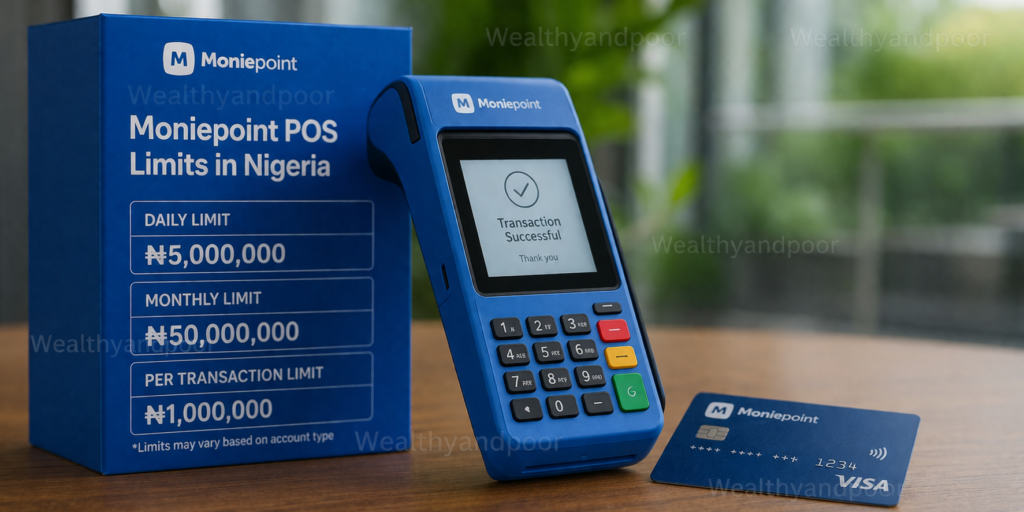

In Nigeria’s fast-growing agency banking ecosystem, few tools are as widely used as the Moniepoint POS terminal. From roadside kiosks to busy urban centers, these devices have become essential for cash withdrawals, transfers, and bill payments. But behind their convenience lies a critical factor many users and agents often overlook transaction limits.
Understanding Moniepoint POS limits is not just a technical detail; it is central to how smoothly your transactions go, how much you can withdraw, and how efficiently your POS business operates.
What Is Moniepoint POS?
Moniepoint Microfinance Bank operates one of Nigeria’s most widely adopted POS networks, enabling businesses and agents to process financial transactions such as withdrawals, deposits, transfers, and payments. Its reliability and near-instant settlement have made it a preferred choice for many small businesses.
However, like every regulated financial service in Nigeria, Moniepoint POS operates within defined transaction limits some set by the system itself, and others influenced by regulatory policies.
Moniepoint POS Withdrawal Limits
One of the most important limits for everyday users is the cash withdrawal cap at POS terminals.
According to current Nigerian banking guidelines:
- Daily POS cash withdrawal limit (per customer): ₦100,000
- Weekly withdrawal limit: ₦500,000
These limits are not exclusive to Moniepoint but apply broadly across POS operators in Nigeria as part of the cashless policy framework.
For POS agents, there is also an operational ceiling:
- Agent daily cash-out capacity: Up to about ₦1.2 million (cumulative across customers)
This means even if individual customers stay within their limits, an agent may be unable to process further withdrawals once their daily payout threshold is reached.
Transfer Limits on Moniepoint POS
Beyond withdrawals, Moniepoint POS also supports transfers. These limits are tied more closely to account verification levels (KYC tiers).
Personal Account Limits
Level 1 (Basic KYC):
- Single transaction: ₦50,000
- Daily limit: ₦300,000
Level 2:
- Single transaction: ₦100,000
- Daily limit: ₦500,000
Level 3 (Fully verified):
- Single transfer: Up to ₦5,000,000
- Daily transfer limit: Up to ₦25,000,000
These tiers show a clear pattern: the more verified your account is, the higher your transaction freedom.
Why These Limits Exist
Transaction limits are not arbitrary restrictions they are part of a broader financial control system led by the Central Bank of Nigeria.
There are three main reasons behind these caps:
- Fraud Prevention
Limits help reduce exposure to fraud and unauthorized transactions, especially in a system where POS agents handle large volumes of cash daily.
- Cashless Policy Enforcement
Nigeria’s financial system is gradually shifting toward digital payments. By limiting cash withdrawals, regulators encourage the use of transfers and electronic payments.
- System Stability
High transaction volumes can strain payment infrastructure. Limits ensure smoother operation across networks and reduce the risk of system overload.
How Limits Affect POS Agents
For POS business owners, transaction limits directly impact daily earnings and customer satisfaction.
- Liquidity Management
Agents must carefully manage their cash flow. Running out of cash or hitting daily payout limits can turn customers away.
- Customer Expectations
Many customers expect to withdraw large amounts at once. When limits prevent this, it can create friction unless properly explained.
- Transaction Planning
Smart agents often advise customers to split large withdrawals across multiple days or use bank transfers instead.
How to Increase Your Moniepoint Limits
If you frequently encounter transaction restrictions, the solution is usually straightforward: upgrade your account.
Steps include:
- Linking your BVN or NIN
- Uploading a valid ID (National ID, Driver’s License, or Passport)
- Providing proof of address
Once fully verified, users can unlock significantly higher transfer limits especially useful for business transactions.
POS Limits vs Digital Banking: A Growing Divide
Interestingly, while POS withdrawals are tightly restricted, digital transfers offer much higher flexibility. Fully verified accounts can move millions daily, far beyond POS cash limits.
This reflects a deliberate shift in Nigeria’s financial system:
- Cash = restricted
- Digital money = encouraged
For many businesses, this means adapting by accepting transfers instead of relying solely on cash-based POS transactions.
The Bigger Picture: Regulation and the Future
Recent regulatory actions also show that authorities are paying closer attention to POS operations. For example, the Central Bank has mandated stricter tracking and monitoring of POS terminals to reduce fraud and improve transparency.
This suggests that limits and controls around POS usage may continue to evolve, especially as Nigeria deepens its cashless economy strategy.
Conclusion
Moniepoint POS limits are a critical part of Nigeria’s financial ecosystem. While they may sometimes feel restrictive, they serve important purposes enhancing security, promoting digital payments, and maintaining system stability.
For users, the key is understanding your limits and upgrading your account when necessary. For agents, success lies in managing liquidity, educating customers, and adapting to a system that is steadily moving away from cash.












Comments