
Why your virtual card is declined
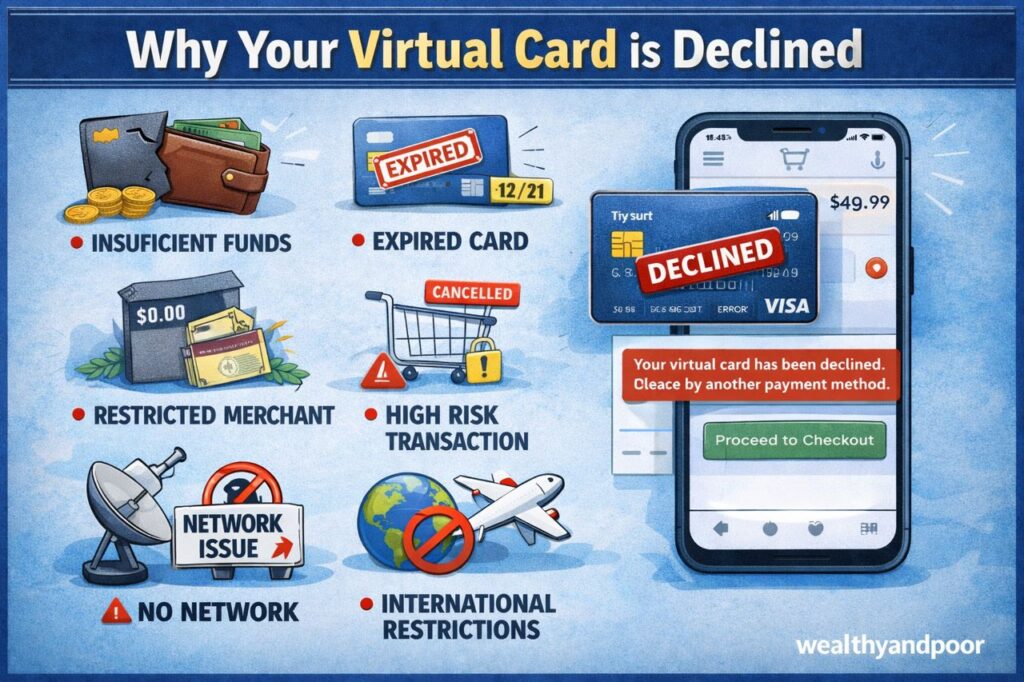

In today’s digital economy, virtual cards have become the backbone of online payments from subscriptions like Netflix and Spotify to international shopping and digital advertising. Yet, one frustrating message continues to disrupt users: “Transaction Declined.”
For many, this feels confusing especially when there is money on the card. But the reality is simple: virtual card declines are rarely random. They are usually triggered by identifiable technical, financial, or security factors. Understanding these reasons can save you time, money, and repeated failed transactions.
- Insufficient Balance: The Most Common Culprit
The number one reason virtual cards get declined is insufficient funds. Unlike traditional debit cards linked directly to your bank account, most virtual cards are pre-funded. This means the transaction will only go through if the exact amount plus possible hidden charges is available on the card itself.
In many cases, merchants also place a temporary hold (called pre-authorization), which may be higher than the actual purchase amount. If your balance cannot cover that hold, the transaction fails even if you think you have enough.
- Merchant Restrictions and Blocked Transactions
Not all transactions are allowed on virtual cards. Many providers restrict certain merchant categories for compliance and fraud prevention.
These often include:
- Gambling and betting platforms
- Cryptocurrency services
- Money transfer platforms (e.g., wallet funding)
- Loan repayments and financial institutions
If your payment falls into a restricted category, the system will automatically decline it.
- The Merchant Simply Doesn’t Accept Virtual Cards
Some websites especially global platforms do not accept prepaid or virtual cards at all. They may require:
Physical debit cards
Cards issued in specific countries
This is common with subscription platforms and certain e-commerce websites, meaning your card may be valid but still rejected.
- Incorrect Card Details or Billing Information
A small mistake can lead to an immediate decline.
Common issues include:
- Wrong card number or CVV
- Incorrect expiry date
- Billing address mismatch
Many international platforms use strict verification systems. If your billing address or phone number does not match what your card provider has on file, the transaction will fail.
- Currency and Region Mismatch
Virtual cards especially dollar cards used in Nigeria can be sensitive to currency and regional settings.
For example:
- A platform may attempt to charge in naira instead of USD
- Your card may not support the currency being billed
- Your account region may conflict with the card’s issuing country
These mismatches often lead to automatic declines, even when the card is funded.
- Card Limits and Spending Controls
Every virtual card comes with limits:
- Daily spending limits
- Monthly transaction caps
- Per-transaction thresholds
If you exceed any of these limits, your payment will be declined instantly.
This is especially common with fintech-issued cards that enforce strict controls to manage risk.
- Security Systems and Fraud Detection
Behind every transaction is a complex fraud detection system. Payment platforms evaluate multiple factors before approving a transaction, including:
- Your location (IP address)
- Device behavior
- Transaction history
- Card reputation (BIN)
If anything appears suspicious, the transaction is blocked even if everything seems correct on your end.
In fact, cards issued from regions with high fraud rates or frequently flagged BINs are more likely to be declined.
- Poor Card Quality or Provider Limitations
Not all virtual cards are created equal. Some low-cost or widely distributed cards suffer from:
- Overused or blacklisted BINs
- Limited international acceptance
- Weak support for recurring payments
This is a major issue in Nigeria, where some virtual cards are designed primarily for local transactions and struggle with global platforms.
- Subscription and Recurring Payment Issues
Subscriptions require special authorization systems.
If your card:
- Cannot handle recurring billing
- Blocks small verification charges
- Lacks sufficient buffer funds
it may fail repeatedly on platforms like Netflix, Apple, or Google services.
- Card Status: Frozen, Expired, or Deactivated
Sometimes the issue is straightforward:
- Your card may be expired
- It could be temporarily frozen
- It might have been deactivated
after repeated failed attempts
In such cases, no transaction will go through until the card is reactivated or replaced.
- Network or System Errors
Not every decline is your fault.
Temporary issues such as:
- Payment gateway failures
- Bank network downtime
- Merchant-side technical errors
can interrupt transactions. Often, simply retrying later resolves the issue.
Conclusion: Virtual Card Declines Are Predictable Not Random
A declined virtual card is not necessarily a sign of failure it’s usually a system doing exactly what it was designed to do: enforce rules, manage risk, and prevent fraud.
In most cases, the issue falls into one of a few categories insufficient funds, restrictions, verification errors, or platform incompatibility. Once you identify the cause, the solution becomes much easier.
For users in Nigeria and other emerging markets, the key is to choose reliable virtual card providers, ensure proper funding, and understand the limitations of each platform.
Ultimately, mastering how virtual cards work is not just about avoiding declines it’s about gaining full control over your digital financial life.












Comments