
Cross -Border Payment in Africa: Challenges and Solutions
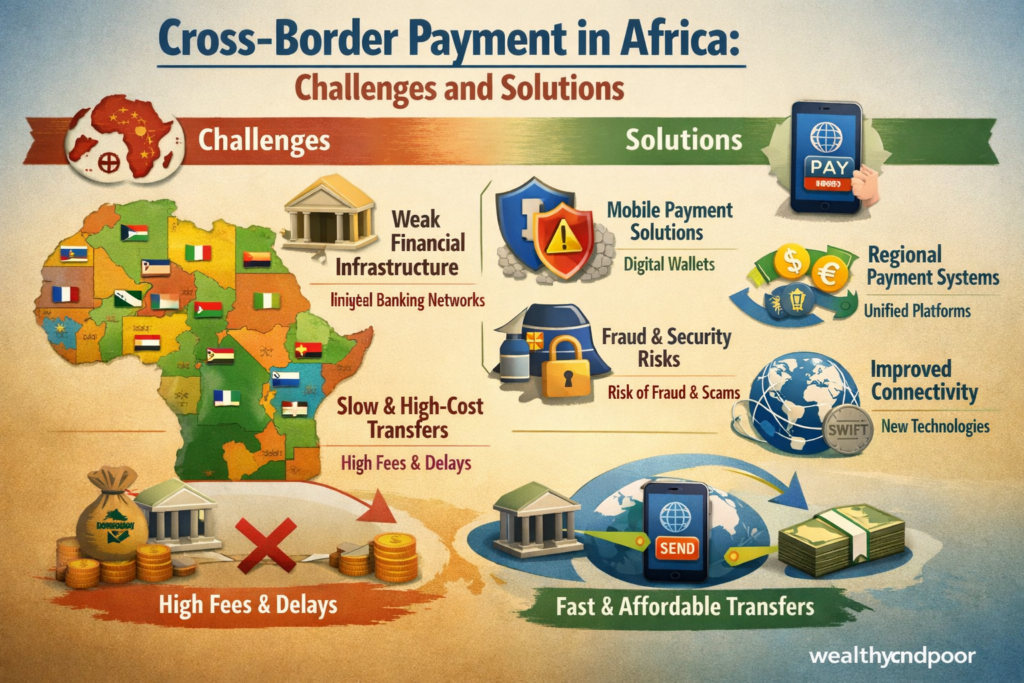

Cross border payments are the lifeblood of global trade, enabling businesses, governments, and individuals to transact beyond national boundaries. In Africa, however, moving money across borders remains one of the most complex and costly financial processes. Despite rapid growth in fintech innovation and digital payments, the continent still faces structural barriers that limit efficiency, affordability, and accessibility.
As Africa positions itself for deeper economic integration under initiatives like the African Continental Free Trade Area (AfCFTA), solving cross-border payment challenges is no longer optional it is essential.
The Current Landscape
Africa’s cross-border payments ecosystem is evolving rapidly. The market is projected to grow significantly, driven by increased trade, migration, and digital adoption. Remittances alone account for tens of billions of dollars annually, while digital payments are expected to power a trillion dollar market in the coming decade.
However, the system remains fragmented, with many transactions still routed through informal channels or reliant on foreign currencies. This has created a system that is expensive, slow, and often unreliable.
Key Challenges Facing Cross-Border Payments in Africa
- Currency Fragmentation and Dollar Dependence
Africa is home to over 40 different currencies, none of which dominate regional trade. As a result, most cross-border payments require conversion into major global currencies like the US dollar before reaching their destination.
This multi-step conversion process increases costs, introduces exchange rate risks, and delays settlement. In many cases, African countries act as “price takers” in global markets, making them vulnerable to currency fluctuations.
- High Transaction Costs
Sending money across African borders can be significantly more expensive than in other regions. Fees accumulate at multiple points currency conversion, intermediary banks, and compliance checks.
In some cases, businesses can lose up to 10% of the transaction value due to these layered costs.
For individuals and SMEs, such costs can be prohibitive, discouraging formal trade and financial inclusion.
- Slow Processing Times
Traditional cross-border transactions often rely on correspondent banking networks and systems like SWIFT. These systems involve multiple intermediaries, each adding processing time.
As a result, transfers can take several days to complete, with limited visibility into transaction status.
This delay disrupts business operations and reduces trust in formal financial systems.
- Regulatory Fragmentation
Each African country operates its own regulatory framework, including different rules for licensing, foreign exchange, and anti-money laundering (AML) compliance.
This lack of harmonization creates friction for financial institutions and fintech companies trying to operate across borders.
It also increases compliance costs and slows innovation.
- Limited Intra-African Trade
Intra-African trade accounts for less than 15% of total exports, limiting the volume of regional transactions.
This reduces the incentive to build robust regional payment systems and perpetuates reliance on external financial networks.
- Infrastructure and Liquidity Constraints
While payment infrastructure has improved in many countries, challenges remain in liquidity management and settlement systems. A lack of unified clearing mechanisms means payments often pass through multiple systems before completion.
Additionally, insufficient liquidity in local currencies drives up foreign exchange costs and limits scalability.
- Non-Technological Barriers
Interestingly, experts argue that technology is no longer the primary issue. Africa already has functioning real-time payment systems in several countries.
The real challenges lie in political will, investment capacity, and coordination among stakeholders.
Emerging Solutions and Opportunities
Despite these challenges, several promising solutions are reshaping the future of cross-border payments in Africa.
- Pan-African Payment and Settlement System (PAPSS)
PAPSS is a landmark initiative designed to enable instant cross-border payments in local currencies across Africa. By eliminating the need for third-party currencies, it reduces costs and improves efficiency.
It connects central banks and payment systems across multiple countries, creating a unified settlement infrastructure.
- Local Currency Settlement Systems
Efforts are underway to promote the use of local currencies in cross-border trade. This reduces reliance on the US dollar and minimizes foreign exchange costs.
Such systems also strengthen regional economic integration and improve monetary sovereignty.
- Fintech Innovation
Fintech companies are playing a transformative role by offering faster, cheaper, and more user-friendly payment solutions.
From mobile money platforms to API-driven payment gateways, these innovations are expanding access and improving efficiency across the continent.
- Blockchain and Digital Assets
Blockchain technology and stablecoins are emerging as potential game-changers in cross-border payments. They offer near-instant settlement, lower costs, and increased transparency.
However, regulatory uncertainty and volatility concerns have slowed widespread adoption.
- Regulatory Harmonization
There is growing recognition of the need for regulatory alignment across African countries. Initiatives under AfCFTA aim to standardize rules, reduce compliance burdens, and facilitate seamless financial flows.
- Investment in Payment Infrastructure
Experts emphasize that the future of cross-border payments lies in strengthening underlying infrastructure rather than just building consumer-facing apps.
Strategic investments in clearing systems, liquidity management, and interoperability will be critical to long term success.
The Road Ahead
Africa stands at a pivotal moment in its financial evolution. The demand for efficient cross-border payments is rising, driven by trade, migration, and digital transformation.
While the challenges are significant, the solutions are within reach. With the right mix of policy reform, technological innovation, and regional collaboration, Africa can build a payment ecosystem that is fast, affordable, and inclusive.
The transformation of cross-border payments is not just a financial issue it is a cornerstone of Africa’s economic future.












Comments