
Why Nigerian Cards Fail on International Sites
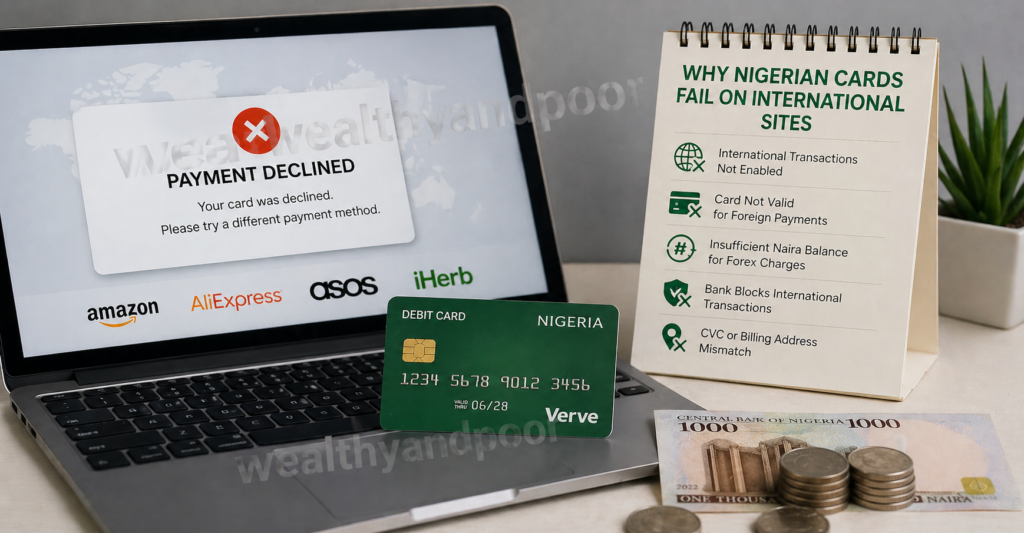

For millions of Nigerians trying to pay for global services from streaming subscriptions to software tools the experience is often the same: the card details are correct, funds are available, yet the transaction fails. This persistent issue is not accidental. It is the result of a complex mix of economic realities, banking policies, global payment systems, and risk controls.
This article breaks down, in clear terms, why Nigerian cards frequently fail on international websites and what the deeper structural issues are.
The Reality: A System That Doesn’t Always Connect
International card payments are not just simple “tap and pay” processes. They involve multiple layers local banks, foreign banks, card networks like Visa or Mastercard, currency conversion systems, and fraud detection tools.
When any one of these layers fails or rejects the transaction, the payment collapses.
In Nigeria, this happens far more often than in many other countries. In fact, cross-border transactions account for a significant share of failed electronic payments in the country.
- Foreign Exchange (FX) Scarcity
At the heart of the problem is Nigeria’s long standing foreign exchange challenge.
When you attempt to pay $50 on an international website using a naira card, your bank must:
- Convert naira into dollars
- Have access to sufficient dollar liquidity
- Transfer that value abroad
If the bank does not have enough foreign currency reserves, the transaction is simply declined even if your account balance is healthy.
This issue became especially severe between 2020 and 2023, when many Nigerian banks completely suspended international transactions on naira cards due to FX shortages.
Although some banks have reintroduced international spending, the underlying FX constraint has not fully disappeared.
- Bank-Imposed Restrictions and Limits
Even when international payments are enabled, they are rarely unrestricted.
Banks often apply:
- Monthly spending caps (sometimes very low)
- Merchant category restrictions
- Country-based transaction blocks
This means your card might work on one platform but fail on another even within minutes.
Recent industry developments show that while some banks have restored international functionality, usage is still limited, conditional, and inconsistent.
- Platform-Level Rejection
Approval from your bank does not guarantee acceptance by the website.
International platforms apply their own filters, and Nigerian cards are often flagged due to:
- High fraud risk perception
- Regional payment inconsistencies
- Compliance concerns
So even if your bank approves the transaction, the website may still reject it.
This explains why users sometimes see:
- OTP received and entered successfully
- Money temporarily debited
Final transaction still fails
- Fraud Detection and Risk Scoring
Global payment systems rely heavily on automated fraud detection.
Nigeria, unfortunately, is often classified as a high risk region for card fraud in global payment models. This leads to:
- Aggressive transaction blocking
False declines - Additional verification failures
- International payment systems are designed around risk minimization.
When a transaction appears unusual such as a Nigerian card paying a US based platform it may be flagged instantly.
As one analysis of global payments explains, cross border transactions naturally trigger more security checks and failures due to differences in geography, regulation, and behavior patterns.
- Technical and Infrastructure Gaps
Nigeria’s payment infrastructure, while improving, is still largely optimized for domestic transactions.
Challenges include:
- Limited international routing capabilities
- Inconsistent payment gateway compatibility
- Poor alignment with global standards
For example, even within Nigeria, international card acceptance at POS terminals has historically been inconsistent due to configuration and routing limitations.
When this same infrastructure is stretched across borders, failure rates increase.
- Currency Conversion and Hidden Costs
Another silent factor is pricing mismatch.
Some international platforms expect:
- Cards billed in USD or EUR
- Accurate billing address matching
- Specific currency handling protocols
Naira cards often struggle here due to:
- Conversion delays
- Exchange rate markups
- Billing inconsistencies
Even when transactions succeed, users may face inflated costs due to hidden FX fees.
- The “Partial Comeback” Problem
Since 2025, some Nigerian banks have resumed international card usage. However, this has created a new issue:
- false expectations.
The system today operates in a grey zone:
- Cards sometimes work
- Sometimes fail without explanation
- Sometimes work only on certain platforms
As one industry summary puts it, international payments with naira cards are now “unreliable and unpredictable.”
- Rise of Alternatives (and Their Limits)
Because of these challenges, many Nigerians have shifted to:
- Virtual dollar cards
- Fintech-issued prepaid cards
These alternatives are designed to bypass traditional banking limitations, but even they are not immune to:
- Platform restrictions
- Funding issues
- Compliance checks
Conclusion: A Structural, Not Personal, Problem
When a Nigerian card fails on an international site, it is rarely the user’s fault.
The failure reflects deeper systemic issues:
Limited access to foreign exchange
Strict banking controls
Global risk perception
Infrastructure gaps
Until these structural challenges are fully addressed, Nigerian users will continue to experience inconsistent access to global digital services.












Comments