
Why Bank Charges Keep Increasing
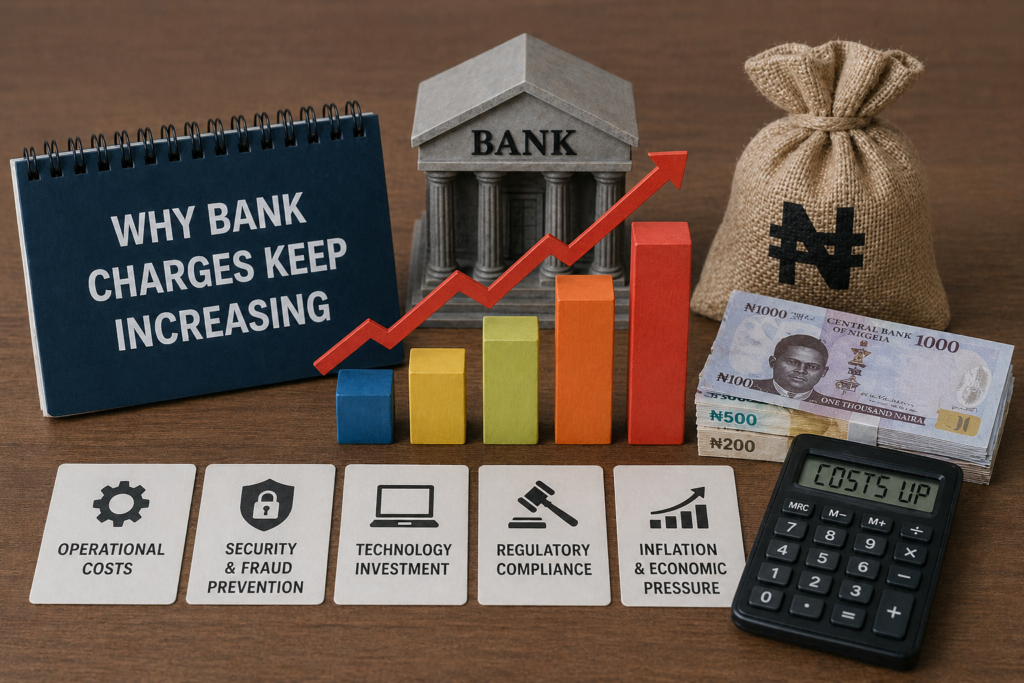

In recent years, bank customers across the world and particularly in developing economies like Nigeria have noticed a steady rise in account maintenance fees, transfer charges, ATM costs, and other service levies. What was once considered a minor inconvenience has evolved into a significant financial burden for individuals and businesses alike. The persistence of these increases is not random; it reflects deeper structural shifts within the banking industry.
Understanding why bank charges keep rising requires a closer look at how banks operate, how economic conditions affect them, and how their business models are evolving in a rapidly changing financial landscape.
The Shift Toward Fee-Based Banking
Traditionally, banks made most of their money through interest earning from loans while paying less on deposits. However, that model is changing. In markets like Nigeria, banks now rely heavily on non interest income, especially fees.
This shift is driven by uncertainty in lending environments. Economic instability, regulatory limits, and credit risks have made loan based income less predictable. In contrast, fees from transfers, account maintenance, and digital services provide a steady and scalable revenue stream.
In simple terms, charging customers directly has become more reliable than waiting for borrowers to repay loans with interest.
Rising Operational Costs
One of the most straightforward explanations for increasing bank charges is cost. Banks are businesses, and like any business, their expenses have risen sharply in recent years.
They must maintain:
- Physical branches and ATM networks
- Digital banking platforms and mobile apps
- Cybersecurity systems
- Customer service operations
These costs are substantial and growing. Inflation alone has pushed up salaries, technology expenses, and infrastructure maintenance.
When operating costs increase, banks often pass part of that burden onto customers through higher fees. Account maintenance charges, ATM fees, and transaction costs are all ways of recovering these expenses.
Technology Investment Isn’t Cheap
While digital banking is often marketed as convenient and efficient, it is far from inexpensive for banks to maintain.
Behind every “instant transfer” or mobile app transaction lies a complex system involving:
- Payment processors
- Data centers
- Fraud detection systems
- Real-time settlement infrastructure
Banks are investing heavily in these systems to remain competitive with fintech companies. But instead of eliminating fees, digital transformation has often repackaged them charging for transfers, SMS alerts, or premium app features.
Regulation and Compliance Pressure
Modern banking is heavily regulated. Banks must comply with anti-money laundering (AML) rules, data protection laws, and financial reporting standards.
These requirements are not optional, and they come with significant costs, including:
- Compliance teams
- Monitoring software
- Audits and reporting systems
All of this adds to operational expenses, which are ultimately reflected in customer charges.
Accounting Insights
In countries like Nigeria, where financial oversight is tightening, compliance costs are rising faster than ever contributing directly to higher fees.
Interest Rate Dynamics
Another less obvious factor is the interest rate environment. When interest rates are low or when lending becomes less profitable banks lose a major source of income.
To compensate, they increase fees.
This explains a paradox many customers experience: even when borrowing becomes cheaper, banking services themselves may become more expensive. Fees effectively act as a buffer, helping banks maintain profitability when traditional income declines.
Inflation and Economic Pressure
Bank charges are also influenced by broader economic trends. Inflation affects everything from electricity bills to employee wages and banks are not immune.
In some markets, banking fees have even risen faster than inflation, reflecting delayed adjustments after periods of economic pressure.
For customers, this means that even small charges ₦10 here, ₦50 there gradually add up, reducing disposable income over time.
Customer Behavior and Market Strategy
Banks don’t set fees in isolation; they respond to customer behavior.
For example:
- Frequent transfers may lead to per-transaction charges
- Low account balances may trigger maintenance fees
- Use of out of network ATMs results in additional costs
Banks analyze usage patterns and design fee structures accordingly. In some cases, fees are intentionally structured to encourage certain behaviors like maintaining higher balances or using digital channels.
At the same time, competition plays a role. While fintech firms often advertise “zero fees,” traditional banks may adjust their pricing models strategically sometimes lowering certain charges while increasing others.
Profit Maximization
At its core, banking is still a profit-driven business. Fees are not just about covering costs they are also about increasing revenue.
Some charges, particularly penalty fees like overdrafts or late payments, are designed to generate significant income. As one study noted, a small percentage of customers often contributes the majority of fee revenue.
This raises ongoing debates about fairness and transparency, especially in emerging markets where consumers have limited alternatives.
The Nigerian Context
In Nigeria, the rise in bank charges is even more pronounced due to:
- Currency volatility
- High inflation
- Increased digital transaction volumes
- Regulatory directives from financial authorities
Banks are under pressure to remain profitable while adapting to rapid digital adoption. The result is a system where transaction-based fees on transfers, USSD services, and card usage have become deeply embedded in everyday banking.
Conclusion
The steady rise in bank charges is not the result of a single factor but a combination of economic realities, technological demands, regulatory pressures, and evolving business models.
Banks are navigating a complex environment where traditional income sources are less reliable, costs are rising, and competition is intensifying. Fees have emerged as a key tool for maintaining stability and profitability.
For customers, however, the impact is clear: banking is becoming more expensive. Understanding why these charges exist is the first step toward managing them whether by choosing lower cost financial services, optimizing account usage, or demanding greater transparency from financial institutions.












Comments