
How CBN Policies Affect Your Bank Account
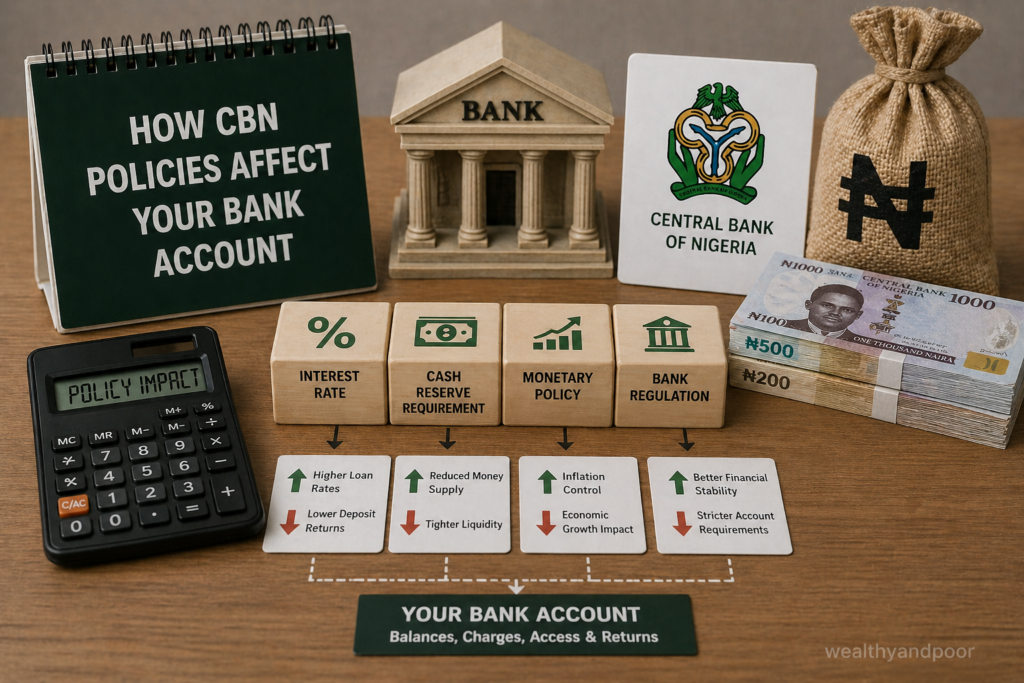

In Nigeria’s financial system, few institutions wield as much influence over your everyday banking experience as the Central Bank of Nigeria (CBN). While many people associate the CBN with abstract economic concepts like inflation or exchange rates, its policies quietly shape how much you can withdraw, the fees you pay, the interest you earn and even how you transact daily.
Understanding how these policies work is no longer optional. It is essential for anyone trying to manage money effectively in today’s evolving financial environment.
- Cash Withdrawal Limits: Controlling Access to Your Money
One of the most direct ways CBN policies affect your bank account is through cash withdrawal regulations. Under recent reforms, individuals are limited to withdrawing ₦500,000 per week, with charges applied to amounts exceeding that threshold.
At first glance, this may seem restrictive. But the policy is part of a broader push to reduce Nigeria’s reliance on physical cash and curb financial crimes such as money laundering.
For the average account holder, the impact is immediate:
- Large cash transactions now attract additional fees
- Banks may question or flag unusual withdrawal patterns
- More transactions are pushed toward digital channels
In practical terms, your bank account is no longer just a storage place for cash it is becoming a gateway to a regulated digital financial system.
- The Cashless Policy: Why You Pay More for Cash
The CBN’s long-standing cashless policy has significantly reshaped banking habits across Nigeria. It imposes charges on high-volume cash withdrawals to discourage excessive use of physical money.
The reasoning is straightforward:
- Handling cash is expensive for banks and the economy
- Cash transactions are harder to track and regulate
- Digital payments improve efficiency and transparency
For customers, however, this translates into:
- Fees when withdrawing above certain limits
- Incentives to use POS, transfers, and mobile banking
- Increased reliance on bank infrastructure
The policy does not eliminate cash but makes it more costly to use at scale. Over time, this subtly changes how individuals interact with their bank accounts less cash, more digital movement.
- Interest Rates: The Silent Influence on Your Savings and Loans
Another critical tool used by the CBN is the Monetary Policy Rate (MPR), which influences how banks set interest rates. As of early 2026, the MPR stands around 26.5%.
This rate affects your bank account in two major ways:
- Savings:
Higher interest rates can lead to better returns on savings accounts and fixed deposits though banks don’t always pass on the full benefit.
- Loans:
Borrowing becomes more expensive. Personal loans, mortgages, and business credit all become costlier when the MPR is high.
In essence, when the CBN tightens monetary policy, your money grows slower in savings but costs more to borrow. When it loosens policy, borrowing becomes easier but savings yields may decline.
- Cash Reserve Ratio (CRR): Why Banks Sometimes Restrict Funds
The Cash Reserve Ratio (CRR) is another powerful but less visible policy. It determines the percentage of deposits banks must keep with the CBN instead of lending out. Currently, this ratio is as high as 45% for commercial banks.
For customers, the effects are indirect but real:
- Banks have less money available to lend
- Loan approvals may become stricter
- Banks may introduce more charges to maintain profitability
In periods of tight CRR policies, customers often feel it through reduced access to credit and increased banking fees.
- Digital Payments Push: Changing How You Use Your Account
CBN policies increasingly favor electronic payments over cash. The goal is to bring more money into the formal banking system, where it can be monitored and regulated effectively.
Why this matters:
- Money outside banks (cash at home or in circulation) weakens monetary control
- Digital transactions improve tracking and economic planning
For users, this results in:
- More reliance on mobile apps, USSD, and POS systems
- Increased transaction fees for transfers and electronic services
- Occasional system downtimes affecting access to funds
Your bank account is no longer just a place to hold money it is now part of a broader digital network shaped by policy decisions.
- Bank Charges: A Policy-Driven Reality
Many customers complain about rising bank charges, but these are often linked to regulatory policies. When the CBN imposes stricter rules such as higher reserve requirements or limits on cash usage banks adjust by introducing or increasing fees.
This includes:
- Transfer charges
- Maintenance fees
- ATM withdrawal fees (especially across banks)
While banks set these charges, the environment that necessitates them is heavily influenced by the CBN’s regulatory framework.
- The Bigger Picture: Stability vs. Convenience
At its core, every CBN policy is designed to achieve macroeconomic stability controlling inflation, stabilizing the currency, and strengthening the financial system.
However, there is often a trade off:
- For the economy: More stability and transparency
- For individuals: Less flexibility and sometimes higher costs
The tightening of policies in recent years reflects an effort to rebuild trust in Nigeria’s financial system, even if it comes with short-term discomfort for bank users.
Conclusion
CBN policies are not distant economic theories they are active forces shaping your daily financial life. From how much cash you can withdraw to the fees you pay and the interest you earn, every aspect of your bank account is influenced by decisions made at the central bank level.
The shift is clear: Nigeria is moving toward a more controlled, digital, and transparent financial system. For individuals, adapting to this reality by embracing digital banking, understanding fee structures, and planning transactions wisely is no longer optional. It is the new rule of money.












Comments