
Why Interest Rates Change in Nigeria
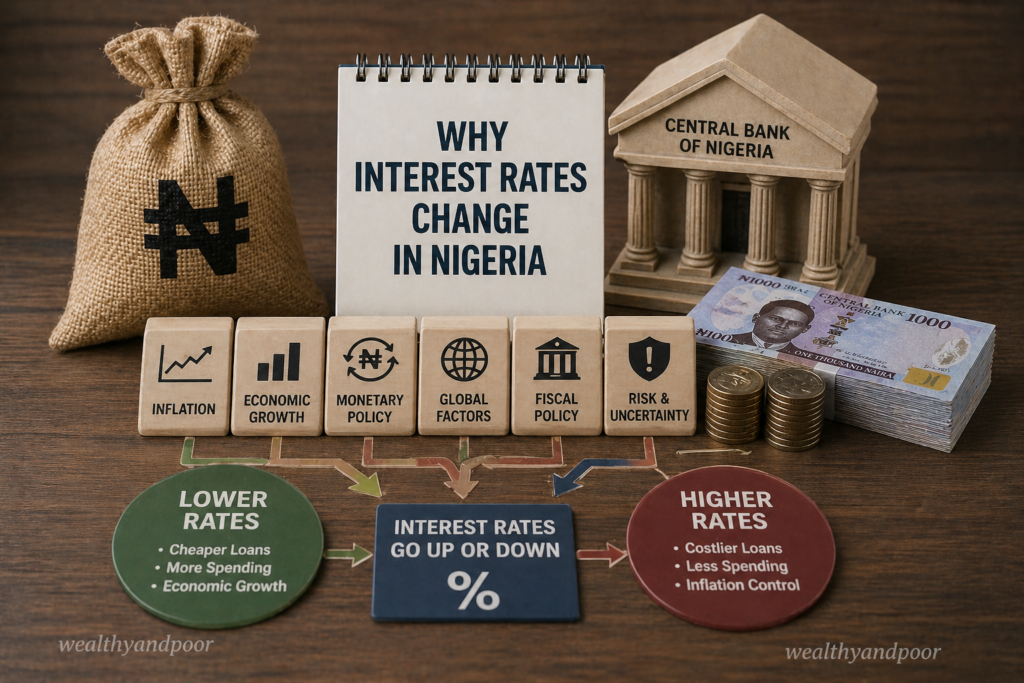

Interest rates in Nigeria rarely move by accident. When they rise or fall, it reflects a careful balancing act between inflation, economic growth, currency stability, and investor confidence. At the centre of these decisions is the Central Bank of Nigeria (CBN), whose Monetary Policy Committee (MPC) adjusts the country’s benchmark rate the Monetary Policy Rate (MPR) to steer the economy.
Understanding why interest rates change is key to understanding how money works in Nigeria. These changes affect everything from bank loans and savings to business expansion and even the price of food.
The Role of Interest Rates in Nigeria’s Economy
Interest rates are the cost of borrowing money and the reward for saving. When the CBN raises rates, borrowing becomes more expensive, and spending tends to slow down. When it lowers rates, borrowing becomes cheaper, encouraging spending and investment.
In Nigeria, interest rates are not just about controlling credit they are a primary tool for managing inflation and stabilising the economy.
- Inflation: The Primary Driver
The most important reason interest rates change in Nigeria is inflation . When prices rise too quickly, the CBN often increases interest rates to reduce spending and slow down price growth.
Nigeria has experienced periods of high inflation driven by food costs, energy prices, and exchange rate pressures. In response, the CBN has maintained a tight monetary policy stance keeping rates high to bring inflation under control.
By 2025, inflation began to decline significantly due to sustained high interest rates and improved economic conditions, showing how powerful this tool can be.
In simple terms:
- High inflation → interest rates go up
- Falling inflation → interest rates may come down
- Monetary Policy Decisions (MPR Adjustments)
Interest rates in Nigeria are formally changed during MPC meetings. The committee reviews economic data and decides whether to increase, reduce, or maintain the MPR.
For example, in February 2026, the CBN reduced the MPR from 27% to 26.5%, signalling a shift toward supporting economic growth after a period of aggressive tightening.
These decisions are rarely abrupt. They reflect months of data on inflation, growth, and financial stability.
- Exchange Rate and the Naira
Nigeria’s exchange rate plays a major role in interest rate decisions. A weak naira can lead to higher import costs, which in turn fuels inflation.
To stabilise the currency and attract foreign investment, the CBN may raise interest rates. Higher rates make Nigerian assets more attractive to investors, helping to support the naira.
In recent years, interest rate hikes have been partly aimed at defending the currency and restoring investor confidence.
- Economic Growth vs. Stability
Interest rates also reflect a trade-off between controlling inflation and supporting economic growth.
- High rates help control inflation but can slow business activity
- Low rates encourage borrowing and investment but may increase inflation
In 2026, Nigeria began cautiously reducing rates after inflation showed signs of easing, indicating a shift toward growth support.
This balancing act is one of the most difficult challenges for policymakers.
- Global Economic Conditions
Nigeria does not operate in isolation. Global trends such as oil prices, international inflation, and interest rate decisions in advanced economies also influence domestic rates.
For instance:
- Rising global interest rates can push Nigeria to increase its own rates to remain competitive for investors
- Falling commodity prices can reduce inflation pressure, allowing rate cuts
The CBN closely monitors global inflation trends and capital flows when making decisions.
- Liquidity and Money Supply
The amount of money circulating in the economy also affects interest rates. If there is too much liquidity, inflation can rise.
To control this, the CBN may:
- Increase interest rates
- Adjust cash reserve requirements for banks
- Use open market operations
These tools help regulate how much money banks can lend, influencing overall interest rates in the economy.
- Structural and Domestic Factors
Nigeria’s unique economic structure also contributes to interest rate changes. Factors include:
- Food supply constraints
- Infrastructure challenges
- Security issues affecting production
- Government fiscal policies
These issues can drive inflation independently of monetary policy, forcing the CBN to respond with interest rate adjustments.
What It Means for Everyday Nigerians
Interest rate changes are not just technical decisions they have real-life consequences:
- Loans become more expensive when rates rise
- Savings earn more interest in a high-rate environment
- Businesses may delay expansion due to higher borrowing costs
- Prices may stabilise if inflation is controlled
Even if the impact is not immediate, these changes shape the financial environment over time.
Conclusion
Interest rates in Nigeria change for a reason and usually, for several reasons at once. Inflation control remains the central goal, but exchange rate stability, economic growth, global trends, and domestic challenges all play important roles.
The recent shift from aggressive rate hikes to gradual easing reflects a changing economic landscape one where inflation is slowing, and attention is turning back to growth.
For individuals and businesses alike, understanding these movements is essential. Interest rates are not just numbers announced after policy meetings they are signals of where the Nigerian economy is headed next.











Comments