
The Sell-off in Banking and Telecommunications Stocks: Are Investors Losing Confidence and Redirecting Their Investments?


The Nigerian Exchange (NGX) has come under renewed selling pressure, with banking and telecommunications stocks among the major counters attracting investor attention. The decline raises an important question: are investors losing confidence in these sectors, or are they adjusting their portfolios in response to changing market conditions and more attractive investment opportunities elsewhere?
The November 25 trading session brought the concern into sharper focus. The NGX lost approximately ₦1.098 trillion in market capitalisation in one session, while the All-Share Index fell by 0.69% to close at 243,995.29 points. The decline followed seven consecutive sessions of losses, suggesting that the weakness was not limited to a single trading day.
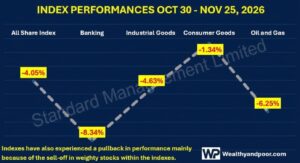
Banking stocks have faced stronger selling pressure
The banking sector has been one of the weakest parts of the market. In October, the NGX Banking Index declined by 10.42%, even as the All-Share Index gained 1.23%. Industrial goods stocks gained 16.85% during the same month.
It shows that investors were not necessarily abandoning Nigerian equities as a whole in October. Rather, money was moving differently across sectors, with banking stocks underperforming while other parts of the market attracted buying interest.
It is also worth looking beyond share prices. MTN Nigeria reported revenue growth of 23.6% and profit after tax growth of 55.3% for the nine months ended September 2026, compared with the corresponding period in 2025. Airtel Africa’s Nigeria operation also reported revenue growth in its six-month results. Strong operating performance alongside weaker share prices shows why stock market performance should not be treated as a direct measure of a company’s operating health.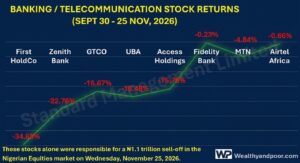
Higher Treasury bill yields are increasing competition for investors’ money
For investors weighing the risks of equities against the relative predictability of fixed-income returns, higher Treasury bill rates can make government securities more attractive. This may encourage some investors to reduce exposure to equities or delay new stock purchases.
However, the auction figures do not prove that the money subscribed to Treasury bills came directly from the sale of bank or telecommunications shares. They show strong demand for the instruments, not the source of every investor’s funds.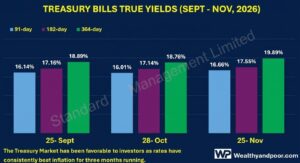
Is this a loss of confidence or a change in investment strategy?
Three observations stand out.
First, banking stocks have underperformed the broader market. The Banking Index fell more sharply than the All-Share Index between October 30 and November 25. The selected banking shares also recorded a deeper average decline than the two telecommunications stocks examined.
Second, the sell-off has become broader. On November 25, the All-Share Index fell 0.69%, while 35 stocks declined and only five advanced, according to market reporting.
Third, the fixed-income market is offering investors increasingly competitive yields. The rise in Treasury bill stop rates provides a credible reason for investors to reassess the balance between equity risk and more predictable fixed-income returns.
What the trend means for the market
The performance of the selected stocks and sector indices suggests that banking stocks have experienced a more pronounced correction than telecommunications stocks during the period under review. The weakness in November also points to a wider market adjustment.
For investors, the question is no longer simply whether a stock has become cheaper. It is whether the current price adequately reflects the company’s earnings prospects, financial position, dividend outlook and risks.
For banks, investors will need to assess earnings quality, asset quality, capital adequacy, interest income and the cost of funding. For telecommunications companies, revenue growth, foreign-exchange exposure, capital expenditure, operating costs and cash generation remain important considerations.












Comments