
How Taxation Is Shaping Profitability in Nigeria’s Banking Sector: FCMB


The Nigeria Tax Act 2025 introduces changes to corporate taxation, including a revised development levy and minimum effective tax requirements for qualifying companies. These provisions have implications for how large financial institutions calculate their tax obligations and manage their after-tax obligations.
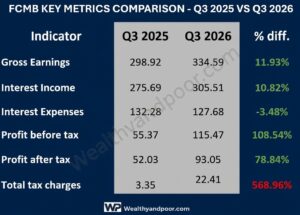
The group’s nine-month financial results for 2026 showed that profit before tax more than doubled compared with the corresponding period of 2025. However, the relationship between its pre-tax and post-tax earnings, alongside its previous tax disclosures, raises important questions about how taxation influences the final earnings reported by financial institutions.
This analysis examines FCMB’s financial performance, its historical tax reconciliation, the implications of Nigeria’s new tax framework and the differences in earnings conversion across selected Nigerian banking groups.
FCMB’s earnings more than double as profitability improves
FCMB Group recorded profit before tax of approximately ₦272.8 billion for the nine months ended September 30, 2026, representing a 102.8% increase from ₦134.5 billion recorded in the corresponding period of 2025.
Profit after tax also increased, rising by 85.7% from approximately ₦125.5 billion to ₦232.9 .
Profit before tax increased at a faster pace than profit after tax, suggesting that the conversion of additional pre-tax earnings into final reported profit was lower during the period.
The increase in FCMB’s earnings was supported by stronger interest income and improved net interest income.
Gross earnings increased by approximately 21% to ₦1 trillion, while net interest income grew by 52.3% to ₦534.2 billion from ₦350.8 billion in the corresponding period of 2025.
The group attributed the improvement partly to a 23.4% increase in interest income and a 3% decline in interest expenses, reflecting an improved deposit mix and lower cost of funds.
Its net interest margin also increased from 10.1% to 12.3%, indicating improved returns from its interest-earning assets relative to funding costs.
These developments suggest that FCMB’s profitability growth was primarily supported by improvements in its underlying banking operations, rather than simply an expansion in revenue.
However, the increase in impairment losses presents another consideration. Net impairment losses rose to ₦76.8 billion from ₦57.1 billion in the corresponding period of 2025, reflecting the credit-risk adjustments undertaken during the year.
Consequently, while the group’s earnings improved significantly, the sustainability of its profitability will also depend on its ability to manage credit risk, operating costs and tax obligations.
Nigeria’s new tax framework and its implications for banks
One of the major provisions is the 30% corporate income tax rate for companies other than small companies.
The legislation also introduces a 4% development levy on the assessable profits of companies chargeable under the relevant provisions, subject to specified exemptions.
More importantly for large financial institutions, Section 57 introduces a minimum effective tax rate of 15% for qualifying companies.
The provision applies to companies that are constituent entities of multinational groups meeting the prescribed global turnover threshold, as well as other companies with annual aggregate turnover of at least ₦50 billion.
Under this provision, qualifying companies whose effective tax rate, calculated using the statutory definition of covered taxes and net income, falls below 15% may be required to pay additional tax to meet the minimum rate.
For FCMB, the 2025 tax reconciliation provides a useful historical benchmark. However, its tax position under the new legislation must be assessed using the relevant 2026 tax disclosures and entity-level calculations.
The development levy also requires attention because it represents an additional statutory consideration in determining the tax obligations of qualifying companies.
The combined effect of these provisions could influence how banks approach tax planning, investment decisions, operating costs and the management of post-tax earnings.
Comparing profitability across Nigeria’s major banks
The relationship between taxation and profitability becomes more interesting when FCMB is compared with other major Nigerian banking groups.
Nine-month 2026 results from Zenith Bank, Access Holdings, GTCO and UBA show that the institutions recorded different levels of pre-tax and post-tax profitability.
Zenith Bank recorded profit before tax of approximately ₦928.8 billion and profit after tax of ₦675.8 billion for the nine months ended September 2026.
Access Holdings reported profit before tax of approximately ₦667.4 billion and profit after tax of ₦474.2 billion.
GTCO recorded profit before tax of approximately ₦879.9 billion, while profit after tax stood at approximately ₦614.6 billion.
UBA reported profit before tax of approximately ₦503 billion and profit after tax of approximately ₦402 billion.
FCMB’s profit before tax of ₦272.8 billion was lower than those of the selected banking groups. However, its 102.8% growth in pre-tax profit was considerably stronger than the growth reported by several of its peers.
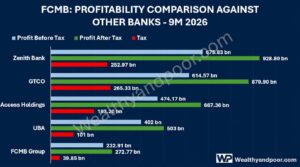
The difference between profit before tax and profit after tax also varied across the institutions.
The banking groups have different geographical operations, subsidiary structures, revenue compositions, tax jurisdictions and accounting adjustments. In particular, international operations can significantly influence the consolidated tax position of financial holding companies.
Access Holdings, for example, disclosed that operations outside Nigeria accounted for 82.2% of its Banking Group profit before tax during the period. This makes a direct comparison of its consolidated tax burden with a predominantly Nigeria-focused earnings structure potentially misleading.
GTCO also attributed part of its lower post-tax earnings to changes in corporate income tax regulations affecting capital allowance reliefs.
This disclosure provides a direct indication that changes to tax regulations can influence reported post-tax profitability even when a bank continues to generate substantial operating income.
The comparison therefore highlights an important distinction: the profitability of a bank cannot be assessed by looking at its tax expense in isolation. Its income composition, geographical exposure, tax adjustments and underlying operating performance must also be considered.
The role of tax planning in banking profitability
Tax planning is an important component of financial management for large banking institutions.
It involves ensuring compliance with applicable tax laws while managing the timing, classification and treatment of taxable income, allowable deductions, tax credits and investment-related tax considerations.
For banks, the composition of income is particularly important.
Interest earned from loans, investments in government securities, treasury bills and other financial instruments may receive different tax treatments depending on the applicable legislation and the nature of the instrument.
Similarly, provisions for credit losses, capital allowances, deferred tax assets and other accounting adjustments can influence the relationship between accounting profit and taxable income.
FCMB’s 2025 tax reconciliation illustrates how these factors can affect the group’s reported effective tax rate.
The substantial reduction associated with tax-exempt income demonstrates the importance of understanding the composition of earnings when evaluating tax expenses.
However, the introduction of the new minimum effective tax requirement means that qualifying companies must also consider whether their tax positions satisfy the statutory minimum after the relevant adjustments.
For investors, the important issue is whether a bank can maintain sustainable earnings growth while meeting its tax obligations and preserving adequate capital for future expansion.
A lower effective tax rate does not automatically indicate better financial performance, just as a higher tax expense does not necessarily indicate declining profitability.
The quality of earnings, the sustainability of tax benefits and compliance with statutory requirements are equally important considerations.
FCMB’s nine-month 2026 results indicate that the group is generating stronger earnings from its banking operations.
The increase in net interest income, improvement in net interest margin and growth in profit before tax demonstrate improvements in its underlying earnings capacity.
However, the difference between the growth in profit before tax and profit after tax suggests that investors should continue monitoring how the group’s final earnings respond to taxation and other below-the-line adjustments.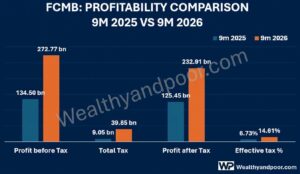
The group’s historical tax disclosures also demonstrate that its tax position can be influenced by tax-exempt income, non-deductible expenses, minimum tax provisions and other statutory adjustments.
As the new tax framework becomes fully reflected in subsequent financial reporting, investors will have to examine whether FCMB’s tax obligations increase relative to its taxable earnings and how this influences its ability to deliver shareholder returns.
The next consolidated financial statements will therefore be particularly important for understanding the group’s actual 2026 tax expense and the reconciliation between accounting profit and taxable income.
Conclusion
Taxation is becoming an increasingly important consideration in evaluating the profitability of Nigeria’s banking industry.
FCMB Group’s financial performance demonstrates that strong earnings growth does not necessarily translate into an identical rate of growth in profit after tax.
Its 2025 audited tax reconciliation also shows that tax-exempt income, non-deductible expenses, minimum tax and other statutory adjustments can significantly influence the relationship between accounting profit and tax obligations.
Meanwhile, the introduction of the Nigeria Tax Act 2025 adds new considerations for qualifying financial institutions, particularly through the development levy and minimum effective tax provisions.
Comparisons with other major Nigerian banks further demonstrate that the relationship between pre-tax and post-tax earnings differs across institutions.
For FCMB, the central issue going forward will be its ability to sustain improvements in operating profitability while managing its tax obligations under the evolving regulatory framework.
Ultimately, the strength of a bank’s financial performance should not be measured by how much profit it generates before taxation alone, but also by how efficiently it converts those earnings into sustainable post-tax returns for shareholders.












Comments