
How Inflation Affects Your Savings
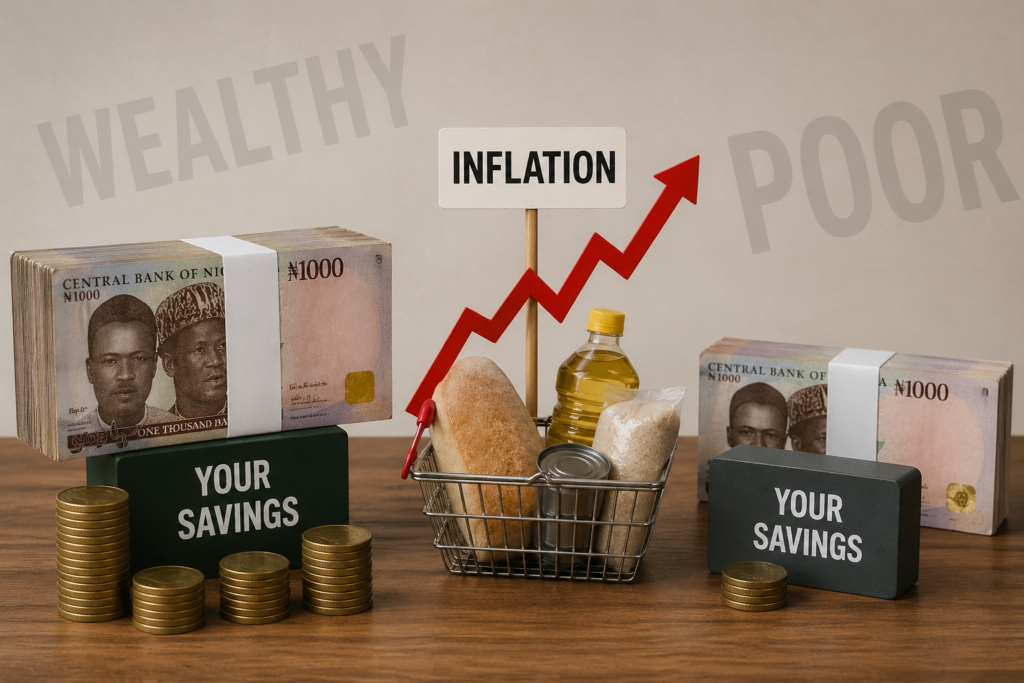

Inflation is often described in abstract economic terms, but for everyday savers, its impact is deeply personal. It shows up quietly through rising food prices, higher transportation costs, and increasing rent until one day, you realize your money no longer stretches as far as it used to. In Nigeria and across the world, inflation has become one of the most significant forces shaping financial decisions, especially for individuals trying to build and preserve savings.
This article explores how inflation affects your savings, why it matters more than many people realize, and what it means for long term financial stability.
Understanding Inflation in Simple Terms
At its core, inflation is the gradual increase in the general price level of goods and services over time. When inflation rises, each unit of currency buys fewer goods and services. In practical terms, this means that ₦10,000 today may not have the same purchasing power next year.
In Nigeria, inflation has been particularly noticeable in essential items such as food and transportation. For example, a bag of rice that cost significantly less a year ago may now cost almost double, reflecting how quickly purchasing power can erode.
The Silent Erosion of Purchasing Power
The most immediate effect of inflation on savings is the reduction in purchasing power. Even if your savings remain the same or even grow slightly their real value declines over time.
If you have ₦100,000 saved today and inflation rises significantly over the next year, that same amount may only be able to buy what ₦80,000 or less could previously purchase. This is why inflation is often referred to as a “silent thief” it doesn’t take money directly from your account but reduces what your money can do.
When Savings Interest Can’t Keep Up
Another major issue is the gap between inflation rates and savings interest rates. In many cases, traditional savings accounts offer relatively low returns often far below the prevailing inflation rate.
For instance, if your bank offers a 4% annual interest rate but inflation is at 14%, your savings are effectively losing value in real terms. Economists refer to this as a “negative real return.” Even though your balance increases slightly, your ability to purchase goods and services declines.
This mismatch is one of the key reasons many people feel like they are saving consistently but not making financial progress.
The Impact on Long Term Financial Goals
Inflation doesn’t just affect day to day expenses it also disrupts long term financial planning. Goals such as buying a home, funding education, or preparing for retirement become harder to achieve when prices rise faster than savings.
For example, if you are saving towards a future expense that currently costs ₦1 million, inflation could push that cost to ₦1.5 million or more in a few years. If your savings do not grow at the same pace, you may fall short of your target despite consistent effort.
This is why inflation is considered a major risk factor in long-term financial planning.
Behavioral Changes: Spend Now or Save?
Inflation also affects how people behave financially. When prices are rising rapidly, many individuals adopt a “buy now” mindset, fearing that goods will become even more expensive later.
This can lead to:
- Increased impulse spending
- Reduced savings discipline
- Short term financial thinking
Ironically, inflation often makes saving more difficult at the exact time when saving is most important. As living costs rise, people have less disposable income to set aside, weakening their financial safety nets.
Broader Economic Effects on Savings
From a broader perspective, inflation has been shown to negatively affect savings rates, especially in the short term. Research on Nigeria indicates that rising inflation can reduce the willingness and ability of individuals to save, as immediate consumption becomes a priority.
This creates a cycle:
- Inflation reduces savings
- Lower savings reduce investment
- Reduced investment can slow economic growth
While some long term studies suggest more complex relationships, the short term effect on personal savings is overwhelmingly negative.
Why Inflation Hits Cash Savings the Hardest
Not all savings are affected equally. Cash savings especially those kept in low interest accounts are the most vulnerable to inflation.
This is because:
- They offer limited returns
- They do not adjust automatically with inflation
- Their value depends entirely on purchasing power
In contrast, certain financial instruments like investments or assets may offer some protection, though they come with their own risks.
Adapting to an Inflationary Environment
Understanding inflation is the first step toward managing its impact. While inflation cannot be avoided, its effects can be mitigated through more strategic financial decisions.
Some general approaches include:
- Seeking higher-yield savings or investment options
- Setting clear, inflation-adjusted financial goals
- Regularly reviewing and updating savings plans
- Increasing income where possible to outpace rising costs
The key shift is moving from passive saving to intentional financial planning.
Conclusion
Inflation fundamentally changes the meaning of saving. It is no longer enough to simply set money aside; what matters is whether that money retains its value over time.
In an inflationary environment, the real question is not “How much have I saved?” but “What will my savings be worth in the future?”
For individuals in Nigeria and beyond, inflation is a powerful reminder that financial security depends not just on discipline, but on strategy. Savings remain essential but to be effective, they must evolve alongside the economic realities shaping their value.










Comments