
How to Avoid Bank Fraud and ATM Scams in Nigeria
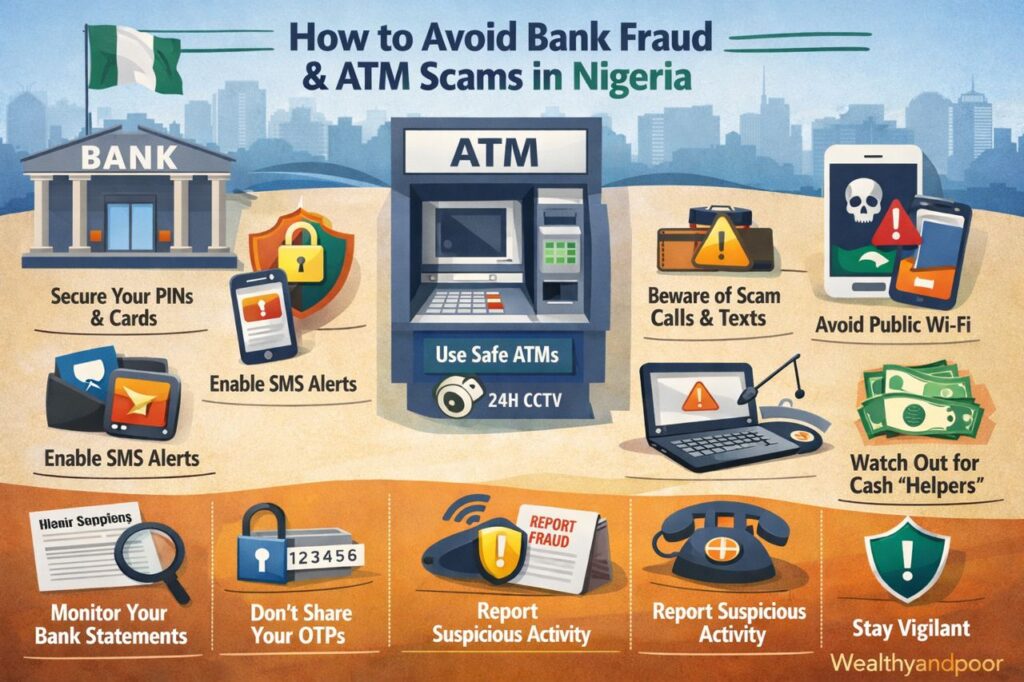

In Nigeria’s rapidly evolving financial landscape, convenience has grown alongside risk. From mobile banking apps to roadside ATMs, access to money is easier than ever but so is access for fraudsters. Increasing reports from regulators and law enforcement agencies show that scams are becoming more sophisticated, targeting both tech savvy users and everyday customers.
Understanding how these scams work and how to stay ahead of them is no longer optional. It is essential financial literacy.
The Growing Threat of Bank Fraud in Nigeria
Bank fraud in Nigeria spans multiple channels: ATM withdrawals, mobile banking, SMS alerts, and even phone calls. Fraudsters often rely on deception rather than technical complexity, exploiting trust and urgency.
According to the Central Bank of Nigeria, common fraud types include phishing messages, fake customer care interactions, and identity theft schemes designed to extract sensitive banking details.
Similarly, Nigeria’s anti-graft agency has warned that ATM-related scams especially card swapping are on the rise, leading to unauthorized withdrawals nationwide.
Common ATM and Banking Scams to Watch Out For
- ATM Card Swapping
One of the most common tricks involves a fraudster posing as a helpful stranger at an ATM. While pretending to assist, they swap your card with a similar one and observe your PIN.
Victims often realize too late after money has been withdrawn. Fraudsters may even create confusion by deliberately causing ATM errors.
- Phishing and Fake Alerts
Fraudsters send messages that appear to come from your bank, urging you to “verify” your account or click a suspicious link. These messages often create panic to force quick action.
Once you click or respond, your login credentials or card details are stolen.
- Fake Bank Staff Calls (Vishing)
Scammers call pretending to be bank officials, claiming your account is at risk. They may request your OTP, BVN, or PIN under the guise of “verification.”
In reality, no legitimate bank staff will ever ask for such details.
- ATM Skimming and Device Tampering
Criminals sometimes install hidden devices on ATMs to capture card information or trap cash. While less visible, these scams can drain accounts without immediate suspicion.
- Public Wi-Fi Exploits
Using unsecured networks for banking transactions exposes users to hackers who can intercept sensitive data. Even basic login details can be compromised.
Practical Ways to Protect Yourself
Avoiding fraud requires a mix of awareness, discipline, and smart banking habits.
- Never Share Your PIN, OTP, or Password
This remains the golden rule. Whether through phone calls, SMS, or emails, never disclose sensitive information. Fraudsters rely heavily on social engineering tactics to trick victims.
- Be Alert at ATMs
Always shield the keypad when entering your PIN and avoid accepting help from strangers. If your card gets stuck, report immediately and block it.
Security agencies also recommend ensuring your card is returned after every transaction and checking for unusual devices on the machine.
- Use Strong Passwords and Enable 2FA
Weak passwords make accounts easy targets. Combine letters, numbers, and symbols, and activate two-factor authentication (2FA) for added protection.
- Avoid Public Wi-Fi for Financial Transactions
Use mobile data or trusted private networks when accessing your bank app. Public networks are often unsecured and vulnerable to interception.
- Monitor Your Bank Transactions Regularly
Set up SMS or app alerts to track every debit. Early detection can prevent further losses and improve recovery chances.
- Separate Your Funds
A growing best practice is maintaining separate accounts one for savings (with limited access) and another for daily transactions. This reduces exposure if your card is compromised.
- Act Immediately If You Suspect Fraud
Time is critical. If you notice suspicious activity:
- Block your ATM card instantly
- Contact your bank’s official customer care
- Report the incident to authorities if necessary
- Delays often give fraudsters more time to empty accounts.
The Role of Awareness in Fraud Prevention
While banks continue to invest in security systems, the weakest link often remains human behavior. Fraudsters succeed because they exploit urgency, fear, and lack of awareness.
Financial experts emphasize that prevention is far more effective than recovery. Once funds are withdrawn or transferred, retrieving them can be difficult especially when transactions happen quickly across multiple channels.
Conclusion
Bank fraud and ATM scams in Nigeria are evolving, but they are not unbeatable. The key lies in staying informed, cautious, and proactive.
Simple habits like protecting your PIN, verifying communications, and staying alert at ATMs can make the difference between financial safety and devastating loss.
In an era where digital banking is unavoidable, vigilance is your strongest security tool.












Comments