
OPay vs bank transfer limits
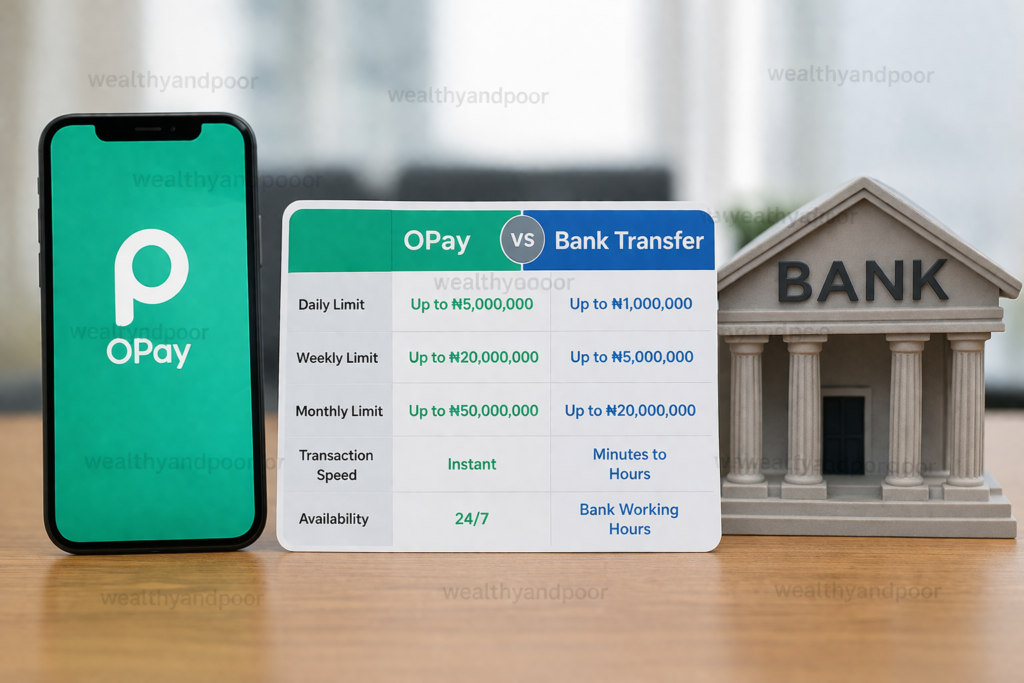

In Nigeria’s fast-evolving digital finance space, the debate between fintech platforms and traditional banks continues to shape how individuals and businesses move money. Among these platforms, OPay has emerged as a dominant player, offering fast and low-cost transfers. However, one critical factor that influences user experience is transaction limits how much you can send, receive, or hold at any given time.
This article provides a detailed, side by side analysis of OPay transfer limits vs traditional bank transfer limits in Nigeria, helping users understand which option best suits their financial needs.
Understanding OPay Transfer Limits
OPay operates a tiered Know Your Customer (KYC) system, meaning your transaction limits depend on how verified your account is.
OPay Account Tiers and Limits
- Tier 1 (Basic account)
Daily transfer limit: ₦50,000
Maximum balance: ₦300,000
- Tier 2 (BVN verified)
Daily transfer limit: ₦200,000
Maximum balance: ₦500,000
- Tier 3 (Fully verified)
Daily transfer limit: ₦5,000,000
Maximum balance: Unlimited
These limits are enforced to comply with regulations and reduce fraud risks.
Notably, since 2024, linking a BVN or NIN is mandatory for OPay accounts to function, aligning with Central Bank of Nigeria (CBN) directives.
Key Takeaways on OPay Limits
- Limits are flexible and upgradeable
- Higher limits require identity verification
- Designed for mobile-first, everyday transactions
- Traditional Bank Transfer Limits in Nigeria
Unlike OPay, traditional banks in Nigeria (such as commercial banks) do not follow a strict “tiered wallet” system. Instead, limits are typically influenced by:
- Account type (savings vs current)
- Channel used (mobile app, USSD, internet banking)
- Security settings and regulatory caps
Common Bank Transfer Limits (General Range)
- USSD transfers
₦20,000 – ₦100,000 per day
- Mobile banking apps
₦500,000 – ₦5,000,000 daily
- Internet banking / corporate accounts
Can exceed ₦10,000,000 daily (depending on authorization)
While exact figures vary by bank, many Nigerian banks allow users to customize limits upward after additional authentication or in-branch requests
Speed and Convenience vs Structure and Control
While limits are important, they cannot be separated from how each system is designed.
- OPay: Speed with Structured Limits
OPay is built for speed and simplicity. Transfers are typically instant and require minimal steps.
However, its structured tier system means:
- Lower-tier users face strict caps
- Upgrading is mandatory for higher usage
- Ideal for retail users and small businesses
Banks: Higher Ceilings with More Control
Traditional banks, on the other hand, offer:
- Higher ceilings for large transactions
- More control over limit customization
- Better suited for corporate and high-value transfers
But they may involve:
- More bureaucracy
- Occasional delays in interbank settlements
- Cost Implications and Hidden Limit Factors
- Transaction limits also indirectly affect cost.
- OPay often offers free or low-cost transfers, especially within its ecosystem
Banks may charge ₦10–₦50 per transfer, depending on the channel
However, hitting your limit can result in:
- Failed transactions
- Need to split payments
- Delays in urgent transfers
This makes understanding limits crucial for financial planning and liquidity management.
Who Should Use What?
Choose OPay if you:
- Make frequent small to medium transfers
- Value speed and ease of use
- Want low or zero transfer fees
Are comfortable upgrading your account for higher limits
Choose Traditional Banks if you:
- Handle large transactions regularly
- Need flexible and adjustable limits
- Require corporate banking features
Prefer a more established financial structure
The Bigger Picture: Regulation and Financial Inclusion
Both OPay and traditional banks operate under the supervision of the Central Bank of Nigeria, which enforces KYC and transaction limits to combat fraud and ensure financial stability.
OPay’s tier system reflects a broader push toward financial inclusion, allowing users to start small and scale up. Meanwhile, banks continue to serve as the backbone for high-value and institutional transactions.
Conclusion
The comparison between OPay and traditional bank transfer limits is not about which is better it’s about which fits your financial behavior.
OPay excels in speed, accessibility, and low-cost transfers, but with structured limits tied to verification levels.
Banks offer higher flexibility and larger transaction capacity, but often with more friction.
For most Nigerians today, the smartest approach is not choosing one over the other but using both strategically












Comments