
PalmPay account upgrade limits
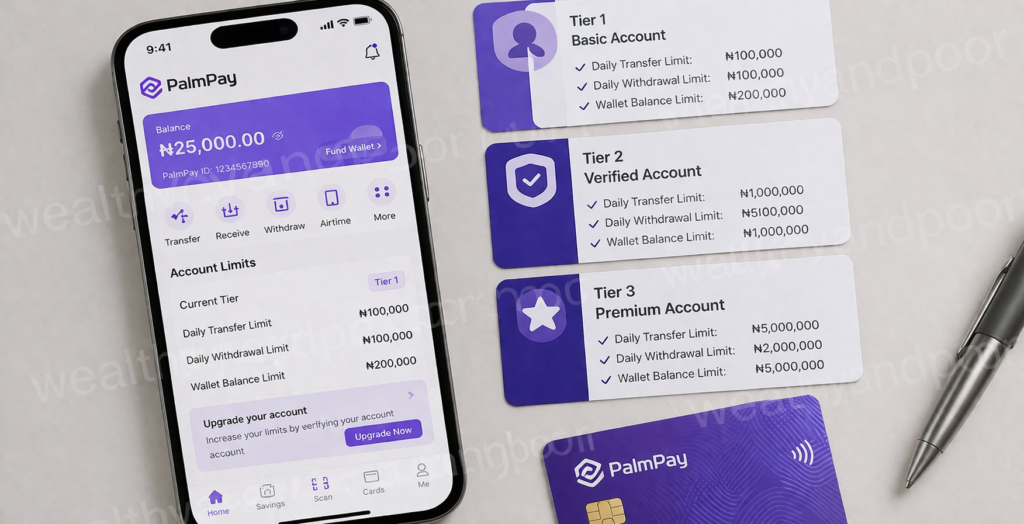

In Nigeria’s rapidly evolving fintech landscape, PalmPay has positioned itself as one of the most accessible mobile payment platforms for everyday transactions. However, like most regulated financial services, PalmPay operates a tier-based system that determines how much users can send, receive, and store in their wallets. Understanding these account upgrade limits is essential for anyone looking to maximize the platform’s full potential.
This article provides a detailed breakdown of PalmPay account tiers, their limits, and what upgrading truly means for users.
Understanding PalmPay’s Tier System
PalmPay uses a three-tier Know Your Customer (KYC) structure to regulate account activity. Each tier is tied to the level of identity verification completed by the user. The higher your verification level, the higher your transaction limits and wallet capacity.
This structure is not unique to PalmPay it aligns with regulatory expectations in Nigeria’s financial system, where customer verification is critical for fraud prevention and financial security.
- Tier 1: Entry-Level Account (Basic Access)
Every new PalmPay user starts at Tier 1 immediately after registration. This level requires minimal information typically just a phone number and basic personal details.
Limits:
- Daily transaction limit: ₦50,000
- Maximum wallet balance: ₦300,000
At this level, users can perform basic operations such as sending money, buying airtime, and paying bills. However, the relatively low transaction ceiling makes it unsuitable for heavy users or small business owners.
Key takeaway: Tier 1 is ideal for casual users but restrictive for anyone handling frequent or large transactions.
- Tier 2: Mid-Level Account (BVN Verified)
Upgrading to Tier 2 requires linking your Bank Verification Number (BVN). This step significantly improves both your transaction capacity and account security.
Limits:
- Daily transaction limit: ₦200,000
- Maximum wallet balance: ₦500,000
At this stage, PalmPay begins to function more like a standard digital bank account. Users can handle moderate financial activities comfortably, including business payments and frequent transfers.
Requirements for upgrade:
- BVN verification
- Basic personal details confirmation
Key takeaway: Tier 2 strikes a balance between convenience and flexibility, making it suitable for most active users.
- Tier 3: Full Access Account (Advanced Verification)
Tier 3 represents the highest level of PalmPay account verification. To reach this stage, users must provide comprehensive KYC documentation.
Limits:
- Daily transaction limit: up to ₦5,000,000
- Wallet balance: Unlimited
This tier is designed for power users—entrepreneurs, merchants, and individuals who regularly transact in large volumes.
Requirements for upgrade:
- Valid government-issued ID (e.g., National ID, passport, voter’s card)
- Proof of address (utility bill or bank statement)
Key takeaway: Tier 3 removes most financial restrictions, enabling seamless high-value transactions.
Why Account Upgrade Matters
Upgrading your PalmPay account is not just about higher limits it also impacts security, functionality, and user experience.
- Increased Transaction Freedom
Higher tiers eliminate the frustration of failed transfers due to limits. This is particularly important for business owners and freelancers who rely on digital payments.
- Enhanced Security
Verification reduces fraud risk and protects user funds. PalmPay integrates identity checks such as BVN and ID verification to ensure account safety.
- Access to Full Features
Certain services such as higher transfers, advanced financial tools, and possibly credit features are only available to fully verified users.
How to Upgrade Your PalmPay Account
Upgrading your account is straightforward and can be completed within the app:
- Log in to your PalmPay account
- Go to your profile section
- Select “Upgrade Account” or “Verification”
- Submit required documents based on your desired tier
- Wait for confirmation
The process is typically fast, especially for BVN verification, while Tier 3 upgrades may take slightly longer due to document review.
Common Issues Users Face
Despite the simplicity of the process, some users encounter challenges:
- BVN mismatch errors: Occur when personal details don’t align with bank records
- Delayed verification: Especially during high demand periods
- Document rejection: Often due to unclear or invalid ID uploads
To avoid these issues, ensure all submitted information matches your official records.
Conclusion
PalmPay’s account upgrade system is designed to balance accessibility with regulatory compliance. While Tier 1 offers a quick entry point, it is the higher tiers that unlock the platform’s true value.
For everyday users, Tier 2 is often sufficient. However, for anyone handling significant financial transactions, upgrading to Tier 3 is not just beneficial it is essential.
As Nigeria continues to embrace digital finance, understanding and leveraging these account limits will help users navigate the system more efficiently and securely.












Comments