
What Happens If You Send Money to a Closed Account
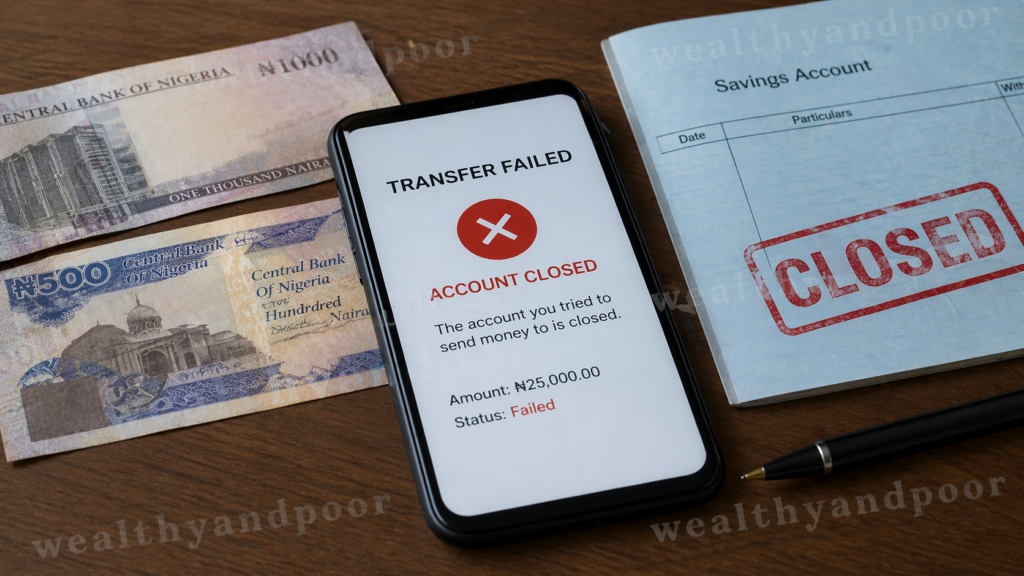

In today’s fast moving digital banking environment, sending money has become almost effortless. Yet, mistakes still happen one of the most common being transferring funds to a bank account that has already been closed. For many customers, especially in markets like Nigeria where real-time transfers are widely used, this situation can cause immediate panic. Does the money disappear? Is it lost forever? Or can it be recovered?
The reassuring truth is that in most cases, money sent to a closed account does not vanish. However, the journey it takes and how long it takes to return depends on several factors, including the transfer method, banking systems involved, and the policies of the receiving institution.
The Immediate Outcome: Automatic Rejection
When money is sent to a closed account, the receiving bank’s system typically identifies that the account is inactive. Modern banking infrastructure is designed to verify account status before funds are fully credited. As a result, the transaction is usually rejected automatically.
Instead of being deposited, the funds are routed back to the sender through the same payment channel used for the transfer. This process is standard across most financial systems globally, including interbank networks.
In Nigeria, for example, transfers routed through the Nigeria Interbank Settlement System (NIBSS) follow a similar logic. If the receiving bank cannot complete the transaction, the system initiates a reversal back to the sender.
How Long It Takes to Get Your Money Back
Although the money is usually safe, it is not always returned instantly. The timeline varies depending on how the transfer was made:
- Bank transfers (ACH or interbank transfers): Typically reversed within 2 to 5 business days.
- Wire transfers: Often returned faster, usually within 1 to 2 business days.
- Internal transfers (same bank): May be resolved within 24 to 48 hours.
- Checks: Can take longer—sometimes over a week—due to manual processing.
Delays can also occur on weekends, public holidays, or high transaction volumes. In some cases, especially in developing banking systems, manual intervention may be required before reversal is completed.
Why the Transaction May Show “Successful”
One of the most confusing aspects for users is when a transfer shows as “successful” or “completed” even though the receiving account is closed.
This happens because the “success” message often refers to the sending stage, not the final settlement. In other words, the money successfully left your account and entered the interbank network but that does not guarantee it was accepted by the recipient’s bank.
Once the receiving bank detects the closed account, it triggers a reversal, but this step can take time to reflect on your balance. This delay creates the illusion that the money is missing.
Possible Complications You Should Know
While most cases are straightforward, there are exceptions that can complicate the situation:
- The Account Is Reopened Automatically
In rare cases, some banks may reopen a previously closed account to accept incoming funds. This practice has been flagged by regulators in some jurisdictions because it can expose customers to unexpected fees or deductions.
- Outstanding Debts on the Account
If the account holder owes money to the bank, the bank may legally apply the incoming funds to settle that debt instead of returning it.
- Payment Apps and Wallets
If the transfer was made via apps, the outcome may differ. Some platforms complete the transaction internally first, meaning the funds may sit in a wallet balance rather than bouncing back immediately.
- Delayed Reversals
In certain cases, especially where transaction status is unclear, banks may take additional time to investigate before reversing the funds. This can extend the waiting period beyond the usual 3–5 days.
What You Should Do Immediately
If you realize you’ve sent money to a closed account, quick action can make a difference:
- Check your transaction status – Confirm whether it is pending, successful, or reversed.
- Contact your bank immediately – Report the issue and request a trace or reversal.
- Keep transaction details – Reference number, date, and amount are essential.
- Inform the recipient (if known) – They may confirm whether the account is active or closed.
Most banks have dispute or complaint channels specifically for failed or delayed transfers. Acting early helps prevent unnecessary delays.
Can You Lose the Money Permanently?
In the vast majority of cases, no you will not lose your money. Banking systems are built with safeguards to prevent funds from being deposited into inactive accounts. Instead, transactions are rejected and reversed.
However, recovery may take time, and in rare scenarios involving debts, account reopening, or system errors, additional follow-up may be required.
Conclusion
Sending money to a closed account is a common but manageable mistake. While it can be stressful especially when the transaction appears successful the underlying systems are designed to protect your funds.
The key takeaway is simple: your money is usually not lost, just delayed.
Understanding how banks process failed transfers, and knowing what steps to take, can turn what feels like a financial emergency into a temporary inconvenience.












Comments