
Why Bank Alerts Come Late in Nigeria
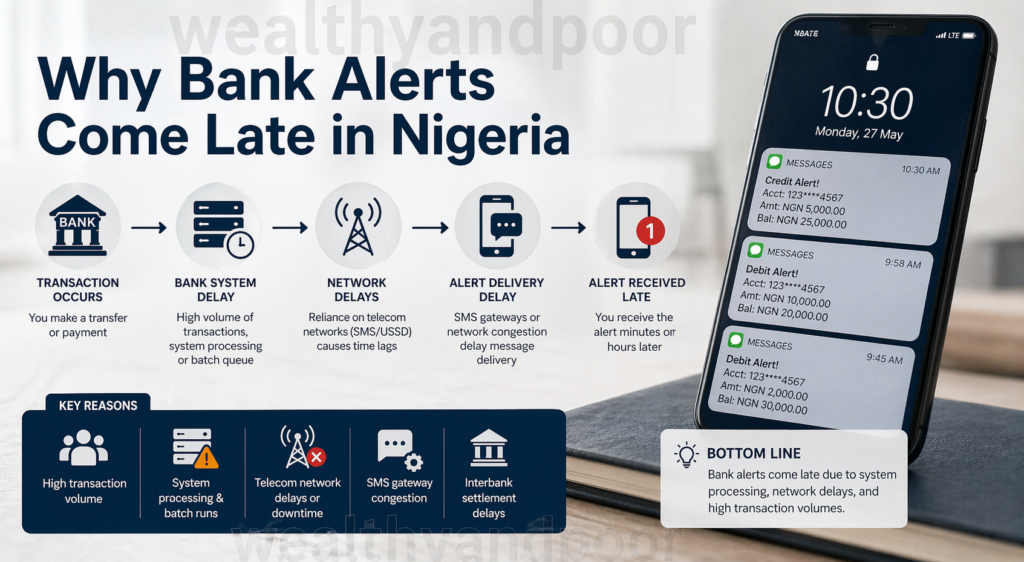

In Nigeria’s fast evolving digital banking landscape, customers increasingly expect real-time updates whenever money enters or leaves their accounts. A debit or credit alert is more than just a notification it is a confirmation of financial reality. Yet, many Nigerians still experience delayed bank alerts, sometimes arriving minutes or even hours after a transaction has occurred. This gap between expectation and reality raises important questions about the underlying causes.
Understanding why bank alerts come late requires a closer look at the complex ecosystem that supports electronic banking in Nigeria from telecom infrastructure to interbank settlement systems and internal bank processes.
- Dependence on Telecommunications Networks
At the heart of most bank alerts is the Short Message Service (SMS), which relies heavily on telecom operators. Once a transaction is processed, banks send alert requests through telecom networks before it reaches the customer’s phone.
However, delays can occur due to network congestion, poor signal strength, or routing issues within telecom infrastructure. In regions with unstable connectivity, messages may queue for delivery, leading to noticeable delays. This explains why a transaction may be completed instantly, but the alert arrives much later.
Additionally, rising telecom costs have impacted how banks manage SMS delivery. Nigerian banks increased SMS alert charges partly due to higher telecom tariffs, highlighting how dependent alert systems are on third party providers.
- High Transaction Volumes and System Congestion
Nigeria has witnessed a surge in digital banking, driven by mobile apps, USSD banking, and fintech solutions. While this growth has improved financial inclusion, it has also placed enormous pressure on banking infrastructure.
During peak periods such as salary payment days, weekends, or festive seasons millions of transactions are processed simultaneously. This can overwhelm bank servers and delay not just transfers, but also the alerts associated with them.
When systems are overloaded, banks often prioritize transaction processing over alert delivery. As a result, the debit or credit occurs immediately, but the notification is pushed to a queue, causing delays.
- Interbank Processing and Settlement Delays
In Nigeria, many transactions pass through centralized systems like the Nigeria Inter Bank Settlement System (NIBSS). While designed for instant transfers, real world operations are not always seamless.
Sometimes, the sending bank debits a customer instantly, but the receiving bank takes time to acknowledge or confirm the transaction. This creates a lag in alert generation, especially for credit alerts.
Such interbank reconciliation issues can lead to situations where:
- Money is debited without immediate confirmation
- Credit alerts are delayed
- Notifications arrive out of sequence
These delays are not always visible to customers but are common within the backend settlement process.
- System Maintenance and Technical Downtime
Banks frequently update their digital platforms, mobile apps, and core banking systems to improve performance and security. However, during these upgrades, certain services including alert systems may be temporarily disrupted.
Technical failures, server downtime, or bugs can also interfere with the timely generation and delivery of alerts. In some cases, banks themselves publicly acknowledge such issues, especially when customers report widespread delays.
Even when transactions are successfully processed, alerts may be delayed until systems are fully restored.
- Internet Connectivity Issues
Modern banking systems rely on internet connectivity at multiple levels customer devices, bank servers, and third party service providers. A weak or unstable connection at any of these points can delay alert delivery.
For instance:
- A bank server experiencing connectivity issues may delay sending alerts
- A customer’s phone with poor reception may not receive messages promptly
Data based notifications (from mobile apps) may lag due to slow internet
This layered dependency means that even if one part of the system is functioning well, another weak link can slow down the entire alert process.
- Security and Fraud Prevention Measures
Banks are increasingly cautious about fraud, especially with the rise of fake alerts and scam tactics. In some cases, alerts may be intentionally delayed or subjected to additional verification processes to prevent fraudulent activity.
Nigerian banks have warned customers not to rely solely on SMS alerts, emphasizing that fraudsters can generate fake notifications that mimic real ones.
To combat this, banks may implement extra checks before sending alerts, particularly for suspicious or high value transactions. While this enhances security, it can also contribute to delays.
- Customer Preferences and Alert Channels
Not all alerts are delivered via SMS anymore. Some customers opt for email notifications or mobile app push alerts to reduce costs or improve reliability.
However, each channel has its own limitations:
- SMS may be delayed due to telecom issues
- Email alerts depend on internet access and server speed
- App notifications require active data connections
In some cases, customers who deactivate SMS alerts may rely solely on email or app notifications, which can create the impression of delayed alerts if those channels are not instantly accessible.
Conclusion
Delayed bank alerts in Nigeria are not caused by a single issue but by a combination of factors spanning technology, infrastructure, and operational processes. From telecom network challenges and high transaction volumes to interbank settlement delays and fraud prevention measures, multiple layers influence how quickly an alert reaches a customer.
As Nigeria’s banking sector continues to modernize, improvements in infrastructure, system capacity, and integration are expected to reduce these delays. However, for now, customers are advised to rely not only on alerts but also on direct account checks via mobile apps, USSD, or internet banking to confirm transactions in real time.












Comments